
Full-scale drone war: Thai military to revamp 2027 arms plan
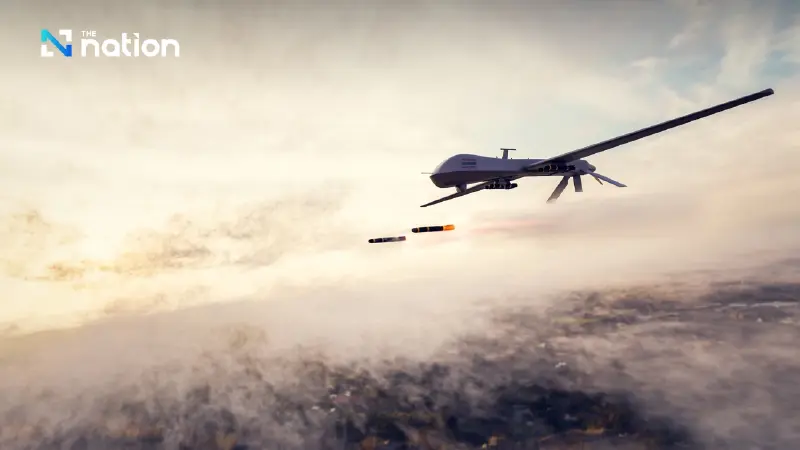


Thai-Cambodian border clashes are pushing the armed forces to rethink procurement for FY2027, with a major shift towards drones, anti-drone systems and domestic production.
Border clashes between Thailand and Cambodia have become a key factor driving the armed forces to review their entire weapons procurement system under the FY2027 budget, to ensure capabilities match evolving threats and conditions.
Although Thailand and Cambodia are now moving towards a second ceasefire framework and close-range clashes may not happen soon, the military assessment is that no one can guarantee long-term stability. Both sides are expected to adjust tactics, strengthen arsenals, fix weaknesses and build on strengths.
Thailand has faced repeated problems with Cambodian drone swarms used to attack Thai troops, including kamikaze-style drones. Some drones have also flown deeper inside Thai territory in what officials describe as harassment and intimidation, with targets ranging from airports and weapons depots to critical infrastructure such as offshore oil platforms in the Gulf of Thailand.
The Second Army Area has assessed that Cambodia is politically calm but militarily tense, and said Cambodian drones have continued to conduct intermittent reconnaissance of Thai positions.
The Thai military believes the next five years will mark a full-scale era of drone warfare. Lessons drawn from the Thai-Cambodian border situation, it says, underscore that self-reliance is Thailand’s true security.

All four armed services, along with the Royal Thai Police, are preparing plans for unmanned aircraft systems (UAS) and counter-UAS (C-UAS), or anti-drone capabilities. Work is under way to integrate these plans and draft doctrine to guide capability development.
The Royal Thai Armed Forces Headquarters said it is conducting research and development on UAS and C-UAS, working with businesses, the private sector and domestic universities to develop offensive strike drones and counter-drone systems. The effort is aimed at supporting both offensive and defensive operations, building production lines, strengthening long-term self-reliance and supporting Thailand’s defence industry, alongside research into explosives and fusing systems for various UAS platforms.
It also cited the development of bunkers made from ultra-high-performance concrete (UHPC) reinforced with high-tensile steel fibres, intended to improve frontline survivability.
Army plans and UAV categories
The Army said it has set a systematic, continuous approach to expanding drone capabilities for both national defence and military operations other than war. It is pursuing a four-phase, whole-of-capability development framework and said it is currently in the medium phase, which includes updating doctrine, establishing task forces to run operational trials, and strengthening equipment-related units.
It also outlined five UAV categories by size and unit role:
- Large UAVs for deep operations, ISR and armed strike missions
- Medium UAVs for ISR and target acquisition for division-level units
- Small UAVs for motorised and armoured units for reconnaissance and target location
- Very small UAVs for infantry units
- Micro UAVs for specialised units focused on counter-UAV missions
In response to the Thai-Cambodian border conflict, the Army said it is setting up a UAS warfare centre and a UAS battalion to direct, plan, control, oversee and integrate Army UAV operations, with trial operations scheduled from October 1, 2025 to March 31, 2026.
Navy, Air Force and police capabilities
The Navy said its use of UAS and C-UAS follows its 2020 force employment guidelines and is aligned with the introduction of specific platforms. It listed three UAS types in service: small UAS supporting tactical units; the Schiebel Camcopter S-100 unmanned helicopter for surveillance and targeting; and the RQ-21A Blackjack fixed-wing UAV for surveillance and targeting—both supporting naval reconnaissance missions.
The Navy said it is developing C-UAS capabilities to address threats across all areas, including Sattahip Naval Base and the Chanthaburi-Trat Border Defence Command, as part of strengthening maritime security.
The Air Force said it has pursued UAS operational concepts since 2023 and has set a 25-year UAS development plan covering 2023-2047. It said capability development combines procurement and overseas collaboration, alongside counter-UAS under an “integrated air defence” concept, using tactical networks to link command and control, air surveillance and detection, air defence systems and counter-drone capabilities. It also cited plans for medium-range air defence, networked surveillance and radar systems, and medium- and short-range air defence weapons to protect military sites, as well as anti-drone systems for protecting VIP areas.
Under a mandate linked to Thai-Cambodian instability, the National Security Council (NSC) is addressing the issue in two phases: an urgent phase to set up a national committee for managing, controlling and countering unmanned aircraft within one month; and a longer-term phase to establish a national centre for the same mission within six months, operating under the NSC.
The Royal Thai Police said it is expanding UAS and C-UAS capabilities for missions including VIP and royal security, route and area reconnaissance, aerial protection, investigations and security work, intelligence gathering, surveillance, crime suppression and crime-prevention planning. It also cited vehicle-mounted anti-drone systems assigned nationwide in line with policing jurisdictions, as part of proactive drone measures.
Beyond drones, the services said they are studying threats across all dimensions arising from the Thai-Cambodian theatre, to shape long-term military strategy and keep pace with technology-driven capability development.
