
Anutin laments two crane collapses in two days, says only Thailand has seen such incidents
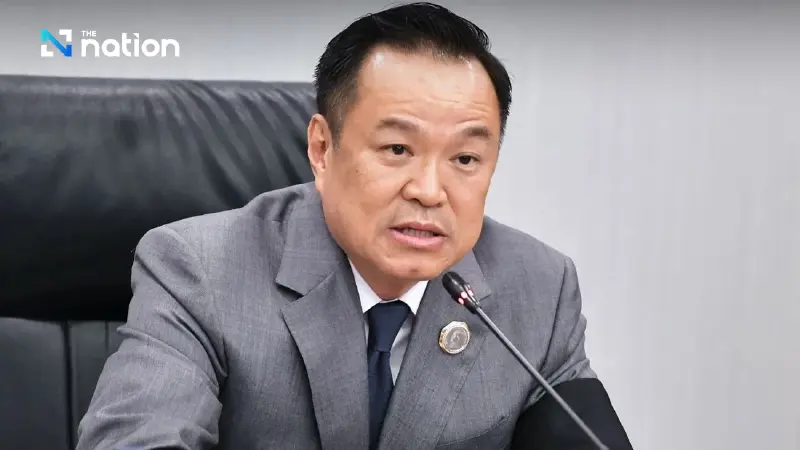


Anutin reveals that two crane collapses in two days, one on Rama II Road, are unique to Thailand. The same contractor is responsible. He urges decisive action to avoid future incidents.
On Thursday (January 15), Prime Minister Anutin Charnvirakul chaired an urgent meeting at Government House to address construction safety concerns following two deadly crane collapses in two days. The incidents, which occurred in Nakhon Ratchasima and on Rama II Road, resulted in multiple fatalities.
Representatives from relevant agencies were in attendance.
Before the meeting, Anutin explained that he had called the urgent gathering following the events of January 14, when a construction crane from the high-speed rail project fell onto a train in Si Khiew, Nakhon Ratchasima. He noted that just this morning, another similar accident was reported on the Rama II elevated road project.
"What is particularly tragic and alarming is that the same contractor is responsible for both incidents," he said.
The Prime Minister further pointed out that these incidents are not isolated. "Over the past 10 months, several issues have occurred, including the collapse of the State Audit Office (SAO) building in March due to an earthquake, a bridge collapse on Rama II, and the recent crane incidents."
He added that this meeting is not to discuss new regulations or measures, as these should already be in progress, but rather to address the underlying problems.
Anutin also expressed concern about the laws regulating construction and contractors, stating, "I believe the laws governing construction and contractor oversight need to be reviewed. Take the SAO building, for instance: the contract has not been cancelled, and the issues remain unresolved. Fines have not been imposed, and there is still no completion date. If fines are imposed, it essentially means rebuilding the structure and restarting the payment process."
He continued, "All contracts have guarantees, yet no action has been taken. The construction at the SAO site has been halted, but no sanctions have been applied to the contractor. No blacklisting has been done, and no abandonment of the work has been declared. Now, the same contractor is involved in the incident on Rama II Road."
Anutin addressed the media’s questions about the responsibility of the State Railway of Thailand (SRT) in the Nakhon Ratchasima incident. "The SRT must take responsibility because the victims were using their services. While the contractor is responsible for construction, the SRT is responsible for the safety of passengers," he said.
The Prime Minister clarified that the state has two main responsibilities in such incidents: "First, as a provider of public transport, the state must be accountable to the passengers. Second, the state must seek compensation and take necessary actions to ensure safety and prevent future incidents for those contracting with the state."
Anutin further stated that today's meeting would focus solely on these issues and not on future actions just yet, as this is for the relevant authorities, including the Comptroller General’s Department and the Department of Public Works and Town & Country Planning, to address.
He added that he would ask how to proceed with Italian-Thai Development (ITD) following similar incidents over the past 10 months. "If nothing can be done—if the contractor must continue with the project, and if we cannot cancel the contract, impose fines, blacklist them, or stop new projects from being awarded—we will certainly face major problems."
"If I were to protect myself, I could say that we are a caretaker government, with no binding authority and no power to amend laws, but that is not the case," Anutin continued. "We must act. Our responsibility as the government remains intact, and I will continue to exercise my authority as Prime Minister. We cannot allow this situation to persist."
The Prime Minister also commented on the ongoing construction projects, stating that halting work for two weeks would result in incomplete progress, as 85% of the project is already finished. Stopping it would delay completion, while allowing it to continue poses risks.
He further explained that if necessary, the contract could be terminated, and a new contractor would need to complete the remaining 15%. The contract should specify costs, and any excess amounts could be claimed through the contract's guarantees.
In conclusion, Anutin stressed the importance of clear, decisive measures and accountability, emphasising that the situation cannot continue as it is.
He stated that the relevant authorities must stop passing the responsibility back and forth, and that the meeting must lead to clear and actionable measures that restore public confidence, address the concerns of those who have lost loved ones, and reassure foreign investors.
He concluded by highlighting the need to ensure that these incidents do not undermine the progress made in projects such as logistics systems and high-speed rail.
"I may have spoken at length, but this is the only place in the world where such incidents have occurred two days in a row. These accidents are similar, and the same contractor is responsible. I urge this meeting to take tangible action. If there are issues with the contract, I ask the Attorney-General to provide opinions to ensure we can move forward," the Prime Minister said.
