
India, Thailand reaffirm partnership for peace and prosperity
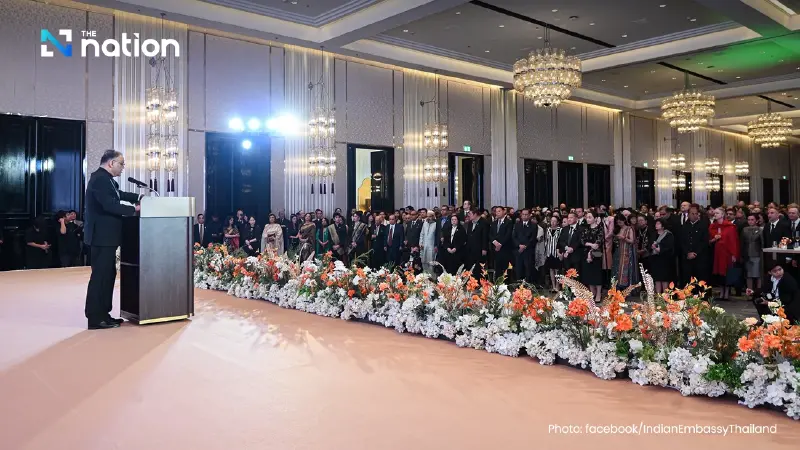


India and Thailand reaffirmed their strategic partnership, highlighting trade, security, tourism, and cooperation in tech, climate, and connectivity.
As the world faces numerous complex challenges, India and Thailand have underscored the importance of further strengthening their robust and multifaceted strategic partnership, aiming for peace, progress, and prosperity for the people of both nations, the region, and beyond.
During the reception marking the 77th Republic Day of India at The Ritz-Carlton, Bangkok on Tuesday (January 20), Indian Ambassador to Thailand Nagesh Singh highlighted India’s current standing as the world’s fourth-largest economy, with projections to become the third-largest by 2030 and a developed economy by 2047.
“India has been the fastest-growing large economy over the last decade and is widely recognised as a key driver of global economic growth, likely contributing up to one-fifth of global GDP growth in the coming decades,” he stated.
Singh further elaborated on India’s advancements in new and emerging technologies, including IT, space, and biotechnology. He also stressed India’s strong commitment to climate action and the green transition, which have not only addressed domestic challenges but also influenced global trends.
We are civilisational neighbours and maritime neighbours, united by the warm waters of the Bay of Bengal. Our shared cultural heritage and religious traditions provide a solid foundation for our ever-growing contemporary partnership, he said.
Singh noted that last year marked a significant milestone when bilateral relations were elevated to a strategic partnership during the historic visit of Prime Minister Narendra Modi to Thailand in April.
“This has given strong momentum to our multifaceted relationship. Our economic and commercial ties are expanding, with bilateral trade reaching nearly US$19 billion last year,” he added.
Singh highlighted the growing interest among investors on both sides to forge durable partnerships by integrating into each other's supply and value chains. He also noted the intensifying defence and security sector engagements between India and Thailand, focusing on evolving security challenges in the region.
Emerging domains such as green transition, blue economy, space, science and technology, and connectivity offer immense potential for deeper collaboration. As the world moves towards a knowledge-driven economy, India and Thailand are increasingly working together in academics and capacity building.
At a time when the world is grappling with numerous challenges, Singh called for a reinvigorated, inclusive, and effective multilateral order, emphasising that the need for such an order has never been more urgent.
He expressed gratitude for Thailand’s steady partnership in regional and multilateral forums, fostering solidarity, dialogue, and cooperation.
“Thailand’s soft power has captured the imagination of young Indians. Last year, more than 2.4 million Indian tourists visited this beautiful country,” Singh remarked. “For the people of Thailand, India is a destination for a pilgrimage of a lifetime, particularly for those visiting the holy sites associated with Lord Buddha.”
Singh also expressed hope for continued growth in tourism and other aspects of people-to-people exchanges.
The large, vibrant, and well-integrated Indian diaspora in Thailand, including hundreds of thousands of Thai citizens of Indian descent, acts as a living bridge between our two countries. We thank them for their invaluable contributions to strengthening our ties, he said.

Vijavat Isarabhakdi Celebrates 77th Republic Day of India
Vijavat Isarabhakdi, Vice Minister for Foreign Affairs, representing Foreign Minister Sihasak Phuangketkeow, extended heartfelt congratulations to Indian nationals on the 77th anniversary of India’s Republic Day.
He acknowledged the current period of turbulence and tension globally, referencing Mahatma Gandhi’s reminder that non-violence is the greatest force available to mankind, stronger than any weapon.
“Today, as we celebrate India’s Republic Day, let us reaffirm this timeless principle and remember that true strength lies not in dominance, but in dialogue, cooperation, and shared humanity,” he said.
Vijavat highlighted that formal diplomatic relations between Thailand and India date back to the birth of India as a sovereign nation. “2026 marks the 79th anniversary of our close diplomatic ties,” he said, noting that the relationship between the two nations has been built on enduring strength, mutual trust, and genuine friendship.
He pointed out that the increasing number of Thai citizens undertaking Buddhist and Hindu pilgrimages in India reflects the deep respect both countries share for their respective faiths. Similarly, nearly 2.5 million Indian tourists visited Thailand in 2025, making India the third-largest source of overseas visitors.
Vijavat went on to describe Indian Prime Minister Narendra Modi’s visit to Thailand in April 2025 as a key milestone, noting that it, along with Foreign Minister Sihasak’s visit to New Delhi, marked a new chapter in bilateral relations. This has led to expanded cooperation in trade, investment, space, defence, science and innovation, education, and digital transformation.
“These areas will be key drivers of our shared economic vision and a more forward-looking partnership,” he stated. Vijavat expressed confidence that the partnership will continue to grow in strength, benefiting not only the two countries but also the broader region and the world.
Looking ahead, as both Thailand and India are members of the Executive Board of UNESCO for the 2025–2029 term, Vijavat looks forward to further collaboration to protect and promote their shared intangible cultural heritage.
“Together, we can address pressing global issues such as maritime security, human trafficking, online scams, and sustainable development, not as challenges that divide us, but as responsibilities that unite us,” he concluded.
“Guided by our shared values and vision, Thailand and India can be a force for peace, stability, and cooperation in our region and beyond.”
