
Bangkok braced for toxic plume from 13,000-rai burn
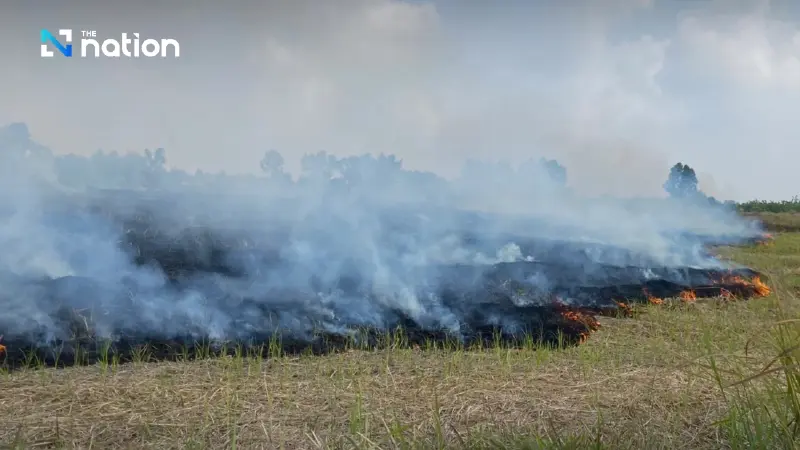


Bangkok Breath Council warns of abnormal burning of 13,000 rai in Nakhon Nayok, with NE winds pushing smoke into Bangkok as PM2.5 worsens
As fine particulate pollution (PM2.5) continues to affect public health, the Bangkok Breath Council issued an urgent statement on 27 January 2026, voicing serious concern over unusually large-scale burning in rice fields in Nakhon Nayok—a key upstream source of particulate pollution.

The council said satellite detections showed abnormal hotspots, with the affected area estimated at more than 13,000 rai. It added that the distribution pattern resembled simultaneous ignition points, suggesting coordinated burning, and warned the situation showed no clear sign of ending quickly.
According to the council, seasonal meteorological conditions are currently unfavourable. Northeasterly winds are blowing towards the central region, carrying smoke and particulate pollution from the burning directly into Bangkok and surrounding provinces—a downwind area where ventilation has been poor in recent days.

Health risks, especially for vulnerable groups
The council warned the haze could have severe health effects, particularly for large numbers of vulnerable people, including:
- children and young people
- pregnant women and older people
- those with respiratory illnesses and people with disabilities
- people who must work or live outdoors
It added that millions of residents who have limited access to clean air may have no choice but to endure hazardous air pollution.
The Bangkok Breath Council urged all relevant agencies to coordinate urgently to extinguish both the “fires in the fields” and the “fires of conflict” that may lie behind the problem, in order to restore clean air and public wellbeing.
Scrutiny returns to past ‘no-burning’ orders
The incident has reignited questions over enforcement and accountability. Bangkok and surrounding provinces remain in a severe PM2.5 episode, with a major driver being smoke drifting in from nearby provinces.
On 27 January 2026, Bangkok Governor Chadchart Sittipunt said during a live broadcast that authorities had detected a large smoke mass from burning in an eastern neighbouring province, with a total burned area of more than 13,000 rai. He said the smoke plume covered roughly 1,700 square kilometres—comparable to the area of Bangkok.

The situation has prompted renewed attention to a hardline order issued in January 2025 by Anutin Charnvirakul in his capacity as national commander for disaster prevention and mitigation. At the time, he announced a strict policy banning all forms of burning for three months, including forest burning, open burning and the burning of agricultural residues.
At a meeting of the national disaster prevention and mitigation command on 29 January 2025, Anutin stressed strict enforcement under the Disaster Prevention and Mitigation Act, describing haze as a national-level disaster.
He also issued a direct warning to provincial governors nationwide: if burning continued, it would indicate the law was not being enforced fully. He said that if any governor was found to have neglected their duties or allowed burning to persist, the prime minister was prepared to sign an order transferring that governor immediately.
From order to reality
Despite previous claims that governors had been granted sweeping authority, daily war-room briefings were in place, and support had been offered to farmers to switch from burning to ploughing residues into the soil, the latest episode—with Bangkok facing a vast smoke plume linked to burning exceeding 10,000 rai—has highlighted how difficult it remains to address the root causes sustainably.
Bangkok authorities said they were responding on the ground by offering to send fire engines to assist neighbouring areas and by warning at-risk groups to avoid outdoor activities.
Politically, the episode is also being seen as a key test of whether the tough warnings previously issued to provincial governors will be enforced in practice to ensure accountability amid a public health crisis.
