
Thailand Seeks to Conquer Japanese Market with Premium 'Gluten-Free' Cassava Starch
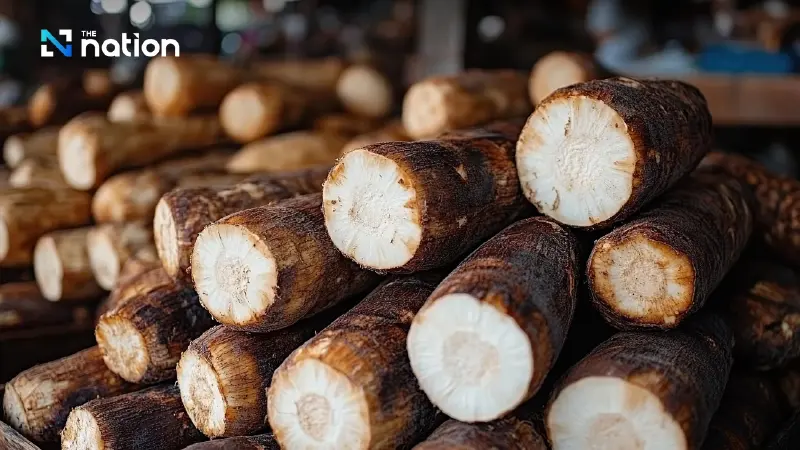


Department of Foreign Trade targets Japan’s high-value food and feed sectors to reduce reliance on China, highlighting superior quality and Non-GMO status
- Thailand is targeting Japan's quality-focused market with premium cassava starch to reduce its heavy export reliance on China.
- The marketing strategy emphasizes the starch's "Gluten-Free" and "Non-GMO" credentials to gain a competitive edge over maize-based products in Japan's food industry.
- To compete on quality rather than price, Thailand is highlighting its superior processing technology and addressing safety concerns like cyanide levels.
- The push extends beyond food, promoting cassava for Japan's large animal feed market and as a raw material for bioplastics to align with green economy goals.
Department of Foreign Trade targets Japan’s high-value food and feed sectors to reduce reliance on China, highlighting superior quality and Non-GMO status.
Thailand is aggressively pivoting its cassava export strategy towards Japan, focusing on "premium" processed products to capture a market that prioritises stringent quality and safety standards over low pricing.
As the world’s leading exporter of cassava products, Thailand is looking to diversify its trade portfolio and mitigate its heavy reliance on the Chinese market, which currently accounts for over 65% of its export value.
In 2025, Thailand saw a significant surge in exports, reaching 8.25 million tonnes—a 26.5% year-on-year increase that comfortably bypassed its original target.

Quality Over Quantity
Noppadon Kuntamas, deputy director-general of the Department of Foreign Trade, stated that Japan represents a high-potential frontier for Thai exporters.
"Japan is a market of opportunity because it values quality and international standards above price points," he noted.
The Thai strategy centres on high-value "Premium Starch," specifically marketing its Gluten-free and Non-GMO credentials.
These attributes give Thai cassava a distinct competitive edge over maize-based starches in Japan's sophisticated food and beverage industry, which spans confectionery, bakery, and health-food sectors.

Tackling Regional Competition
While Vietnam remains a fierce competitor due to lower price tags, Thai officials are confident that superior processing technology and consistent delivery will win over Japanese buyers.
Thailand is positioning itself as a leader in research and development, offering native and modified starches with unique properties, such as high viscosity and clarity, which are essential for products like mochi, sauces, and soups.
The push isn't limited to human consumption. A high-level delegation, including representatives from four major cassava trade associations, recently visited Tokyo to promote cassava pellets for the animal feed industry.

Overcoming Safety Concerns
One significant hurdle has been Japanese concerns regarding cyanide levels in raw cassava. However, experts from Kasetsart University have reassured Japanese importers that Thailand’s traditional sun-drying process naturally and effectively reduces cyanide to levels well within international safety margins.
With Japan requiring roughly 24 million tonnes of animal feed annually—currently dominated by maize—replacing a portion of this with Thai cassava pellets could significantly lower production costs for Japanese farmers while securing a stable supply chain.

A Green Future
Beyond food, the "Thai Cassava" brand is aligning itself with Japan's focus on the Bio-Circular-Green (BCG) Economy.
Thai exporters are developing starch-based raw materials for the bioplastics industry, aiming to assist Japanese partners in reducing their carbon footprint.
By leveraging a network of nearly 500 Japanese agricultural cooperatives, Thailand hopes to embed its cassava products into the heart of Japan's industrial and environmental supply chains, ensuring long-term growth in one of the world's most discerning markets.
