
Thailand strengthens defences at Ban Nong Ya Kaew, prepares for future operations
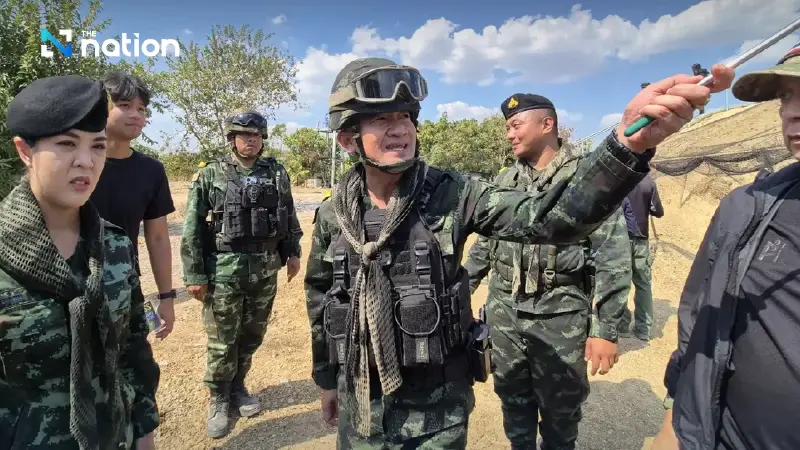


The Thai military has fortified Ban Nong Ya Kaew in Sa Kaeo Province with enhanced security measures, including barbed wire fences, trenches, and tanks, as part of ongoing efforts to secure the area and prepare for future operations.
On Thursday, Maj Gen Winthai Suvaree, spokesperson for the Royal Thai Army, accompanied local and international media to Ban Nong Ya Kaew in Sa Kaeo Province to observe the aftermath of a military operation aimed at asserting Thailand's territorial sovereignty. The area, once home to illegal Cambodian settlements encroaching on Thai land, was cleared following a military operation that successfully dismantled 42 houses and 6 shacks, amounting to a total of 48 structures.
Colonel Chainarong Kasi, commander of the Special Task Force 12, reported that the operation initially faced difficulty. Although the area was regained, it was not secure at first due to heavy artillery fire from Cambodia. This prompted Thai forces to pull back to a safer position, reinforcing the region as a contested zone. Following the operation, Thailand successfully established control over the area and has set up enhanced security measures, including the installation of barbed wire fences, shipping containers, and three trench lines, supported by tanks. Additional roads have been constructed to further secure the area.
“We are fully prepared for future operations. If clashes occur again, we are ready, regardless of how many rounds it takes,” said Colonel Chainarong.
He also noted that Cambodian nationals had attempted to return to the area, claiming they needed to retrieve personal belongings from the damaged houses. These individuals were apprehended and handed over to the police for further legal proceedings.
Colonel Chainarong clarified the recent controversy surrounding the alleged use of a Thai military truck in a Cambodian content piece. On the day of the incident, the truck had been used to transport sandbags and barbed wire for securing the area. The truck was reportedly moving quickly and left the area, leading to an escalation of tensions with Cambodia, resulting in gunfire from their side. The driver had to abandon the vehicle to escape, but discussions are underway to negotiate the return of military equipment and supplies.
Colonel Chainarong said that the Cambodian military, in response to the evolving situation, has started digging additional trenches, though these defences are not as robust as Thailand’s, lacking the same infrastructure quality. The trench system in Cambodia appears more improvised, with zig-zag formations possibly indicating concerns about Thailand’s potential advance into disputed areas.
In Ban Nong Ya Kaew, the likelihood of Cambodia successfully entering to confront Thai forces is considered low. The region now has strong defensive positions and is fortified with infantry and armoured units, ensuring it is well-protected. However, Thailand remains vigilant, prepared for any future incursion, he said.
Local Relief Efforts: Compensation for Affected Residents
Khok Sung District Chief Naris Palakawong Na Ayutthaya discussed the ongoing relief efforts for those affected by the Thailand-Cambodia border conflict. Residents whose homes were damaged and incurred losses under 49,500 baht have already been compensated, with funds distributed as of January 31, 2026. For properties with damage exceeding this amount, Prime Minister’s Office funds have already been approved. A meeting will take place tomorrow with affected individuals to explain the disbursement criteria and ensure payments are made accordingly.
He confirmed that compensation would be based on actual damage assessments, with 10 properties affected by damage exceeding 230,000 baht. These residents will receive support from the Red Cross and additional provincial assistance as requested.
