
Thai border Joint Info Center: force ‘last resort’, cites December 27 joint statement


Thailand says it is ready 24/7 to defend sovereignty but calls force a last resort, denying “occupation” and issuing a 16-language white paper
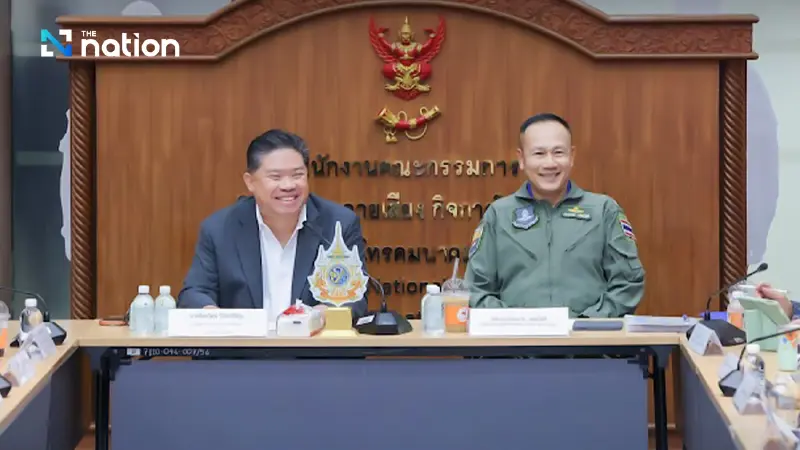
Air Chief Marshal Prapas Sornjaidee, Assistant Commander-in-Chief of the Royal Thai Air Force, in his capacity as Director of the Joint Information Center on the Thailand - Cambodia Situation (JIC), briefed the media after a meeting on communication guidelines aimed at strengthening public and international confidence in Thailand’s role in managing the border situation.

He said the meeting brought together representatives from the Royal Thai Army, Royal Thai Navy, Royal Thai Air Force, the Royal Thai Police, and the Royal Thai Armed Forces Headquarters to clarify facts on conditions in each area, while also hearing suggestions from the media. He noted that several issues had to be discussed in a restricted setting because they involve security information.
He affirmed that the Thai armed forces are ready 24 hours a day to protect Thailand’s sovereignty, but stressed that the use of military force is a “last resort.” He said diplomatic, economic, social and public-communication mechanisms are being pursued in parallel. He also thanked Thai embassies in 98 countries, offices of defence attachés, and Thai government scholarship students overseas for helping convey factual information to the international community, underscoring that the dispute is not a conflict between the peoples of the two countries, but a state-to-state policy issue.

Regarding allegations by Cambodian leaders that Thailand has occupied territory, he insisted Thailand has strictly adhered to the joint statement dated December 27. Forces that halted at a given point have remained at that point, he said, for the safety of Thai personnel and Thai civilians, and with no intention of occupying Cambodian territory. He added that the December 27 joint statement serves as the principal reference framework above earlier arrangements, and that Thailand has fully complied with the agreed troop deployment line.
Maratee Nalita Andamo, Deputy Director-General of the Department of Information and Deputy Spokesperson of the Ministry of Foreign Affairs, said Thailand remains committed to the joint statement and has already lodged protests and issued clarifications regarding the accusations.
She said it is regrettable that the matter has been raised in international forums without evidence, as it harms trust—especially as confidence between the two countries had already declined following last year’s clash. Nevertheless, she said Thailand continues to keep bilateral channels open at all levels for direct talks, and reaffirmed Thailand’s readiness to provide a full clarification at a high-level meeting in Geneva, supported by complete information and evidence.


She added that Thailand is also pressing ahead with landmine clearance and promoting cooperation to address scammer-related crime through a humanitarian approach, alongside efforts to build sustainable peace on the basis of non-provocation.
At the same time, the Information Center released a “White Paper” compiling historical facts, the 2011 incident, incidents in July and December, and a fact sheet containing operational evidence, information on the use of force, and detailed, verifiable material for public reference. The center said it issued more than 1,000 press documents in December and more than 800 in January, across 16 languages.
The center’s director called on the media and the public to follow Do’s and Don’ts in communications, avoid speculation or sharing unverified information, and prevent confusion or an atmosphere of provocation. He added that Thailand is not concerned about the other side’s use of lobbyists, because facts and transparency are the country’s key strengths.
He stressed that all mechanisms currently being pursued share the ultimate goal of protecting national interests and preserving sustainable peace, grounded in truth and shared responsibility.


