
EC: Not suing public or media; case targets six suspect groups
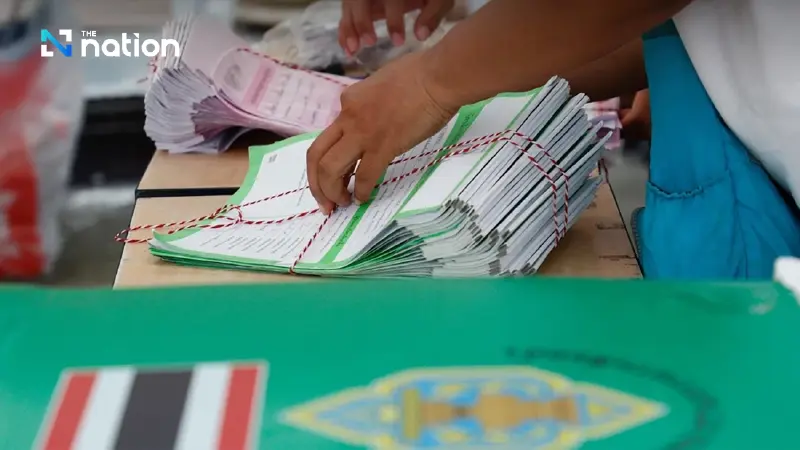


The EC says it is not suing citizens or the media, but is pursuing legal action against six groups accused of breaching ballot secrecy and undermining election integrity
- The Election Commission (EC) clarified that it is not taking legal action against ordinary citizens and media who observe or take photos of vote counting.
- The complaint and prosecution are aimed at a group of six individuals who allegedly acted together as an organised process, with behaviour attempting to reveal secret ballot information of voters.
- The EC said the actions of the group undermine the election process’s credibility and constitute a threat to national security.
The Office of the Election Commission (EC) issued a clarification document regarding news reports suggesting that the EC filing a complaint with the Crime Suppression Division was suing citizens for photographing ballot papers, or that the EC was harassing the media, stating that this is not true.
In this regard, for individuals or the media who set up video cameras or take photos of ballot papers while polling-station committee members call out votes or count votes, and display ballot papers that have already been adjudicated for the public to see, this can be done. Filming or photographing the atmosphere of the public coming to cast ballots can also be done and is not an offence under the law, but it must not affect:
1. the rights of eligible voters;
2. or affect or obstruct the performance of duties of the polling-station committee;
3. the EC has the duty to oversee the process and results of the election, and the public can inspect the election at every step, as appeared in the election on February 8, 2569, or the re-vote on February 22, 2569. But if the inspection (the exercise of rights and freedoms) violates the three points above, the EC must act according to its powers and duties and cannot refrain. This is a filing of a complaint against individuals who acted together and divided tasks as an organised process.
The EC did not act against any single profession and filed the complaint according to the facts.
On February 22, 2569, more than 100 media and members of the public joined as observers. It can be seen that the EC did not file any complaint at all, and it recognises the freedom of the media to seek facts and present information so that the public is informed.
The EC filed a complaint to prosecute, accusing the group of individuals who violated the law as follows:
On February 22, 2569, it appeared that there was conduct by a group of persons / or offences by specific persons who set up video cameras from the morning, photographed members of the public who came to vote, continuing through to the vote count.
There was conduct in front of the polling station where a group of persons tried to decode so as to find out which voter the photographed and recorded ballot belonged to. Voting under the law must be direct and secret.
But this group of persons attempted to reveal, or could lead to the revealing of, by carrying out the action, claiming they came to “prove something”, because the vote information in this election must be used as real results.
This is an act that erodes and undermines the performance of duties and powers, including the EC’s mission to act under the law, making it lack credibility, by a method that cannot be considered to be conducted in good faith.
In the election on February 22, the EC filed a complaint to prosecute and accused the group of persons as follows:
1. A group of persons obstructed the EC’s work, because some eligible voters did not come to vote after learning that cameras would be installed to observe this matter.
Some people who came to vote, upon reaching the front of the polling station and seeing a video camera set up, decided not to vote. There were news reports that images of the public that were recorded would be put into a technological process so identities could be identified from the photographs, with the target being those who voted that day.
2. An act of reading the barcode on ballot papers to reach information about which candidate a voter chose is a dishonest act as prescribed by law. The EC therefore has the power and duty to proceed under the law.
3. The claim that the EC is taking action against or suing citizens is not true. In the past, the EC has never prosecuted anyone. There was only a first case in Chonburi, Constituency 1, by the constituency election director for Constituency 1 only, because it was an individual’s act that violated the law with dishonest intent, not action in the capacity of ordinary citizens.
4. The case of names of persons as in the EC’s complaint filed with the Crime Suppression Division, Royal Thai Police, because they are a group of people who appeared at the scene, with evidence of jointly presenting information, photographs, and other evidence showing involvement with the organised process.
5. The case of names of persons as in the EC’s complaint filed with the Crime Suppression Division, Royal Thai Police, because the individuals had an appointment with the organised group to reveal what had been done on a public stage, but did not appear at the scene. Their behaviour indicates they are also involved in the organised process.
6. There were posts on social media throughout, both from persons in the organised group who compiled various matters about barcodes on ballot papers to make the election vote not secret, using dishonest methods, and there was an organised effort to spin narratives in various forms, causing disorder, which could be a threat to national security.
However, the EC stressed that election management and referendums adhere strictly to the Constitution B.E. 2560 and amendments, Section 85, requiring voting to be direct and secret, supervising every step to be transparent, verifiable, and fair to all sides, with no exceptions and no double standards.
