
Three Mayuree Naree crew still alive, but rescue remains difficult
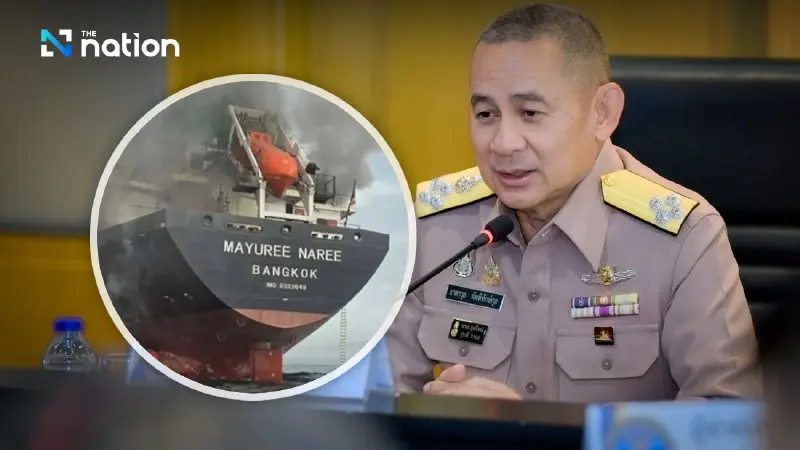


The Navy chief of staff has confirmed that three crew members aboard the Mayuree Naree are still alive, but rescue efforts remain difficult because the vessel is in a conflict zone.
Adm Thadawut Thatpitakkul, chief of staff of the Royal Thai Navy, said on Friday (March 13) that authorities had made progress in the case of the cargo vessel Mayuree Naree, which was carrying Thai crew members and encountered danger in international waters between Bahrain and Oman, an area of conflict where weapons have reportedly been used from the Iranian side.
He said 20 crew members had already been rescued and moved to a safe area, while three others, all engine room personnel, remained stranded on board.
At this stage, it has been confirmed that all three are still alive. The main difficulty, however, is the continuing danger at sea, with weapons fire still being reported intermittently, making it impossible for officials to board the vessel and extract them immediately.
As part of the ongoing operation, the Royal Thai Navy has dispatched liaison officers to the Combined Maritime Forces (CMF) and coordinated with the Thai embassies in Manama, Bahrain, and Muscat, Oman, as well as neighbouring navies, in an effort to find a way to carry out the rescue in line with the navy chief’s policy of prioritising the safety of Thai nationals above all else.
The Royal Thai Navy has also found that four Thai-flagged vessels, including the Mayuree Naree, are currently operating in the high-risk area. The other vessels have already docked safely.
Warnings have been issued to shipping operators to exercise the utmost caution, as the area is dangerous and lies outside Thai legal jurisdiction, although navigation there is governed by international maritime rules.
Meanwhile, the Marine Department has held talks with the shipowner, calling for it to take responsibility and work closely with rescue agencies. The navy said it would continue monitoring the situation and assisting Thai fishermen and Thai crew in every possible way.
Even if the vessel is foreign-flagged, the navy said it would move to provide assistance immediately if Thai nationals were on board.
Mayuree Naree still adrift in combat zone, heading towards the Persian Gulf
RAdm Parach Rattanachaiyapan, spokesman for the Royal Thai Navy, briefed relatives of the missing crew members after meeting them to provide information and coordinate assistance following the attack in the Strait of Hormuz.
He said the navy had been aware of the incident from the day it occurred through the automatic ship tracking system and had already been monitoring the Mayuree Naree closely. According to the available tracking data, the vessel’s intended destination had been India via the Indian Ocean.
He added that the navy had been monitoring the situation and had already warned the Thai Shipowners’ Association and shipping companies that this remained a period of high risk, urging them to avoid transiting the Strait of Hormuz.
He said the navy also wanted to help the families understand that it had assessed the risks in advance by examining the seriousness of the conflict in the area, the capabilities involved and the likelihood of escalation. This information had been passed on to Thai shipping companies as part of the navy’s duty.
After the incident, the Royal Thai Navy was informed by its officer stationed in Bahrain and immediately asked that officer to coordinate with the Thai embassy in Muscat, Oman, so that assistance and verification could be arranged.
The Thai navy chief, concerned by the situation, also contacted the commander of the Royal Navy of Oman directly.
The Omani navy then helped rescue the first group of 20 crew members and brought them ashore. All those rescued were safe, although some suffered minor injuries. The Thai embassy is now helping facilitate immigration procedures so they can return to Thailand.
Parach said the Thai navy chief had also stressed to his Omani counterpart that Thailand was still seeking further help to rescue the remaining three crew members.
Over the past two days, he said, Thai authorities had seen the clear commitment of the Omani navy to assist and carry out operations, but risk assessments were also necessary because the area remained an active combat zone and the parties to the conflict had announced the closure of the gulf.
He said this was why extreme caution was required and asked families to understand that the Omani navy was not refusing to help. Thailand and Oman enjoy good relations, and the Omani navy has continued sending forces to observe the situation.
However, it has also tried to maintain neutrality, meaning any entry into the area would require broader cooperation.
At present, he said, there had been no further progress. The latest information received by the Thai navy indicated that smoke was still visible from the Mayuree Naree, but there had been no other significant movement.
Based on the vessel’s coordinates, it was believed that, after coming under attack, the ship had not had time to drop anchor and was continuing to drift with the current towards the Persian Gulf.
He said the vessel was now moving slowly, drifting from the original incident site towards the south-east under the influence of currents and wind, and it could be confirmed that the Mayuree Naree remained in the combat zone.

The navy spokesman urged the families of the missing not to lose hope. He acknowledged that the Royal Thai Navy was not directly responsible for the area and lacked the capability to deploy forces into an active war zone, but said Thailand had good diplomatic ties and had already asked for help through those channels.
He stressed that the Royal Thai Navy had not remained idle, adding that the navy chief was closely following developments and remained deeply concerned for the Thai nationals involved.
He also said that if the families wanted the navy to take any additional steps, it would do so immediately if it had the ability.
Parach added that, based on available images, the vessel appeared to have suffered tears near the waterline, which was a major concern, as well as damage along the port side and smoke at the stern behind the navigation bridge.
He said the stern section housed the ship’s main propulsion systems, while the forward section was more like a cargo hold without core operating systems.
He said relatives had been informed that, according to the available information, the missing crew members had engineering and mechanical duties, meaning their work areas would likely have been in the stern, where the ship’s critical systems were located.
As for whether the damage might cause the vessel to sink, Parach said the ship had been struck in a critical area, but the full extent of the damage could not yet be assessed because there was no clear view of the internal damage and no additional information on what kind of weapon had been used.
He said the available information was still insufficient to assess the overall extent of the damage. However, at present, the ship remained afloat and appeared to have strong buoyancy.
He added that it was possible the cargo had already been unloaded, as much of the hull was sitting high above the waterline. So long as the vessel remained afloat, there was still a chance it could be salvaged, although that would be a matter for the shipowner to handle.
On other vessels still in the Persian Gulf, Parach said Thailand was monitoring all three relevant categories: Thai-flagged ships, ships registered in Thailand and owned by Thai nationals, and foreign-flagged vessels with Thai crew members. The navy was paying attention to all three groups.
He said checks had found that three vessels in these categories were still in the Persian Gulf. The navy had coordinated with the shipping companies and advised that, given the risks, the vessels should not move or depart until the situation had eased. At present, he said, the authorities were not yet able to bring the three vessels out of the area.
Parach reiterated that, because the waters concerned were outside Thai territory, the navy could only assess the situation and issue warnings. It had no authority to manage the area directly, as it lay beyond Thai jurisdiction. Decisions on navigation remained the responsibility of the ship’s captain and the owning company.
He said the navy had issued its first warning on February 24 after assessing that the area posed a high risk and should be avoided. A second warning was issued on March 2, and a third step was taken on March 6, when shipping company representatives were invited to a joint meeting with the Royal Thai Navy’s Naval Operations Department to review the situation, discuss what should be done if an incident occurred and receive emergency contact channels.
The spokesman said representatives of the Mayuree Naree company had attended the March 6 meeting and raised a number of questions, all of which were answered by the navy.
He said the navy understood that the company had also carried out its own risk assessment. Still, he stressed that the navy could only provide warnings and useful information, and had no authority to issue orders outside Thai waters.
He added that, on March 10, the navy sent another letter to confirm the outcome of the March 6 meeting.
“We would like to reaffirm that the Royal Thai Navy has not stood by idly. Even though we are a relatively small agency with limited capabilities, we are using every means available to help Thai nationals in the area of the incident, and we will continue to do so,” he said.
He added that several other agencies, including the Ministry of Foreign Affairs, were also providing assistance, and said that whenever the Royal Thai Navy received further verified information, it would certainly clarify the facts immediately.
