
Egg prices to rise 6 baht per tray from March 16
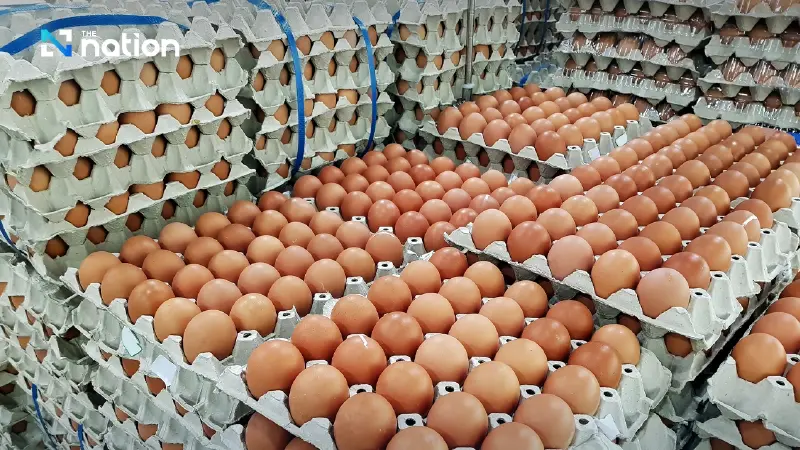


Egg farmer cooperatives will raise farm-gate egg prices by 0.20 baht per egg to 3.40 baht, pushing tray prices up by 6 baht from March 16
Thailand’s network of egg farmer cooperatives has announced a price increase for eggs, raising the farm-gate price of mixed eggs by 0.20 baht per egg to 3.40 baht. The adjustment will push the price of a tray of eggs up by around 6 baht and will take effect from March 16, 2026.

An industry source told Thansettakij on March 14 that the announcement was made by the Egg Farmer Cooperative Network, which includes the Paet Riu Egg Farmer Cooperative, Chonburi Egg Farmer Cooperative, Chiang Mai–Lamphun Egg Farmer Cooperative and the Noi River Basin Egg Farmer Cooperative.
The cooperatives said the price increase reflects tighter supply in the market. Larger eggs have become scarcer as farmers continue to cull older hens, while newly raised hens have not yet reached full production. In addition, hot weather has reduced egg output.

Manoch Chutaptim, president of the Egg Farmers Association, said egg price announcements were previously issued by the Egg Producers and Traders Association. However, due to legal scrutiny from the Commerce Ministry, farmers decided to issue the announcement themselves.
He explained that the announced price is only a recommended price and does not force sellers to trade at that level.
“If the price is announced and buyers refuse to purchase, then the market will simply ignore it. The announcement will lose its credibility,” he said.
He added that the price announcement serves mainly as a guideline for the market.
“In the industry we sometimes joke that the announced price is there to prevent eggs from being sold too expensively,” he said. “If demand is strong, some sellers may want to charge more, but the announced price acts as a ceiling. On the other hand, if buyers try to push prices down, farmers may still have to sell because they have limited options.”
Manoch said the key factor behind any price announcement is credibility and acceptance among farmers, traders and consumers.
The price must reflect actual market conditions, including both buyers and sellers in a relatively free market environment.
“If the market does not accept the price, it may gradually adjust down by 10 or 20 satang,” he said, noting that egg quality can vary from farm to farm depending on freshness, appearance and payment conditions.
He emphasised that the recommended price is intended to reflect market conditions rather than the desires of producers.
“If consumers stop buying, no matter how much producers try to push prices higher, it will not work,” he said. “People should not worry that farmers will exploit society — that is simply not possible.”
Manoch also said he had previously proposed reviewing policies related to the distribution of breeding stock, which he described as a major issue in the industry.
Demand for laying hens has grown as farmers see egg production as relatively stable and profitable. However, if breeding stock distribution becomes too liberal and farmers later face heavy losses, many may abandon the industry.
“There is a well-known theory in farming: when few people raise chickens, profits are high; when too many do, profits disappear,” he said.
Responding to a question about whether current conditions might limit opportunities for new farmers, Manoch said the issue should be viewed in terms of market reality.
“If prices fall to only one or two baht per egg, would new farmers still want to enter the business?” he asked. “Many experienced farmers have already lived through those crises.”
He added that the Department of Livestock Development should play a role in overseeing breeding expansion by companies, as such activities are governed by regulations and livestock transport permits.
As for the price of breeding stock, he said farmers could accept current levels to some extent given demand, international comparisons and production costs, including the need to cull male chicks — unlike in broiler production.
“For us, it is enough if farmers can still earn a reasonable profit and survive,” he said.
Looking ahead, Manoch said egg prices in 2026 are unlikely to be as strong as last year. Although some may attribute this to weaker tourism or the economic slowdown, he said another issue is the increasing presence of illegal or unregistered poultry operations entering the market.
However, he added that there is still a possibility that prices could rise again, particularly after farmers began culling large numbers of hens earlier this year when egg prices dropped below production costs.
“If the cost is 3.20 baht but eggs sell for only 2.80 or 2.90 baht, farmers inevitably face losses,” he said, particularly those who purchase feed from commercial suppliers.
“As a result, everyone has had to adjust production simply to survive.”
