
Thai Egg Market Stabilises Through Exports, Faces Price War at Home
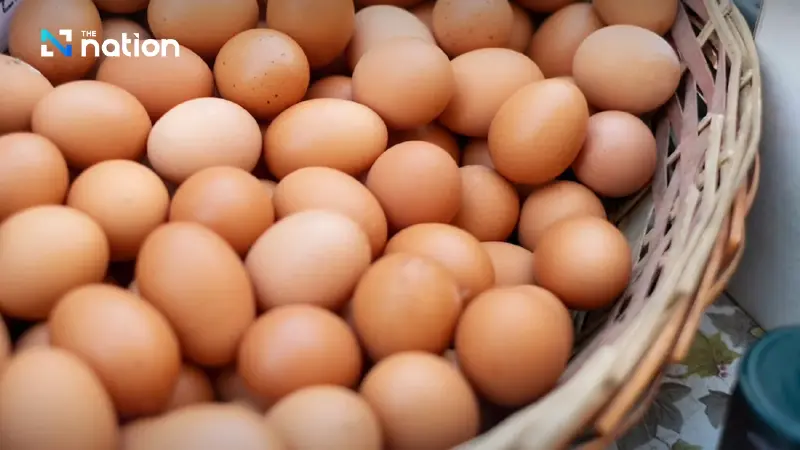


Government pushes 60 million egg export target to curb surplus and lift farm-gate prices, but small farmers demand urgent action against supermarket price dumping
- A government-backed export drive, aiming to ship 60 million surplus eggs, has successfully stabilized farm-gate prices at 3.40 baht per egg.
- Despite this stability, small-scale farmers are facing a domestic price war, accusing major supermarkets of "price dumping" by selling eggs below the farm-gate price.
- A farmers' trade association has formally requested government intervention to stop these supermarket promotions, which they claim create unfair competition.
Government pushes 60 million egg export target to curb surplus and lift farm-gate prices, but small farmers demand urgent action against supermarket price dumping.
The Thai egg market is showing signs of recovery following a significant government-backed export drive, but smaller farmers are now facing an intense price war against major modern trade retailers.
A total of 16 major producers are collaborating with the Department of Livestock Development (DLD) to export 60 million surplus eggs by December under the "PS SUPPORT" initiative.
This action has successfully stabilised the farm-gate price for mixed-size eggs, lifting it from a low of 3.00 baht to its current level of 3.40 baht per egg.
This recovery comes after a period of oversupply, slowed consumer spending, school holidays, and the recent Vegetarian Festival depressed prices.
To further manage domestic supply, the DLD is fast-tracking the 2026 import quota plan for the Egg Board to prevent future market saturation.

However, the price stabilisation at the farm level has not filtered down fairly to the retail sector, leading to an urgent complaint from small-scale producers.
The Central Small-Scale Egg Producers Trade Association has formally written to the Department of Internal Trade (DIT), claiming that numerous major supermarkets and modern trade outlets are actively running promotions that constitute price dumping.
"Many supermarkets are currently selling 30-egg packs (mixed sizes No. 3-4) for 99 baht, which averages out to 3.30 baht per egg," said a source from the farmers' association. "This is being sold below the current farm-gate price of 3.40 baht per egg that farmers are receiving, creating grossly unfair competition."
The farmers argue that while retailers may claim these are short-term consumer-benefit promotions, they are continuous, and small producers lack the capital or financial stability to compete with large corporations.
The association is demanding that the DIT issue an immediate order to suspend these promotions or mandate that retailers set prices based on production costs plus a reasonable profit margin.

The industry is navigating risks, including avian influenza prevention during the cold season transition. Currently, the national stock stands at 52.36 million laying hens, yielding an estimated 43.46 million eggs daily.
Data shows that the average cost of production in Quarter 3/2025 dropped to 3.25 baht per egg due to falling feed costs, but this margin remains thin against the low retail promotional price.
Exports remain a crucial outlet. From January to September 2025, Thailand exported 388.63 million fresh eggs, marking a 27.31% increase in volume year-on-year. Key markets are Singapore (79%), Hong Kong (9%), and Japan (7%).
Meanwhile, the DLD's 2026 import plan for breeding stock projects a potential increase of 1.89 million chicks annually, signalling that strict market mechanisms and culling protocols will be necessary to prevent future devastating oversupply.
