
Senate panel urges end to MOU 43 over repeated Cambodian breaches
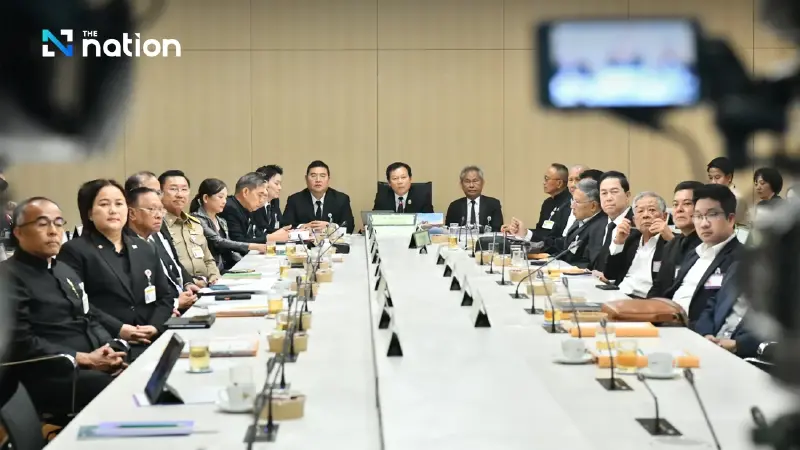


A Senate committee has unanimously recommended scrapping the MOU 43, citing six reasons and alleging repeated Cambodian violations, with the report expected to go before the Senate in April.
Noppadon Inna, a senator and chairman of the Senate’s ad hoc committee studying the advantages and disadvantages of revoking the 2000 and 2001 memorandums of understanding, announced the committee’s findings, saying the panel had unanimously agreed that the 2000 MOU (MOU 43) should be revoked, after previously resolving to revoke the 2001 MOU (MOU 44) in December 2025.
He said that, after more than 20 meetings, field visits to seven Thai-Cambodian border provinces, and in-depth briefings from security agencies and the Ministry of Foreign Affairs, the committee had found that Cambodia had continuously encroached on Thai territory and ignored Thailand’s objections.
Noppadon said the committee had proposed revoking MOU 43 for six reasons:
- The provisions of the MOU are flawed, particularly the acceptance of Cambodia’s 1:200,000-scale map, which conflicts with Thailand’s 1:50,000-scale map and has created problems in boundary demarcation. In addition, the Joint Boundary Commission (JBC) lacks the authority to deal with encroachment issues.
- MOU 43 may have constitutional problems because a previous Cabinet merely acknowledged it rather than formally approved it, and it was not reviewed by Parliament, despite the fact that the agreement affects changes to Thai territory.
- Cambodia’s 1993 Constitution mandates the use of a 1:100,000-scale map. As a result, maps produced under MOU 43 may not be recognised by Cambodia, rendering negotiations futile.
- Progress has been delayed. Although nearly 26 years have passed, only 60% of the first phase has been completed.
- The border situation changed completely after two major clashes in 2025, forcing Thailand instead to rely on the General Border Committee’s joint statement of December 27, 2025, under which troops are to remain at their current positions.
- Cambodia has shown a pattern of failing to honour agreements, provoking tensions and creating fake news, while MOU 43 is not robust enough to address such behaviour.
“Regarding the revocation process, the committee believes Thailand can unilaterally withdraw under Article 60 of the Vienna Convention on the Law of Treaties because Cambodia has seriously violated the agreement through the construction of tall buildings along the border, the laying of landmines, and the use of military weapons against Thai civilians,” Noppadon said, adding that Thailand would have to notify Cambodia at least three months in advance.
“After revocation, Thailand and Cambodia would still be able to use the mechanisms under the 1904 and 1907 Franco-Siamese treaties, as well as the 1995 border cooperation agreement, to resolve disputes as usual.”

He added that the committee had also recommended that, should a new agreement be drafted in the future, it must not recognise the 1:200,000-scale map as the basis for boundary demarcation, that the JBC must be given greater authority to deal with encroachment, that the cliff-edge line must be used as the boundary in the Phanom Dong Rak mountain range, and that the agreement must include a clearly defined expiry condition in order to protect national sovereignty and the country’s highest interests.
Noppadon said the next step would be to place the committee’s resolution on the Senate agenda for approval. After that, the Senate would forward the committee’s report to the Cabinet for further consideration.
He said the committee’s resolution was expected to be submitted to the Senate in April.
