
Labour groups rally at Government House, Energy Ministry over fuel crisis
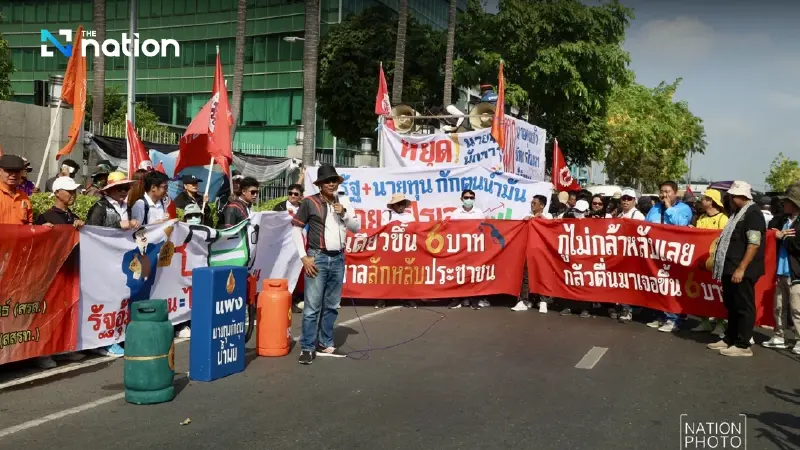


Labour networks submit 7 demands at Government House and Energy Ministry, urging fuel price controls, refinery reform and action on hoarding
Labour networks staged parallel protests at Government House and the Ministry of Energy on April 2, calling for urgent government action to tackle rising fuel prices and the broader energy crisis, with largely similar demands submitted at both locations.
At Government House, representatives from the Thai Labour Solidarity Committee, led by Sawit Kaewwan, joined by the State Enterprises Workers’ Relations Confederation and civil society networks, gathered at Gate 5 on Ratchadamnoen Nok Road. Around 120 protesters submitted a list of seven demands to Prime Minister Anutin Charnvirakul.

On the same day, another group led by the State Enterprises Workers’ Relations Confederation assembled outside the Ministry of Energy to oppose rising oil prices. The group submitted its demands to Petai Mudtham, chief inspector-general of the ministry, on behalf of Energy Minister Akanat Promphan, urging swift and concrete measures to address energy price volatility and ease the cost of living.

The demands:
1. The government must control energy prices, cut refining margins to Bt2 per litre, remove overlapping taxes, cap diesel at no more than Bt30 per litre, prevent fuel shortages, halt oil exports to ensure adequate domestic supply, and recover windfall gains from groups accused of hoarding fuel.
2. The government must stop privatisation of state enterprises and bring PTT and oil refineries back under state control to ensure fair management of oil and gas resources for the benefit of the country and the public.
3. The state must disclose full data on domestic oil production, refining and imports so the public can clearly understand volumes and proportions.
4. Authorities must urgently investigate and take legal action against refineries, individuals and corporate entities accused of hoarding fuel or raising prices despite holding older stock.
5. The prime minister should use special powers to manage the energy sector during the emergency, impose effective fuel price controls and ensure fair and nationwide public access to oil.
6. The government must implement measures to control the prices of consumer goods in order to prevent the cost of living from rising further during the crisis.
7. In the electricity sector, the government must cancel what the group described as unfair power purchase agreements with private firms, which they said are driving up electricity costs, and restore the Electricity Generating Authority of Thailand as the country’s main power producer.
The group rallying at the Ministry of Energy submitted largely the same set of demands, particularly on fuel price controls, refinery margin reductions, transparency, legal action against hoarding and restructuring of the energy sector. However, their submission did not explicitly include a separate demand on consumer goods price controls.
Sawit said that once elected by the people, the government has a duty to protect national and public interests. Failure to act, he warned, would reinforce accusations that the administration is siding with big business at the expense of the public.
He also questioned whether the Bhumjaithai Party was living up to its pledge to “say it and do it”, arguing that concrete action, particularly lowering fuel prices, is urgently needed.
