
Diesel to rise another Bt3.50 on Friday, topping Bt47 a litre
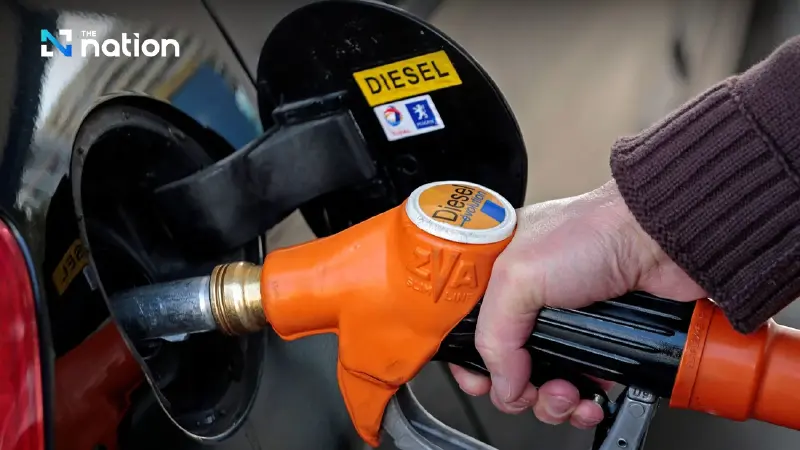


Thailand’s Oil Fuel Fund Committee has cut diesel subsidies by Bt3.51 a litre, pushing the retail diesel price up to Bt47.74 from April 3.
Thailand’s Oil Fuel Fund Committee said after its April 2, 2026 meeting that it had approved a cut in the diesel subsidy of Bt3.51 per litre, reducing support to Bt14.27 per litre.
As a result, the retail price of diesel at service stations will rise by Bt3.50 per litre to Bt47.74 per litre.
The committee also cut the subsidy for B20 biodiesel by Bt3.48 per litre, leaving support at Bt16.64 per litre. This will push the retail price of B20 up by Bt3.50 per litre to Bt42.74 per litre.
Retail prices for petrol will be announced separately by traders.
The new fuel prices will take effect from 5am on April 3, 2026.
The Ministry of Energy on Thursday reported on Thailand’s and the international energy situation, domestic oil reserves and diesel supply volumes, the status of the Oil Fuel Fund, and other related matters as of April 2, 2026.
1. Global energy situation and factors affecting prices
- President Donald Trump said this morning (April 2, 2026) that the United States was close to achieving its objectives in the fighting after destroying almost all of Iran’s military and missile capabilities within 32 days. He also stressed that the US had sufficient resources and no longer needed to rely on oil from the Strait of Hormuz. Although media outlets noted that there was still no clear timetable for peace talks, Iran’s leader at the same time published an open letter to the American people, urging them to question the US government’s motives for waging war on behalf of Israel. He also insisted that Iran’s actions were in self-defence and that it did not regard the American people as its enemy. Following the statement, global crude oil prices remained highly volatile, with WTI crude rising to US$103 per barrel, while Dubai crude stood at US$131 per barrel.
2. Domestic oil reserves, and diesel production and sales
- Domestic oil reserves: Based on data as of April 2, 2026, Thailand has sufficient oil to meet demand for around 106 days, comprising 25 days of legally required reserves, 18 days of commercial reserves, 33 days of oil in transit, and 30 days of confirmed supply.
- Diesel production and sales: Based on data as of March 31, 2026, Thailand was able to produce 78.73 million litres of diesel, while sales totalled 82.54 million litres.
3. Domestic and international retail oil prices, and the status of the Oil Fuel Fund
- Based on PTT prices, diesel (B7) is priced at 44.24 baht per litre, benzene (E20) at 38.25 baht, gasohol 95 at 43.25 baht, and gasohol 91 at 42.88 baht.
- Comparing Thailand’s retail oil prices with those in other ASEAN countries, Thailand’s average benzene price stands at 43.25 baht per litre, while prices in the Philippines, Cambodia, Myanmar, Laos and Singapore range from 52.22 to 86.16 baht per litre. Thailand’s diesel price is 44.24 baht per litre, while prices in Malaysia, Vietnam, Cambodia, Laos, the Philippines, Myanmar and Singapore range from 50.36 to 107.20 baht per litre.
- The estimated status of the Oil Fuel Fund as of April 2, 2026 showed a deficit of 48.217 billion baht, with diesel compensation payments of around 1.442 billion baht per day.
4. Other matters
- Bangchak Corporation Public Company Limited has produced its first batch of B20 diesel, amounting to 35,000 litres. The fuel is being distributed through depots and is expected to go on sale at service stations within April. Vehicles able to use it must have large diesel engines, such as trucks, buses and industrial machinery. The use of B20 diesel supports energy sourced within the country, reduces reliance on imports, and helps create added value for Thailand’s agricultural sector. This is in line with energy development policies that take into account energy security, the economy and the environment.
