
Anutin names six oil-hoarding tricks, orders DSI crackdown
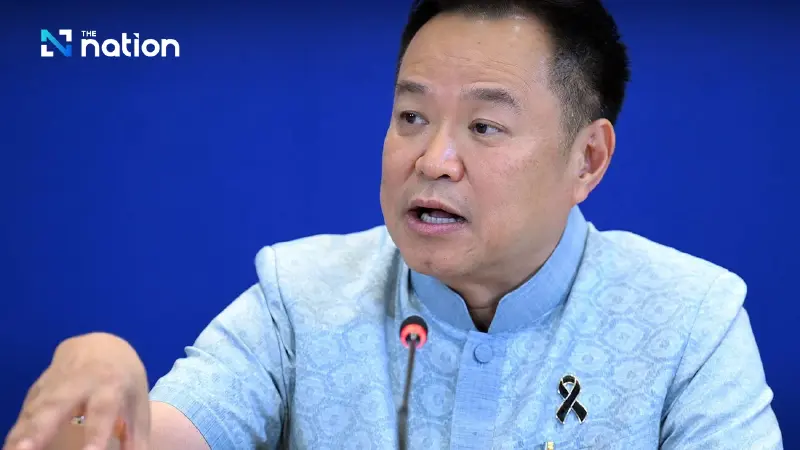


PM Anutin Charnvirakul orders DSI to pursue oil hoarders, citing six suspected scam tactics amid Thailand’s energy security crisis
Prime Minister Anutin Charnvirakul has accused oil-hoarding networks of exploiting Thailand’s energy crisis through six suspected forms of misconduct, and has ordered the Department of Special Investigation to treat the matter as a special case, declaring that no level of influence will shield those responsible.

Speaking after the ninth 2026 meeting of the Joint Management and Monitoring Center for the Situation in the Middle East, Anutin said the session was a crucial one before the current government’s term ends next week. The main focus, he said, was energy security, especially efforts to prevent and suppress hoarding and the illicit diversion of oil outside the formal system at a time when the public is already under pressure.
He said the government would act on the principle of judging conduct rather than status, making clear that whether those involved are large traders, medium-sized operators or powerful figures, anyone found exploiting the public and undermining national energy security will face the harshest legal action without exception.
Anutin said the Justice Ministry had assigned the Department of Special Investigation, or DSI, as the lead agency, working in coordination with the Royal Thai Police, the Department of Energy Business, the Thai Maritime Enforcement Command Centre, the Marine Department, the Excise Department, the Department of Internal Trade, the Customs Department and provincial administrative authorities. The DSI is part of the Justice Ministry, while the Department of Energy Business is the Energy Ministry unit responsible for fuel-sector oversight.

Based on inspections carried out since April 1, the government said it had identified six particularly suspicious patterns.
The first involves delays in marine transport, with oil tankers allegedly ordered to remain offshore instead of unloading into storage as scheduled, in order to wait for a retail price increase and capture the higher margin.
The second is refusal to release supply, with some large depots allegedly holding back oil from service stations and end-users in an apparent attempt to speculate on price gains.
The third concerns off-route transport, with fuel allegedly moved away from approved routes and hidden for stockpiling.
The fourth is suspected ship-to-ship transfers at sea, which authorities believe may have been used to avoid scrutiny, with investigators now trying to identify those directing the operation.
The fifth is irregular data. Anutin said officials had found discrepancies between oil volume records held by the Marine Department and the Department of Energy Business, and excise tax data from refineries, which he described as a major red flag.
The sixth concerns possible exports that breached permit conditions, with authorities now checking whether fuel transported overland to neighbouring countries exceeded authorised volumes.
He said such conduct amounted to robbing the public. At present, he said, the government is using the Oil Fuel Fund to subsidise prices by around 17 baht per litre in order to keep transport and travel functioning normally, leaving the fund with losses of more than 50 billion baht. That money, he said, is intended to help Thai people, not to subsidise fuel that is then diverted for speculative profit abroad. For that reason, he said, he had ordered DSI to take up the case as a special investigation and pursue those responsible to the fullest extent of the law.
Anutin said another striking anomaly was the jump in domestic oil consumption. Thailand’s normal daily use is about 67 million litres, he said, but since the Middle East conflict intensified, the figure has surged to almost 90 million litres a day, despite there being no matching shift in economic or industrial activity to justify such an increase. He said that strengthened the government’s suspicion that hoarding and illicit diversion were indeed taking place, and vowed to restore supply volumes to normal levels.
For people preparing to travel during Songkran, Anutin said he could assure the public, on his honour as prime minister, that Thailand has enough fuel. He said the government had coordinated with operators under Sections 7 and 10 to prepare reserve fuel trucks, and had also temporarily eased transport regulations so that tankers could be dispatched around the clock to refill stations facing shortages as soon as requests came in.
He urged the public not to panic. There is no need, he said, to fill drums or jerry cans and stockpile fuel at home, because such behaviour would only worsen shortages at petrol stations unnecessarily. Motorists should continue using their vehicles and refuelling as normal, he said, and would be able to travel safely for the holiday and return to work without disruption.
Looking further ahead, Anutin said this centre would hand over to a more intensive “Middle East Situation Centre Plus” under the next government, with a broader remit that would include restructuring energy prices to make them fairer and more in line with global conditions, as well as deeper relief measures for the public.
He said Thailand may import all of its crude oil, but it has efficient refineries and a global procurement network through PTT. The government, he said, has already confirmed forward crude orders that will be delivered continuously through to early June, while additional supplies are being sought from other sources all the time. Some matters may not be discussed publicly in detail because they involve national security and negotiating strategy, he said, but insisted that nothing is being concealed from the public.

He ended by thanking officials from all agencies for working honestly and diligently to protect national interests, and said the government would continue to put the public first as it steers the country through the crisis.
