
RID, RAOT launch rubber innovation drive for Thai irrigation
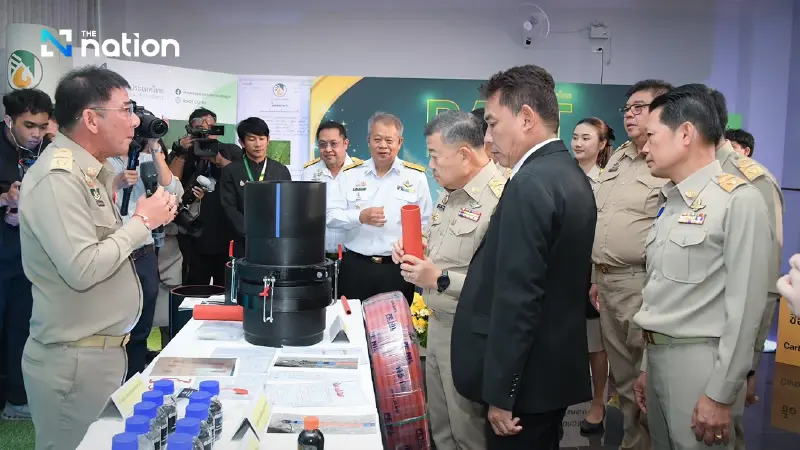


The Royal Irrigation Department and the Rubber Authority of Thailand have unveiled new rubber-based irrigation innovations to cut costs, reduce imports and support Thai farmers.
The Royal Irrigation Department (RID), together with the Rubber Authority of Thailand (RAOT), recently held a press conference to unveil “rubber innovations for Thai irrigation” under a joint initiative to develop and expand the use of natural rubber in irrigation works.
The event was presided over by Winaroj Subsongsuk, permanent secretary for agriculture and cooperatives. Also attending were Suriyapon Nuchanong, director-general of the Royal Irrigation Department, Dr Perk Lertwangpong, acting governor of the Rubber Authority of Thailand, senior executives from various agencies, civil servants, officials and members of the media.

The event featured two key innovations already in practical use in irrigation areas: the RID-UNITED rubber float system for trapping water hyacinth and HDPE pipes blended with natural rubber for water conveyance and drainage.
Suriyapon said the department had applied rubber-based innovation to irrigation work as part of efforts to solve operational problems and improve field work. Natural rubber, he said, is flexible, durable, long-lasting and can be produced domestically, making it suitable for development into equipment and structures for water management.

He said innovations such as the RID-UNITED rubber float system and HDPE pipes mixed with natural rubber help improve operational efficiency, reduce reliance on imported materials, lower costs, support environmental sustainability and can be used effectively in irrigation areas nationwide.

Under the rubber innovation for Thai irrigation project, more than 900 tonnes of natural rubber are planned for use to produce around 43,000 rubber floats and about 15,000 metres of rubber-blended piping.

The project is the result of cooperation between the Royal Irrigation Department and the Rubber Authority of Thailand in integrating knowledge, innovation and material support to promote the practical use of natural rubber in irrigation, in line with the Agriculture and Cooperatives Ministry’s policy of encouraging greater use of rubber in the public sector.

Natural rubber remains one of Thailand’s key economic crops. The Royal Irrigation Department said it was confident that the project would mark another important step in cooperation between state agencies to make better and more sustainable use of the country’s own resources.
It said the initiative would not only help improve the efficiency of Thailand’s irrigation and water management systems, but also add value to Thai rubber, strengthen income security for rubber farmers, and support stronger growth in the agricultural sector alongside the country’s long-term economic and environmental development.
