
Princess Sirivannavari shares vision behind ‘La Mode en Majesté’
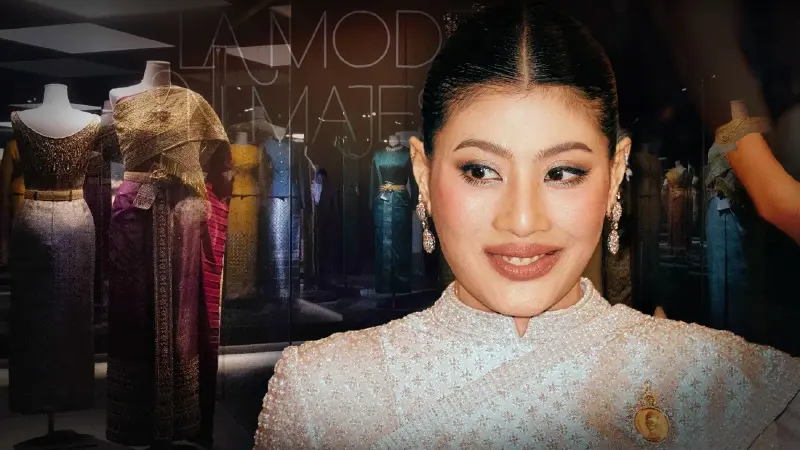


Princess Sirivannavari discusses how ‘La Mode en Majesté’ brings royal Thai dress, Queen Sirikit’s legacy and Thai craftsmanship to Paris.
- The exhibition was conceived by Princess Sirivannavari to mark the 170th anniversary of Thai-French relations, using her grandmother Queen Sirikit's 1960s Balmain gowns as the central inspiration.
- Her vision was to present Thai fashion and culture to a global audience by showcasing not only royal gowns but also traditional textiles, contemporary designers, and national craftsmanship.
- The Princess intended for the exhibition to act as a cultural ambassador, demonstrating how fashion can reflect a nation's history and timeless identity on the world stage.
- Realizing the vision required extensive collaboration between Thai institutions, such as SACIT and the Queen Sirikit Museum of Textiles, and the Musée des Arts Décoratifs in Paris.
A special interview granted by Her Royal Highness Princess Sirivannavari Nariratana Rajakanya has offered insight into the vision behind bringing ‘La Mode en Majesté – Royal Thai Dress: From Tradition to Modernity’ to an international audience.
The interview took place as part of celebrations marking the 170th anniversary of diplomatic relations between Thailand and France, during the exhibition held at Musée des Arts Décoratifs in Paris.
The interview was published by the Sustainable Arts and Crafts Institute of Thailand (SACIT).

The origins of La Mode en Majesté
“This project has been in the making for more than a year. When I first heard that the Royal Thai Embassy in Paris was preparing to organise an event to mark the 170th anniversary of relations between Thailand and France, I already had some ideas in mind about the direction it could take.”
“I studied here, worked here and have friends here, so I am familiar with the French way of life and French tastes.”

“I therefore discussed with the team the idea of doing something related to fashion, art and Thai culture — but presenting it in a way that would make people around the world marvel at Thailand’s fashion heritage, craftsmanship and timeless identity.”
“That led me to think of the Balmain royal gowns, adorned with Lesage embroidery, worn by my grandmother [Her Majesty Queen Sirikit The Queen Mother] in the 1960s as she accompanied my grandfather [His Majesty King Bhumibol Adulyadej The Great] on visits to the United States and several European countries, as well as in later years. That became the starting point for this exhibition.”

The journey behind bringing La Mode en Majesté to the world
“After the idea had taken shape, I had to seek royal permission from my father [His Majesty King Maha Vajiralongkorn], which was a very nerve-racking moment because this was the first time my grandmother’s royal gowns would be displayed outside Thailand.”
“I was delighted with the outcome, as my father granted royal permission for my grandmother’s royal gowns to be exhibited in Paris.”

“After that came the preparation stage. On the Thai side, there were SACIT, the Queen Sirikit Museum of Textiles and the Royal Thai Embassy in Paris. We also had to work closely with the curators, Beatrice and Yvon, from MAD Paris. The MAD team flew to Bangkok in the middle of last year to study my grandmother’s collection of royal gowns.”
“After that, we set the direction for the exhibition and divided it into categories and different sections. These included a room dedicated to the eight styles of Thai national dress, a room for royal gowns by Balmain with Lesage embroidery, a room for Thai brocade, and a room for Mudmee silk used in couture.”
“There was also a room showcasing the art of embroidery by Sirivannavari Atelier and Academy, displayed alongside works by contemporary Thai designer brands such as Tirapan, Asava, Vatit Itthi, Wisharawish and Meshmuseum.”

“The exhibition also extended to a room devoted to Thai craftsmanship, including Yan Lipao basketry, Benjarong porcelain and nielloware. The two categories of works shown there — Yan Lipao basketry and nielloware — were produced under the Queen Sirikit Institute. Yan Lipao basketry is mainly created by craftspeople from the South, particularly from Nakhon Si Thammarat province.”
“As for ancient nielloware, it originated in Nakhon Si Thammarat, but its popularity later declined. My grandmother was concerned that the craft might disappear, so she revived it by training a new generation of artisans and developing its patterns and refinement.”

“In addition, there is a Benjarong porcelain set on display. I must say that this Benjarong set is from the private collection of MAD Paris itself, and every piece is beautiful and valuable.”
“Before the exhibition could be completed in the form everyone has now seen, all of us had to search for information, conduct research and look for many details — old photographs, sketches, fabric samples, embroidery samples and many other elements.”

“The research was very in-depth and involved a great deal of information. We discovered many things along the way. Some of the information we found was something we had never seen before, and we learnt a great deal from the process.”
“After gathering all the information, we had to go through discussions, careful review and, at times, debates on points of principle in order to create La Mode en Majesté as an exhibition that presents Thailand’s heritage of wisdom, art, culture and evolution, so that all eyes may witness the essence of Thai identity.”

My favourite room in La Mode en Majesté
“I love every corner. There is something I love about every room, and I like every colour. The lighting in each room also enhances the exhibition, making it look interesting and modern while engaging both the emotions and the viewer’s perspective.”
“But if you ask which room I like the most, it would probably be the Brocade room, or the ‘Pha Yok’ room, where the walls are entirely pink. Before we arrived at this room and before everything came together, we had to discuss the design back and forth with MAD and change the room colour two or three times. But the result is one that I am very happy with.”
“When you enter this room, it immediately feels bright and fresh. It makes the royal brocade gowns stand out and also adds colour and a change of mood to the exhibition.”

The response
“I feel deeply moved and heartened that leading international media have seen and understood the exhibition so well. Major international media outlets such as WWD and Vogue USA have published articles paying tribute to my grandmother, while also praising the beauty of Thai dress and Thai craftsmanship.”
“I was also delighted for the team to see people queuing in the heart of Paris to visit our exhibition from the very first day. I am happy for everyone involved.”
“We spent a year preparing this exhibition. Every member of the team, both Thai and international, devoted themselves fully to it. This truly reflects the cooperation between Thailand and France. Most importantly, I am proud on behalf of all Thai people that we have been able to present Thai art, culture and identity for the world to recognise and admire.”

The message I would like to share
“La Mode en Majesté does not present only the heritage of wisdom, art, culture and the evolution of Thai fashion. This exhibition also carries a deeper meaning: the role of fashion in reflecting the history of a nation over time.”
“Fashion also plays the role of a cultural ambassador, as can be seen through my grandmother’s royal gowns. Every outfit has its own story, meaning and role according to the occasion and the era.”
“Finally, I would like to thank every member of the team, every organisation and everyone who supported this exhibition and helped bring it to a successful conclusion.”
“If anyone has the opportunity to visit Paris, I would like them to come and see it. I believe that every Thai person who has the chance to see this exhibition will certainly feel proud of their Thai identity.”
