
Thai stance hardens as Cambodia border closure drags into 10th month
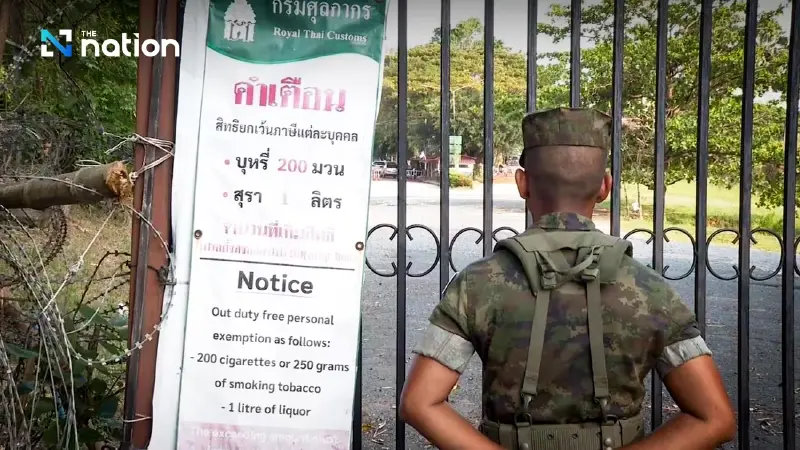


Thailand is expected to keep its Cambodia border shut as security concerns, economic strain and pressure on casino hubs deepen after 10 months of closure
Thailand is showing no sign of easing its position on the closure of checkpoints along the Cambodian border, with security officials believing the shutdown could remain in place for the rest of the year as national security concerns continue to outweigh economic pressure.
Thai security agencies estimate that Cambodians could face acute hardship within the next one to two months as the domestic economy deteriorates further.
The strain is being driven not only by the closure of the Thai-Cambodian border, which has remained shut along the entire frontier since June 23, 2025, but also by added pressure from US tariffs and the energy crisis linked to the war in the Middle East.
Cambodia has long been known for its large gambling industry. It reportedly holds more than 130 casino licences, with 54 casino sites spread across 11 provinces.
Many of them are clustered along the Thai-Cambodian border, a key economic artery for the country. That border economy has slowed sharply because around 90% of casino visitors normally cross by land, and most customers are Thai.
Cambodia has also come under mounting pressure to accelerate crackdowns on criminal activity, as a number of casino compounds have been linked to call-centre scams and human trafficking operations that have caused damage worldwide.
Several casino-resort areas along the Thai-Cambodian frontier have effectively fallen under Thai control since clashes ended, including Thomoda Casino in Trat, O’Smach in Surin and the Chong An Ma crossing area in Ubon Ratchathani.
The pressure is reflected in the recent stance of Cambodian Prime Minister Hun Manet.
After returning from a visit to France, he called for bilateral negotiations with Thailand and for the revival of the Thai-Cambodian Joint Boundary Commission, or JBC, as a faster and more effective mechanism than the International Court of Justice.
That is broadly in line with the long-standing framework under the 2000 memorandum of understanding, which Thailand’s Foreign Ministry has described as the key mechanism for joint survey and boundary demarcation.
Under what is often referred to as MOU 43, a major tool in the border demarcation process, progress over the past 20 years has reportedly exceeded 50%, with agreement reached on 43 of 74 points. Hun Manet has indicated that the JBC remains a proven mechanism, even if it is not perfect.
Amid reports of quiet local-level talks aimed at persuading Thailand to relax restrictions at Chanthaburi and Trat border crossings so relief supplies could be sent from Thailand into Cambodia, the Royal Thai Navy has flatly denied any plan to reopen the frontier.
On April 15, 2026, Navy spokesman Rear Admiral Parach Ratanachaiyaphan said online claims of a reopening were false and stressed that any Cambodian request for assistance must go through diplomatic channels.
He said the navy had no policy to reopen any checkpoint or crossing route and would continue strict border control under the law and national security framework.
His comments suggest that while informal approaches may have been discussed behind the scenes, Thailand is not prepared to take the political risk of reopening the border in the current climate.
That caution is likely to be especially strong for Prime Minister Anutin Charnvirakul, who is already grappling with an energy crisis that has spilled into the cost of living and broader economic confidence.
Any move to reopen the border now could deepen domestic political pressure at a time when public trust is already under strain.
“There has been no reopening of the checkpoints, and it is not yet time to reopen them,” Anutin said.
“There has also been no diplomatic coordination. Everything must begin step by step. Relations would first have to start being restored, and there has been no discussion of that at this stage.”
Another reason for Thai caution is a lack of confidence in Cambodia’s internal power structure.
Although Hun Manet has adopted a softer tone, Thai officials do not believe that means the situation is stable, as real authority is still widely seen as centred on former premier Hun Sen.
That has fuelled concern in Thailand that policy signals from Phnom Penh may not always match actions on the ground.
Current intelligence from the Chanthaburi-Trat border area suggests Cambodia continues to reinforce both land and naval positions, in line with activity seen in other sectors under the responsibility of the 1st and 2nd Army Regions.
That is why the Commander-in-Chief of the Royal Thai Navy, Admiral Jirapol Wongwit, travelled to inspect operational readiness in the Chanthaburi-Trat border defence zone on April 16, underlining the area’s role as a frontline barrier protecting sovereignty, security and national interests on both land and sea.
The navy has separately reaffirmed that it will not soften its position on border security.
He instructed all units to strengthen preparedness in three key areas: personnel, by improving capability and morale; materiel, by checking weapons, equipment and support systems; and tactics, by adjusting plans and training to match the changing threat environment.
Thai commanders say the opposing side continues to reinforce both ground and maritime forces, making it necessary for units in the area to raise readiness levels so they can respond quickly and effectively to any security development.
“I have ordered that there be absolutely no reopening of the checkpoints,” the navy chief said. “We will follow the government’s orders. We will not yield to the other side, whatever the interests involved. If it is closed, it is closed.”
Security agencies now believe the Thai-Cambodian border is unlikely to reopen at any point this year, as any decision would have to take account of not only security concerns but also Thai public sentiment, which remains deeply resistant.
The only scenario that could force renewed talks, officials believe, would be a humanitarian spillover if large numbers of Cambodians began fleeing hardship and crossing into Thailand in the coming months.
In that case, Bangkok and Phnom Penh might have little choice but to reopen discussions in search of a practical way out.
