
PTT Bets on Ammonia, Carbon Capture and Global LNG to Power Its Future Beyond Thai Borders


Thailand's state energy giant is accelerating its transformation into a global operator, pivoting from domestic utility to international competitor through low-carbon technology, infrastructure consolidation, and strategic divestments
- PTT is prioritizing ammonia co-firing in power plants as a pragmatic and commercially viable step towards decarbonization, choosing it over the more complex pure hydrogen technology.
- The company is actively developing carbon capture and storage (CCS) projects, including one at the Arthit gas field targeting a 2028 start and a larger Eastern Thailand CCS Hub.
- A key global strategy is the significant expansion of its Liquefied Natural Gas (LNG) trading, with a goal to increase its portfolio to 10 million tonnes per year by 2030.
- The company is fundamentally shifting from a domestic utility to a global competitor, seeking international partners to gain market access and technological capabilities.
- To support its global ambitions, PTT is consolidating its infrastructure assets under a single entity and divesting from non-core businesses to fund its strategic pivot.
Thailand's state energy giant is accelerating its transformation into a global operator, pivoting from domestic utility to international competitor through low-carbon technology, infrastructure consolidation, and strategic divestments.
Thailand's PTT Group is charting an increasingly bold course away from its domestic roots, placing long-term bets on liquefied natural gas trading, ammonia co-firing, and carbon capture technology as the pillars of an energy transition strategy designed to keep the state-owned conglomerate competitive well beyond the fossil fuel era.
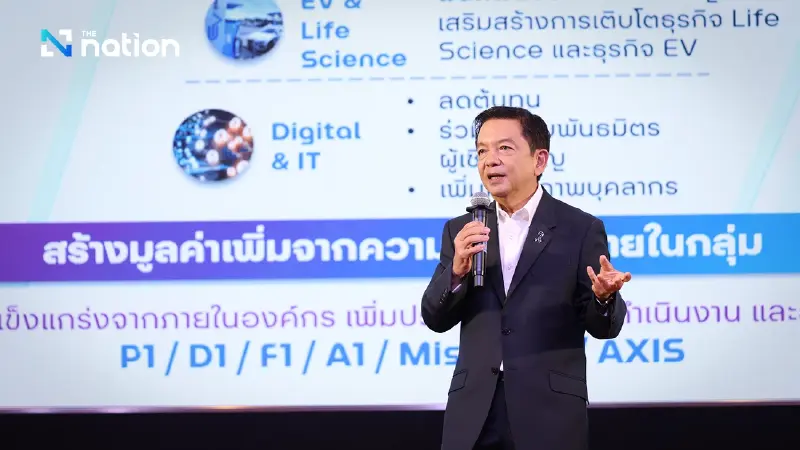
Speaking at a press conference in Bangkok on Friday, Chief Executive Kongkrapan Intarajang outlined a strategic roadmap that reflects a company grappling with its own size and global exposure — some 70 to 80 per cent of PTT's business now operates outside Thai domestic regulation — and responding with what he described as a fundamental shift in corporate mindset, from national utility to global competitor.
"If we let it be business as usual, profits would have been 50,000 million baht," Kongkrapan said. "But we achieved 90,000 million through internal improvements."
That 40-billion-baht gap, he argued, demonstrates that internal efficiency, not commodity luck, is what will define PTT's future.

Pragmatic Transition: Ammonia Before Hydrogen
On the energy transition front, PTT is taking a notably pragmatic stance.
Rather than committing wholesale to pure hydrogen — a technology still hampered by high costs, regulatory uncertainty, and infrastructure gaps — the group is prioritising ammonia co-firing in power plants as an immediate, commercially viable step toward decarbonisation.
The logic is straightforward: ammonia can be blended with coal or gas in existing power plant infrastructure, offering a tangible path to lower emissions without requiring the wholesale overhaul that hydrogen demands.
PTT is actively working with partners to advance this approach through knowledge exchange and pilot implementation.
Carbon capture and storage (CCS) forms the other half of PTT's decarbonisation equation.
A CCS project at the Arthit gas field is targeting the start of carbon storage by 2028, with potential injection capacity of up to one million tonnes of CO₂ per year.
The group is also progressing its Eastern Thailand CCS Hub in the upper Gulf of Thailand in collaboration with the government — a project that gained significant momentum following recent regulatory approval for exploration permits in the area.
The hub represents PTT's ambition to continue gas operations while meeting its climate commitments, with the group aiming to reach net zero by 2050.

Infrastructure Consolidation to Underpin Growth
On the operational front, PTT is centralising its sprawling infrastructure assets — pipelines, storage tanks, and port facilities previously scattered across subsidiaries including GC, Thai Oil, and IRPC — under a single entity, PTT Tank Terminal, which has been elevated to the role of Infrastructure Flagship.
The rationale is financial as much as operational. PTT's superior credit rating relative to its individual subsidiaries allows the group to fund these stable, low-risk assets through optimised debt structures at the group level rather than via equity financing at the subsidiary level, meaningfully reducing the cost of capital.
The consolidation programme, known internally as the A1 Initiative, has already generated 17 billion baht in cash flow and an additional 15 billion baht in incremental profit through the optimisation of underutilised assets. For institutional investors, the play translates directly into enhanced return on equity.

Strategic Monetisation and the Genesis Project
PTT's headline-grabbing portfolio restructuring initiative — the Genesis project — is advancing to plan, with the group targeting a world-class partner for its petroleum refining and petrochemicals flagship. An announcement is expected before year-end.
The broader strategy marks a deliberate shift from the "solo operator" model to a partnership-driven approach.
PTT intends to remain the majority owner of core assets but is actively seeking co-investors from the United States, the Middle East, and Europe who can offer market access, technological capabilities, and raw material integration that the group cannot achieve on its own.
The philosophy: convert potential global rivals into strategic allies.
At the same time, PTT has been rapidly exiting non-core positions. Through what it terms a "Smart Exit" strategy in its EV and non-hydrocarbon businesses, the group has recovered more than 13 billion baht in cash.
This includes a reduction in its stake in Horizon Plus, the sale of its CATL shareholding, and the disposal of Neo Mobility Asia.
PTT has also restructured its Life Sciences arm — reducing its stake in Lotus Pharmaceuticals to 30 per cent — specifically to remove the subsidiary's debt from PTT's consolidated balance sheet and allow it to pursue independent growth and self-funding, including an expansion into the US market via New Alvogen Group Holdings.

LNG Ambitions and the Global Trading Push
PTT's most tangible global play remains LNG. The group traded 3.3 million tonnes of LNG last year and signed long-term contracts for a further 1.6 million tonnes of supply.
Looking ahead, it is targeting a trading portfolio of 10 million tonnes per year by 2030, rising to 15 million tonnes by 2035 — positioning itself firmly as a global LNG player rather than simply a domestic gas supplier.
Terminal investments in the United States and the Middle East are under consideration to strengthen the group's supply-side position in international arbitrage markets.
On the upstream side, PTT is also adding production capacity at the Arthit, Sinphuhoum, and Malaysia-Thai Joint Development Area fields, and has committed to further investment in onshore gas assets in Algeria.

2025 Performance and Shareholder Returns
The strategic pivot is being executed from a position of financial strength. PTT reported consolidated net profit of 90.17 billion baht for 2025, supported by 38 billion baht in group-wide profit enhancements driven by supply chain collaboration programmes P1 and D1, the MissionX operational efficiency initiative, and the AXIS digital and AI deployment programme.
The group declared a total dividend of 2.30 baht per share for the year — comprising a regular annual dividend of 2.10 baht and a special dividend of 0.20 baht per share, the latter being the first special payout in the company's history.
PTT also continued its share buyback programme and confirmed plans to participate in the Stock Exchange of Thailand's JUMP+ corporate value enhancement initiative.
PTT's credit ratings remain at investment grade, and the group committed over 181 million baht to disaster relief and community support across the year, including aid for earthquake victims, flood-affected communities, and border security incidents.
Its reforestation institute has planted a cumulative 129,629 rai of new forest between 2023 and 2025, supporting Thailand's national net-zero targets.
