
Navy readies 52 barges and 2,200 personnel for royal procession
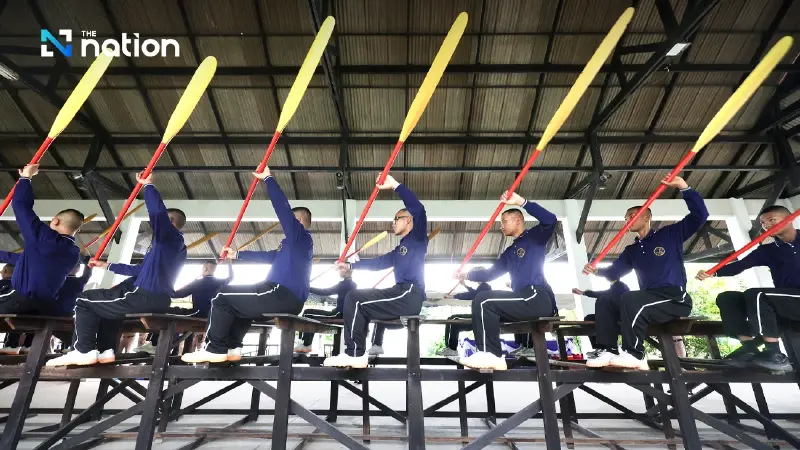


The Royal Thai Navy is checking readiness for the upcoming Royal Barge Procession to Wat Arun on November 6, featuring 52 vessels and more than 2,200 personnel.
The Royal Thai Navy is checking the readiness of its royal barge oarsmen as preparations continue for the Royal Barge Procession marking His Majesty the King’s journey to perform the annual royal Kathin robe-offering ceremony in 2026.
The procession will take place on November 6 this year, when His Majesty travels to Wat Arun Ratchawararam for the royal merit-making ceremony.
Oarsmen are currently undergoing land-based rowing drills, known as training on wooden rowing rigs, to familiarise themselves with the weight of the paddles, proper posture and synchronised movement before moving on to practice on water.
The next stages will include separate training sessions at different naval units, practice on actual barges, and formation drills on the river ahead of further rehearsals and full-dress rehearsals.

Navy leadership checks oarsmen’s training
VAdm Rattana Ruangroong, the Royal Thai Navy’s chief of staff for personnel and chairman of the Royal Barge Procession preparation committee, inspected the training of royal barge oarsmen at the Naval Transportation Department in Bangkok Noi district, Bangkok, on Tuesday (May 12).
He was welcomed by RAdm Pisit Rangsipanuratn, director-general of the Naval Transportation Department and chairman of the subcommittee responsible for oarsmen’s training.
Rattana encouraged all personnel taking part in the land-based rowing drills, describing the training as a key stage in preparing the royal barge procession. This year marked another important occasion for navy personnel to serve and express their loyalty to the monarchy, he said.
He added that all personnel assigned as royal barge oarsmen should take pride in being an important part of the procession and in having the opportunity to serve on this significant occasion.

“The synchronisation, graceful movement and accuracy in accordance with ancient royal tradition among the officers, helmsmen and oarsmen are central to ensuring that the procession is complete, dignified and worthy of royal honour. Such precision can only be achieved through intensive and serious training,” he said.
“I therefore ask all personnel to devote their physical and mental strength, and to train with full dedication, so that this important Royal Thai Navy mission proceeds smoothly and brings honour and prestige to the navy and the nation.”

Grand procession to feature 52 ceremonial vessels
The Royal Thai Navy will organise the event as a grand royal barge procession, using 52 ceremonial vessels arranged in five lines: the central line, two inner lines and two outer lines.
The procession will involve about 2,200 personnel and stretch 1,200 metres in length and 90 metres in width, covering the full breadth of the Chao Phraya River.
The royal route will run from Wasukree Pier to Wat Arun Ratchawararam, covering about 3.9 kilometres. The Royal Barge Suphannahong will serve as the principal royal barge, while the Royal Barge Anantanakkharat will carry the royal Kathin robes.
The royal barges and accompanying vessels will be arranged according to ancient royal tradition as follows:

Central line: 10 vessels
The central line will consist of 10 vessels:
- One principal royal barge: the Royal Barge Suphannahong, the royal barge for His Majesty the King.
- Two reserve royal barges: the Royal Barge Narai Song Suban HM King Rama IX and the Royal Barge Anekkachatphutchong.
- One robe-carrying royal barge: the Royal Barge Anantanakkharat.
- Two drum barges: the inner drum barge Tang Mo, used by the procession commander, and the outer drum barge E-Luang, used by the deputy procession commander.
- Three police barges: Police Barges 1-3, used by the royal guards.
- One Saeng barge: Saeng 7, used to provide royal protection.

Inner lines: 14 vessels
The two inner lines will comprise seven vessels each, making 14 vessels in total:
- Two front gate barges: Thong Khwan Fa and Thong Ba Bin, which lead the procession lines.
- Two battle barges: Sua Thayan Chon and Sua Khamron Sin, used as leading war vessels.
- Eight figurehead barges: Asura Vayuphak Barge, Asura Paksi Barge, Krabi Ran Ron Rap Barge, Krabi Prap Mueang Man Barge, Pali Rang Thawip Barge, Sukhrip Khrong Mueang Barge, Krut Hern Het Barge and Krut Tret Traichak Barge. These barges are carved with figureheads of real or mythical creatures, traditionally indicating the department or nobleman to which each vessel belonged.
- Two tow barges: Ekachai Hern How and Ekachai Lao Thong, used to tow royal barges when needed, such as when currents are strong or when the royal barge requires greater speed.

Outer lines: 28 vessels
The two outer lines will comprise 14 vessels each, making 28 vessels in total:
- Twenty-two Dang barges, numbered 1-22, used to protect the front of the procession.
- Six Saeng barges, numbered 1-6, used to provide royal protection.
