
Sharp words — Suchart apologises after graft-poll media clash
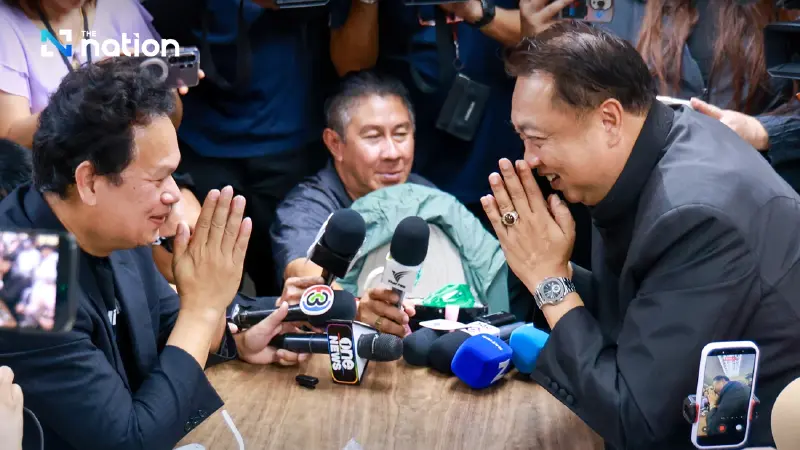


Suchart Chomklin seeks evidence from anti-corruption poll organisers after apologising for a tense exchange with a reporter
Natural Resources and Environment Minister Suchart Chomklin apologised to a reporter on Tuesday after a heated exchange at Government House over questions about a corruption survey that named the Pollution Control Department as the agency with the highest average bribe value per case.
The incident began after Suchart was asked about a survey by the Zero Corruption working group of the Joint Standing Committee on Commerce, Industry and Banking and “Friends Against Corruption”, which listed the Pollution Control Department as having the highest average bribe value per transaction, at 102,160 baht.
Suchart rejected suggestions that the ministry was resisting scrutiny, saying any allegation that damaged the reputation and morale of officials should be backed by evidence. He compared the ministry’s nine departments to “nine children” in a family, saying that as the head of the ministry he had a duty to protect them unless clear proof of wrongdoing was presented.
He said the Pollution Control Department was a technical agency and did not issue licences or have the authority to grant or deny benefits to operators. Its role, he said, was to conduct inspections when instructed, such as checking pollution in the Kok River, PM2.5 with the Bangkok Metropolitan Administration, or contaminated factories together with other agencies.
Suchart said he had already asked the department’s director-general to explain the issue and had assigned the ministry’s permanent secretary to coordinate with the business group behind the survey to request evidence and clarify the facts.

Asked repeatedly why the ministry had not first set up an internal investigation, Suchart said the process had already begun through the permanent secretary. He insisted he was not protecting wrongdoing and said any official found guilty would be punished.
The exchange grew tense as reporters pressed him on whether his stance appeared to reject the scrutiny process. Suchart responded that he had contacted the chairman of the Thai Chamber of Commerce from the first day the issue emerged and asked for supporting documents.
After the interview ended, Suchart appeared visibly upset and walked through the media scrum, reportedly brushing shoulders with the reporter who had pressed him with several questions. The reporter was heard saying, “Are you really walking into me like this?” Suchart then turned back and said, “You know me too little.”
About an hour and a half later, Suchart’s team contacted the reporter so he could apologise and clear the air. The minister then left the Cabinet meeting room before the meeting had ended and went to the Government House press room to meet the reporter.
Suchart greeted the reporter with a wai and said, “I’m sorry.” He shook hands with the reporter and sat down to talk, saying he accepted the advice and acknowledged that they had looked at the issue from different angles.

The reporter told him there was no problem and said he had expected the minister to come and talk after the interview, as usually happens after tense exchanges.
Suchart apologised again, saying he had spoken poorly and that he respected the reporter’s intention. He said that while sitting in the Cabinet meeting, he had reflected on the exchange and decided it would be better to come down and apologise in person.
He also apologised to all members of the media, saying he had always been willing to give interviews but admitted that the issue had left him feeling disappointed and unsettled.
“I accept that when we are working and then face something like this, we feel bad too. I don’t know how it happened,” Suchart said before raising his hands in another wai, shaking hands with the reporter again and returning to the Cabinet meeting.

