WHO honours Dr Worawit for humanitarian care on Thai-Myanmar border
THURSDAY, MAY 21, 2026
Play
WHO honours Dr Worawit Tontiwattanasap of Umphang Hospital for humanitarian healthcare along Thailand’s remote border
Thai border doctor honoured on world stage
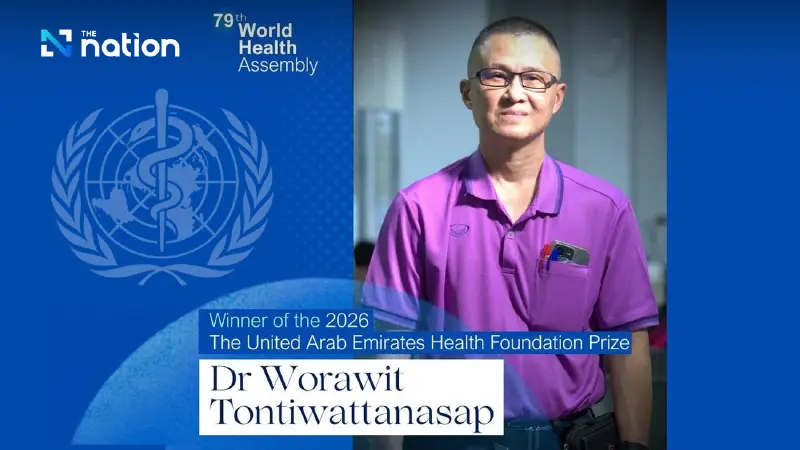
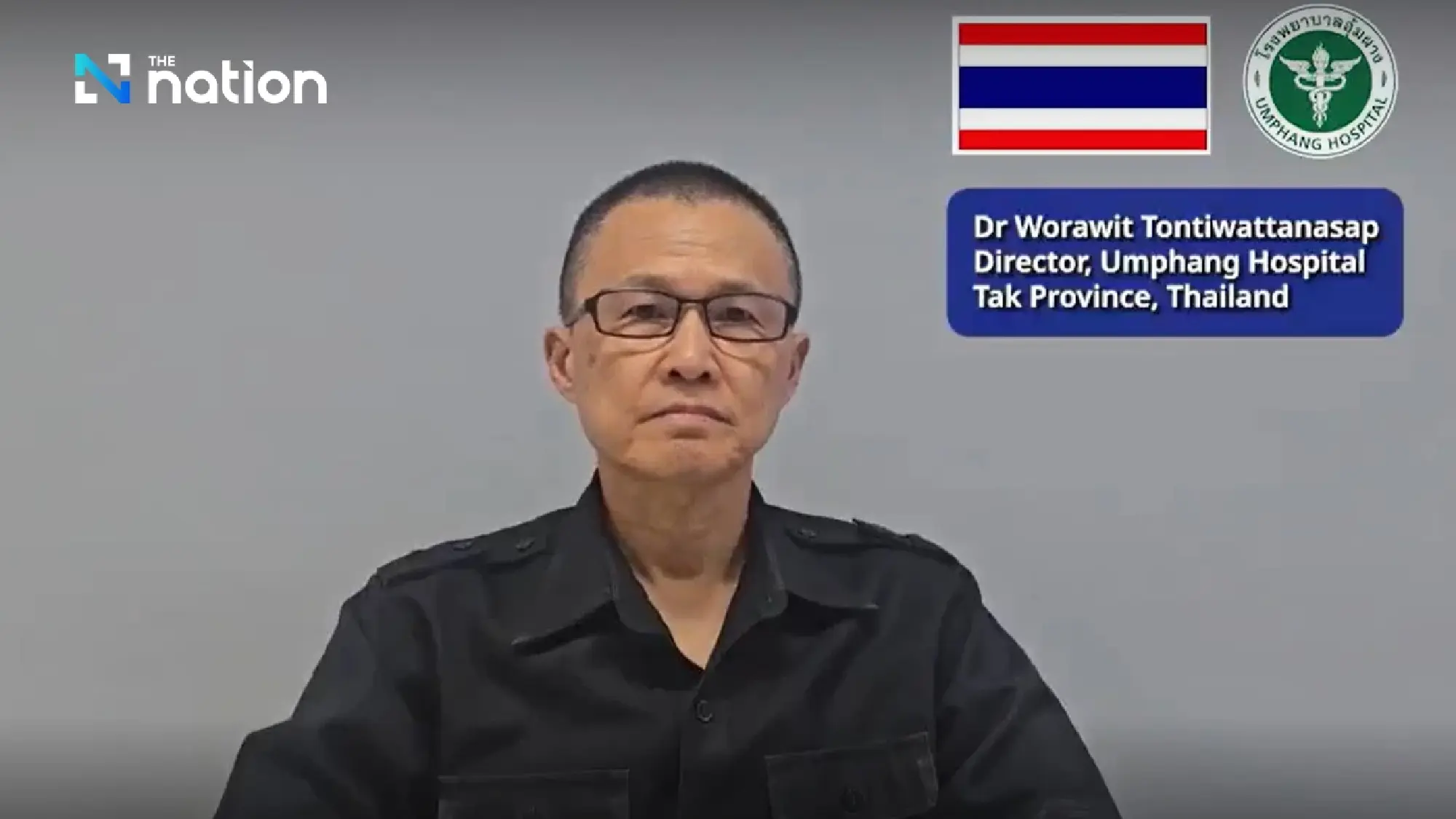
Dr Worawit Tontiwattanasap, director of Umphang Hospital in Tak province, has been honoured by the World Health Organization for his long-standing humanitarian work to expand healthcare access for people living in one of Thailand’s most remote border areas.
The Thai doctor received the 2026 United Arab Emirates Health Foundation Prize during the 79th World Health Assembly in Geneva, where public health awards are presented to individuals and institutions recognised for outstanding contributions to public health.
The WHO Executive Board had decided in February to award the prize to Dr Worawit for his outstanding contribution to health development. The award includes a certificate, a plaque and US$40,000.
Humanitarian care without borders
WHO said the prize recognised Dr Worawit’s humanitarian work to improve health services for rural, vulnerable and displaced populations. It described him as a doctor who has dedicated his career to strengthening access to primary healthcare for vulnerable groups, including stateless people, in Umphang district, northwest Thailand, along the Myanmar border.
His work has helped push forward important national resolutions on health subsidies and the registration of undocumented populations. It has also contributed to the expansion of mobile health services on both sides of the border, covering immunisation, disease prevention and control for malaria, tuberculosis and dengue, as well as antenatal and maternal care and dialysis treatment.
WHO also highlighted his role in training community health workers and auxiliary midwives from Thailand and Myanmar, with a focus on humanitarian care delivery. It said his contribution had helped advance more equitable primary healthcare in rural areas.
For Dr Worawit, the principle is simple: responsibility in healthcare should be guided “not by geographical boundaries, but by our ethical values and humanity”.
His recognition brings renewed attention to the challenge of providing healthcare in Umphang, a mountainous district where distance, poverty, nationality and legal status can all affect whether people receive timely treatment.
An earlier profile traced how Dr Worawit left his hometown in Chachoengsao and chose to stay in Umphang after being posted there as a young rural doctor. The same profile described the hospital at the time as a 60-bed facility located 247 kilometres from Tak, along a road with 1,219 bends, and serving many people living in isolated border communities.
To reach patients in mountainous areas, he had travelled by foot, by local motorised cart and, at times, even with the help of an elephant pulling a four-wheel-drive vehicle. The hospital was also providing care to large numbers of non-Thai patients without health insurance, many of whom were too poor to pay medical bills.
That long record helps explain why the latest WHO recognition is more than a personal honour. It is also a reminder of the difficulty of delivering public health services in border areas where communities often fall between formal systems.
Thailand’s border health role recognised
WHO Thailand congratulated Dr Worawit and praised Thailand’s continuing leadership and commitment to strengthening border health and equitable access to care.
The organisation said it remained committed to working closely with Thailand and partners to build inclusive, people-centred health systems and advance health equity, ensuring that no one is left behind.
The award comes as the 79th World Health Assembly places global attention on primary healthcare and health equity. WHO said this year’s laureates shared a commitment to expanding primary healthcare, reducing inequities and making tangible improvements in their communities through dedication and innovation.
For Thailand, Dr Worawit’s recognition turns a remote border hospital into a global example of public health service rooted in humanity. It shows that the strength of a health system is often tested not in the centre, but at the edges where the people most at risk are also the easiest to overlook.