
Thai rescuers liken Laos cave mission to Tham Luang challenge
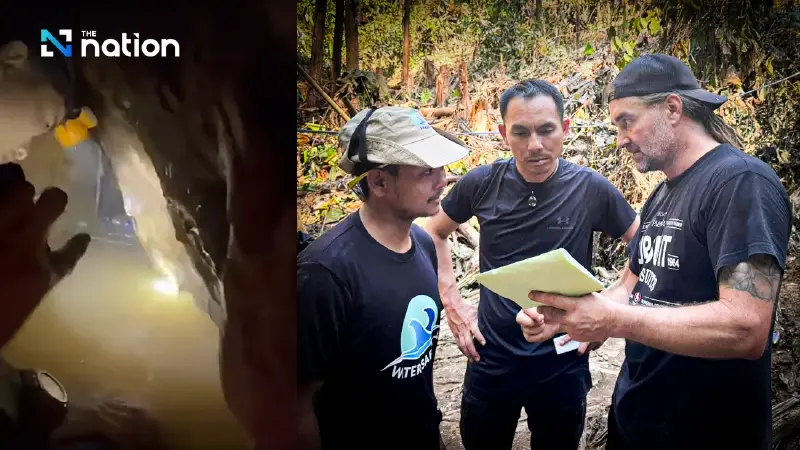


Thai rescue teams have joined efforts to save seven villagers trapped in a flooded cave in Laos, where narrow tunnels and rising water are hampering access.
An urgent mission to save seven villagers trapped inside a flooded cave in Laos has stretched into its second week, as rising water, narrow passages and remote mountain terrain turn the operation into a high-risk race against time.
The rescue effort is under way near Long Tieng valley in Long Chaeng district, Xaysomboun province, after heavy rain and flooding cut off access to a cave linked to gold mining activity. The seven villagers are believed to have been trapped since May 19.
Local and foreign rescue teams are working to find a safe route through waterlogged and tightly confined passageways, as bad weather and deteriorating conditions continue to hamper the mission.
A Thai rescuer involved in the operation has described the access challenge as even more difficult than the 2018 Tham Luang cave rescue.

Narrow passages and rising water complicate rescue
Kengkad Bongkawong, head of the Metta Tham Kalasin Command and Control Centre and leader of the Thai rescue team in Laos, described the entrance route as extremely difficult, with narrow passages beginning almost immediately from the mouth of the cave.
In an update on the mission, Kengkad said cave-scan images showed rescuers had reached only about halfway along the route, with a long distance still ahead. Teams must crawl, move on their knees and pass through water-filled constrictions before reaching an area near the highest mound inside the cave.
From there, rescuers face a narrow dive of more than 30 metres.
Inside the cave, teams must install both an air-line system and safety systems for medical and rescue personnel. Water seeping from upper layers and rock formations must also be pumped out continuously.

Kengkad said the absence of rain over the past two days had helped limit the build-up of water, but emergency plans remained essential in case water suddenly surged into the cave.
“We have placed diving equipment and pure oxygen tanks at every possible point along the route,” he said.
Although there is air inside the cave, he warned that much of it is unsafe. Rescuers have therefore installed an air-line system to pump in fresh air and improve safety for the forward team.
Outside the cave, teams are searching for shafts that may connect to the cave chambers. Using mapping technology to guide them, rescuers have already identified four shafts, allowing rope-rescue teams to begin further checks.
Another team of local terrain experts has been inspecting water sources along the mountain’s edge to identify inflow and outflow points, with the aim of lowering water levels inside the cave more quickly.

Tham Luang veterans join Laos mission
Kengkad said he was working alongside Finnish cave diver Mikko Paasi and Naraset Palasingh, all of whom were involved in the 2018 Tham Luang operation to rescue 12 members of the Wild Boars youth football team and their coach.
He said their shared experience had allowed the Laos cave operation to move more quickly, with no need for trial and error in setting priorities.
The mission, he added, had been placed under his full command after the provincial governor gave him approval to manage the planning and rescue operation. He acknowledged the pressure of leading such a difficult mission, saying success must also mean that every rescuer and member of the working team returns safely.
Kengkad said the Thai team was not working alone. Specialists in Thailand are supporting the operation remotely, including experts in diving medicine, geology, weather forecasting, emergency medical support, evacuation planning and mission data recording.

More than 100 people join high-risk operation
According to CNN, more than 100 people are involved in the dangerous rescue operation, including cave divers and 15 experienced specialists who previously took part in the Tham Luang rescue.
Kengkad told CNN that rescuers were using a map believed to be highly accurate and that the villagers were thought to be in the safest area inside the cave. Given the terrain and the conditions at the suspected location, he said their chances of survival would be high if they remained there.
Arnold Dix, a geologist and rescue specialist who helped save 41 Indian workers from a collapsed tunnel in 2023, warned in an interview with the Australian Broadcasting Corporation that the operation remained highly dangerous.
He said that after seven days, the trapped villagers were unlikely to have food or clean water, while the risk of illness would rise with every passing minute. Conditions were also extremely difficult for rescuers, who had to avoid becoming trapped themselves in the narrow tunnel system.
Dix said his “heart goes out” to the rescuers in Laos and that he hoped they would succeed without becoming casualties.

Rescuers crawl through 340-metre tunnel
The Metta Tham Kalasin Command and Control Centre said rescuers must move through a 340-metre tunnel to reach the trapped villagers. The centre said some sections are only 60 centimetres wide, meaning rescuers must crawl towards the group while cables are laid through gaps between rocks to guide them deeper into the cave.
The natural entrance slopes down at an angle of about 45 degrees, adding to the difficulty.
Kengkad said the cave is so narrow that rescuers must turn sideways, lower their bodies and crawl flat against the ground to pass through. Entry and exit must be carefully coordinated because there is no room for rescuers to pass one another.
Rescuers must wear helmets, breathing masks and gas detectors to monitor oxygen and toxic gas levels inside the confined cave system. Video from inside the cave shows personnel moving through dark, water-filled passages while teams continue pumping water out to improve access.
Above the cave, rope-rescue teams have also descended into four shafts found on the mountain to assess whether they could provide alternative routes to reach the trapped villagers.

Mountain terrain raises further risks
The rescue is taking place in a mountainous area near Long Tieng valley, known for its vast terrain and rich mineral deposits. The cave is a limestone structure located in the foothills of a mining project, where underground waterways and complex weather-related structures converge.
That geography has increased the danger during the rainy season, with further concern over possible thunderstorms in the afternoon and evening over the next few days, according to state-run Lao Phattana News.
While every cave rescue carries its own risks, the Laos mission is being led and supported by rescuers with extensive experience, including veterans of the Tham Luang operation.
In 2018, that mission mobilised expert divers from Australia, the United Kingdom and the United States to bring the Wild Boars team out one by one through the flooded cave network after they had been trapped for 18 days.
Comparing the two operations, Kengkad said: “Tham Luang was difficult to search; this cave is difficult to access.”
