
Queen Sirikit royal crematorium works on track for October completion
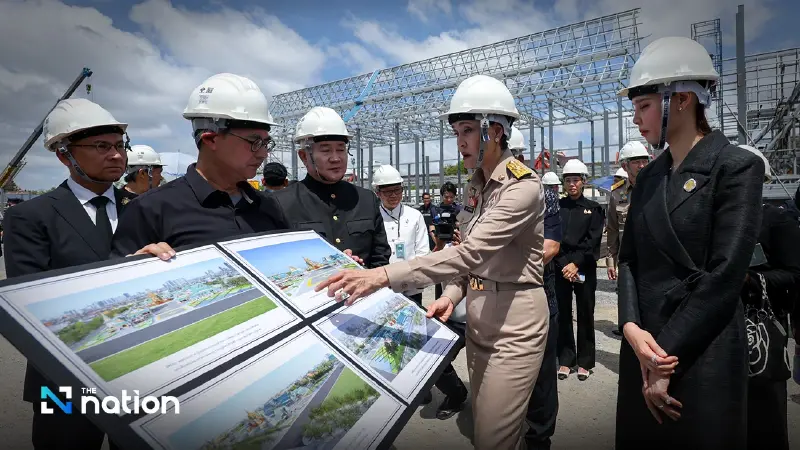


Work on the royal crematorium and royal chariots for Her Majesty Queen Sirikit The Queen Mother is progressing as planned, with completion expected in October.
- Overall construction of the royal crematorium and related structures is 23.65% complete and is on schedule to be finished by October 31, 2026.
- Progress on key components includes the main structure being 50% complete and the royal merit-making pavilion (Phra Thinang Song Tham) reaching 60% completion.
- The project also involves extensive decorative artwork, the crafting of the sandalwood royal urn and coffin, and the restoration of royal chariots, which is scheduled for completion by September 2026.
Deputy Prime Minister and Commerce Minister Suphajee Suthumpun inspected progress on the construction of the royal crematorium and related ceremonial works for the Royal Cremation Ceremony of Her Majesty Queen Sirikit The Queen Mother on Friday (June 5).
She was accompanied by Culture Minister Sabeeda Thaised and relevant officials, who briefed her on the latest progress.
The delegation later inspected the restoration and repair of royal chariots and royal palanquins at the Funeral Chariot Hall inside the National Museum Bangkok in Phra Nakhon.

Phanombut Chantarachot, director-general of the Fine Arts Department, reported that the work was progressing in line with the approved schedule.
Overall construction of the royal crematorium and its accompanying structures is now 23.65% complete. Foundation work has been finished, while the main structure is 50% complete, with workers currently laying the floor of the royal crematorium.
Full-scale design enlargement for all components, particularly architectural patterns and decorative art details, is 30% complete. Architectural work stands at 10%, while structural work on the Phra Thinang Song Tham, or royal merit-making pavilion, has reached 60%.
Work is also continuing on the Sala Luk Khun pavilions for high-ranking government officials, the Thap Kaset pavilions for officials, and the Thim buildings. Crumpled gold paper for decorating the base of the royal crematorium has already been ordered from China.
Phanombut noted that the overall work remained on schedule and was expected to be completed by October 31, 2026.

For the ceremonial pavilion in front of Phra Thinang Sutthaisawan Prasat, foundation work has been completed. The raised pavilions in front of Wat Phra Chetuphon Wimon Mangkhalaram, or Wat Pho, and at Sanam Luang are still undergoing foundation work.
Decorative artwork for the royal crematorium is also under way. This includes mural paintings inside the royal crematorium and the Phra Thinang Song Tham pavilion, as well as painted backdrops for the raised pavilion at Wat Phra Chetuphon. Sculptural works now in progress include Brahma faces, seated angels holding ceremonial fans, standing angels and hongsa, or celestial swan, pillars.

The production of the sandalwood royal urn and sandalwood royal coffin is at the pattern-enlargement stage. Designs for the sandalwood floral offerings, sandalwood logs, the sandalwood royal urn, the sandalwood royal coffin and 10 designs of sandalwood flowers have been completed. Twenty-five sandalwood logs have already been turned, while their decorative patterns have been finalised.
Work is also progressing on receptacles for the royal relics. These include one large royal relic urn measuring 80 centimetres and four smaller royal relic urns measuring 65 centimetres. They have been moulded in resin and are now undergoing detailed pattern enlargement.
Designs have also been completed for one reliquary and one stone vessel for the royal ashes. The accompanying ceremonial offerings, known as Khrueang Sangket, have also been designed. They include bookcases, work desks with chairs, four models of five-piece altar tables totalling 45 sets, 10 five-piece mother-of-pearl trays, and 19 ceremonial lamps with stands.

The restoration of royal chariots, palanquins and related ceremonial objects is also moving ahead. These include the Phra Maha Phichai Ratcharot, Vejayant Ratcharot, smaller royal chariots, Phra Yannamat Sam Lam Khan, Phra Thinang Rachendrayan, Phra Wo Siwikakan, two naga staircase devices, trays for supporting royal urns, and the gun carriage.
The items are undergoing scientific conservation and detailed traditional craftsmanship, including lacquer work, gilding and glass decoration. The restoration is scheduled to be completed by September 30, 2026, before rehearsals begin for the pulling of the royal chariots during the Royal Cremation Ceremony of Her Majesty Queen Sirikit The Queen Mother.

The Fine Arts Department, through the Office of Traditional Arts, has also been assigned to produce ceremonial fans for the royal merit-making rites connected to the royal cremation, ceremonial fans for the merit-making rites for the royal relics, fans for Chinese and Vietnamese monks, and ceremonial shoulder bags. The Queen Sirikit Institute is responsible for the embroidery work.
Phanombut added that Suphajee, in her capacity as chair of the royal crematorium construction committee, had appointed a subcommittee to oversee the construction of the royal crematorium and related structures, as well as the restoration of royal chariots and palanquins for the Royal Cremation Ceremony of Her Majesty Queen Sirikit The Queen Mother.
The subcommittee is also tasked with providing advice and recommendations on the exhibition for the royal cremation ceremony.

The Fine Arts Department is ready to proceed with all related work and consider further recommendations to ensure the ceremony is conducted with the highest honour.
