
Thailand's Children Are Falling Behind — And the Nation's Future Depends on What Happens Next
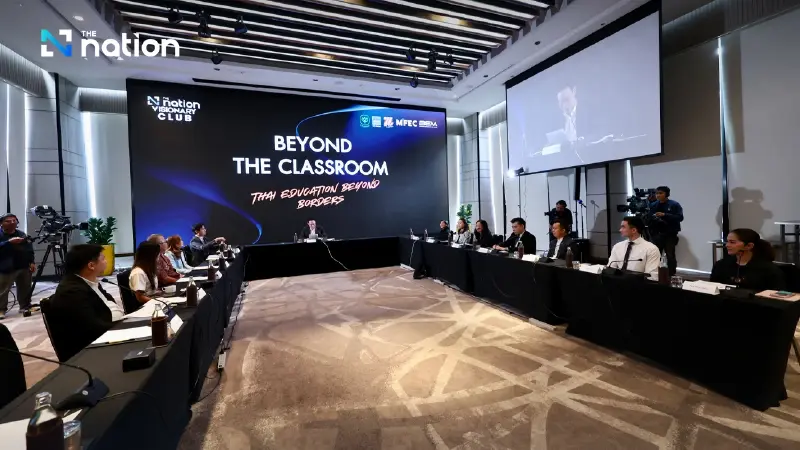


The Nation roundtable unites policymakers, academics, and students to chart a bold new course for Thai education before it is too late
- Thailand is facing a systemic education crisis, with one in three children unable to read properly by age ten, rising youth unemployment, and significant spending inequality between the wealthiest and poorest families.
- Key problems identified include an outdated, centralized curriculum that stifles individuality, chronic policy instability with 21 education ministers in 20 years, and funding models that disadvantage rural schools.
- Experts and students have called for urgent reforms, including decentralizing budgets, overhauling the curriculum to focus on well-being and practical skills, and creating a seamless lifelong learning system.
- There is a consensus that without meaningful reform within the next decade, Thailand risks economic stagnation and a generation of young people ill-equipped for the future.
The Nation roundtable unites policymakers, academics, and students to chart a bold new course for Thai education before it is too late.
One in three Thai children cannot read properly by the age of ten. Youth unemployment is rising. And the workforce needed to power Thailand's next decade of growth is simply not being trained.
Against this backdrop of mounting urgency, The Nation hosted a high-level roundtable on Monday, bringing together some of the country's foremost voices in education, policy, academia, and student leadership to confront what many are now calling a systemic crisis.
The event, titled Beyond the Classroom: Thai Education Beyond Borders, was held at Skyview Hotel in Bangkok with the singular objective of imagining a fairer, more modern, and genuinely inclusive education system — one capable of reaching every province and every child, regardless of postcode or income.

A System in Crisis
Aura-Orn Akrasanee, managing director of The Nation and host of the roundtable, opened proceedings by challenging participants to dare to build beyond the constraints of limited resources and entrenched inequality.
"If there is a genuine will," she told the gathering, "there will always be a way forward."
That will, the panel agreed, is urgently needed. Dr Kraiyos Patrawart, managing director of the Equitable Education Fund, laid bare the scale of the problem: Thailand's wealthiest ten per cent spend seven and a half times more on their children's education than the poorest ten per cent.

The result is what he described as a "two-dimensional inequality" – one that disadvantages not only students from poorer backgrounds but also the nation's economy as a whole.
He called for a decisive shift away from the mass production of degrees towards education genuinely aligned with the future of work.

Dr Jomhadhyasnidh Bhongsatiern, head of the National Education Policy and Planning Division at the Ministry of Education's Office of the Education Council, presented the ministry's strategic framework, centred on five pillars: Learner agency, Educator empowerment, Allocation of resources, Reach, and Network — collectively known as LEARN.
Central to this vision is the development of a flexible credit bank system that allows learners to accumulate qualifications across institutions and throughout their lives.

Political Will and Policy Continuity
Parit Wacharasindhu of the People's Party argued that the system suffers from a fundamental deficit of both efficiency and empathy.
He called for a wholesale redesign of budget allocation, moving away from per-pupil funding models that systematically disadvantage small rural schools, and demanded that the national curriculum be overhauled for the post-smartphone era.

Dr Karndee Leopairote of the Democrat Party focused on the human cost of perpetual policy instability—Thailand has had 21 education ministers in 20 years—warning that such discontinuity makes meaningful reform impossible.
She advocated for harnessing artificial intelligence as a levelling force, describing it as "a new electricity" with the potential to close the gap between urban centres and remote communities.

Wellbeing, Morality, and the Whole Child
Several speakers turned their attention from structures to souls. Hartanto Gunawan, director of the Community Learning Centre, warned that Thailand is losing something intangible but vital — its culture of warmth and resilience — through the neglect of what he termed "mental education".
He proposed that a dedicated well-being subject, ME101, be integrated into the national curriculum to equip students with the emotional tools needed to navigate an AI-driven world.

Nisanart Dharmageisirattana, director of the American School of Bangkok – Green Valley Campus, echoed this call, emphasising that mindfulness and mental discipline are zero-cost interventions that can meaningfully improve learning outcomes and help children process trauma.

Associate Professor Dr Suriyadeo Tripathi, director of the Centre for Morality Promotion, connected these themes to a broader social crisis, linking declining educational values with Thailand's falling birth rate and weakening civic fabric.
He made a compelling case for moving from outcome-based to value-based education — one that places empathy, not examination results, at its heart.

Universities, Industry, and Lifelong Learning
At the tertiary level, Professor Dr Parichart Sthapitanonda, vice president of Chulalongkorn University, proposed a radical restructuring: merging the Ministry of Education with the Ministry of Higher Education to create a seamless lifelong learning pathway, from early childhood through to career and beyond.

Associate Professor Dr Komsan Maleesee, president of King Mongkut's Institute of Technology Ladkrabang, argued that universities must prioritise hands-on, collaborative experience over traditional top-down teaching methods.

Dr Apitep Saekow, acting president of Stamford International University, challenged institutions to confront the return on investment of a degree head-on, insisting that curriculum design must be explicitly job-ready and embedded with real industry partnerships.

The Student Voice
Perhaps the most pointed contributions came from the students themselves. Krai Satarak of Chulalongkorn University and Parinyasiri Yohuang of Thammasat University closed the roundtable with two perspectives that, together, painted a complete picture of a system failing its young people — though from very different angles.

Krai approached the problem through the lens of structure and curriculum. He argued that centralised standardisation and top-down administration are actively "killing children's individuality" and that Thailand's fixation on metrics such as PISA scores amounts to setting KPIs in entirely the wrong place.
To illustrate his point, he described a child in Nan Province who had left school to work in greenhouse farming — skilled in practice, yet lacking even basic agricultural science knowledge because the curriculum had been preoccupied with abstractions such as advanced calculus and physics.
His conclusion was unequivocal: localising education is not a compromise but a necessity, and he would sooner see test scores fall than watch children lose their joy of learning.

Parinyasiri approached the same crisis from the angle of inequality and economic opportunity. Drawing on her own experience and those close to her, she described how children in rural and marginalised communities continue to be shut out of quality education not by lack of ambition but by cost – the government's promise of 15 years of free schooling having proved, in practice, far from sufficient.
The result, she said, is that far too many children are still falling out of the system entirely, a loss that is as much Thailand's as it is theirs.
Their shared message was clear: the system does not yet trust young Thais to determine their own futures.

A Decade to Act
The roundtable concluded with a collective sense of urgency. Without meaningful reform within the next ten years, Thailand risks both economic stagnation and a generation of young people ill-equipped for the world they will inherit.
The panel reached consensus on three imperatives: a new National Education Bill, decentralised budget authority, and a curriculum rebuilt around human intelligence, creativity, and compassion — rather than rote learning and standardised testing.

The event was moderated by Dr Theerathon Tharachai and supported by leading private sector sponsors including CP Group, Muang Thai Insurance, The Mall Group, MFEC, and Bangkok Expressway and Metro (BEM).
