
Fate of key economic policies hangs on new government’s stance



The removal of the prime minister has created uncertainty over several flagship economic policies. With a possible House dissolution in four months, some draft laws may not be passed in time.
The Constitutional Court’s ruling on August 29 that ended Prime Minister Paetongtarn Shinawatra’s tenure has effectively dissolved the entire cabinet, creating a political vacuum that could reshape Thailand’s economic agenda. Analysts warn that a shift in political power may disrupt or delay major policies and economic laws currently in the pipeline.
A review by Krungthep Turakij’s economic news team highlights several flagship policies and draft laws that now face uncertainty, either pending review by the next government or awaiting parliamentary approval.
20-baht electric train fare
One of the Pheu Thai Party’s signature pledges, a flat 20-baht fare across all electric train lines, was originally scheduled for launch on October 1, with public registration already opened on August 25. However, Deputy Prime Minister and Transport Minister Suriya Juangroongruangkit later admitted the rollout would be delayed to November 15.
The policy is backed by three key laws: the Rail Transport Department Act, the Joint Ticketing Management Act, and the Mass Rapid Transit Authority of Thailand Act (2000). These bills have passed scrutiny by the House of Representatives and are now before the Senate. Still, opposition from other parties has raised doubts over whether the scheme will survive if power shifts from Pheu Thai to Bhumjaithai.

Land Bridge project
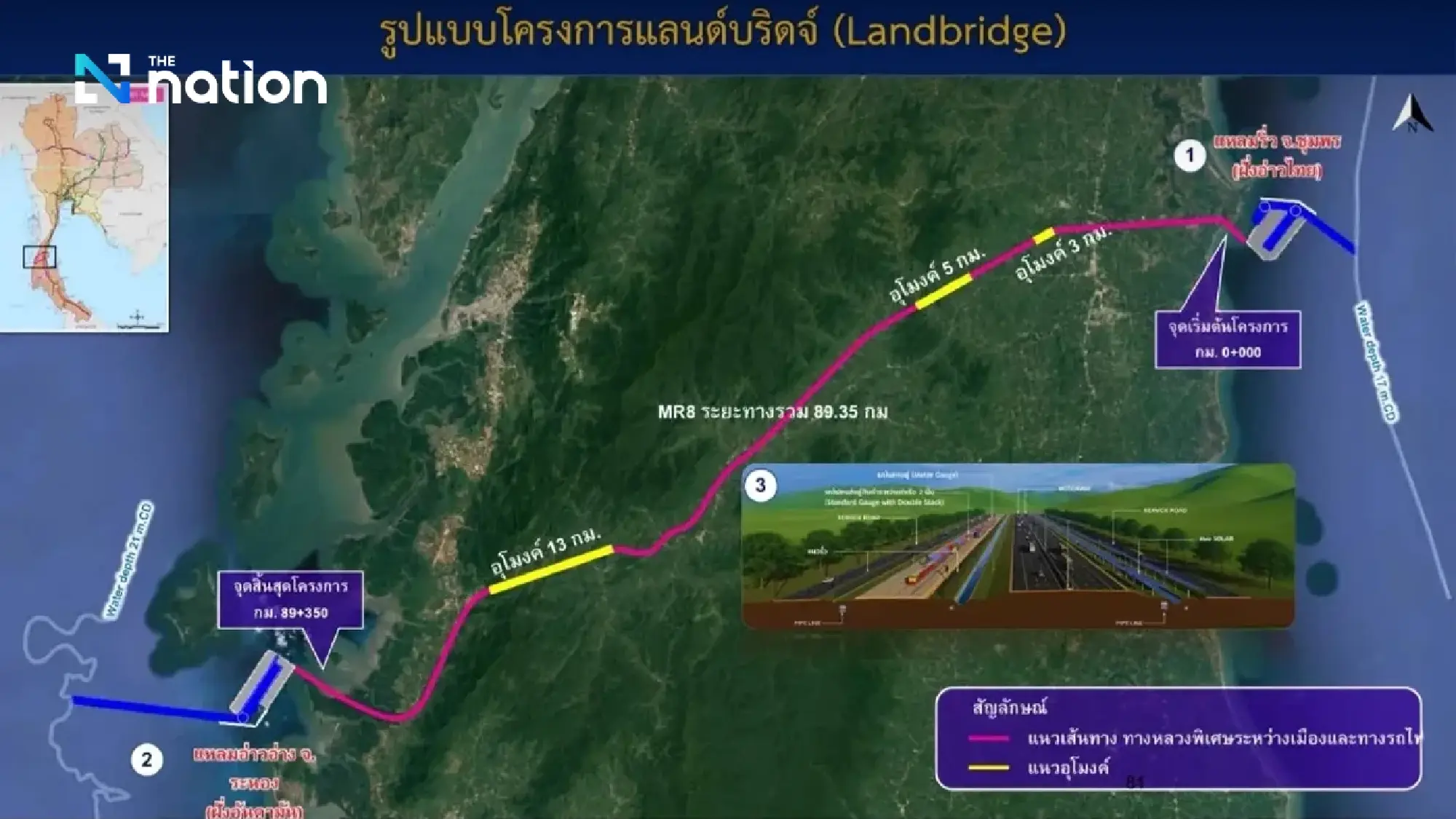
Another centrepiece policy is the Land Bridge project, a mega-infrastructure plan aimed at turning Thailand into a maritime transport hub with investment exceeding one trillion baht.
The Ministry of Transport has completed public hearings on the draft Southern Economic Corridor (SEC) Act, which is due to be tabled before the Cabinet and Parliament this year. The SEC Act is critical as it sets out the legal framework for development across 14 southern provinces and anchors the Land Bridge initiative, scheduled for bidding in 2026.
Unlike the 20-baht fare scheme, the Land Bridge project enjoys bipartisan support from both Pheu Thai and Bhumjaithai. Observers note that this cross-party backing gives the project a high chance of moving forward regardless of political shifts, though the timeline remains under close watch.

Retirement lottery
The proposed retirement lottery scheme is another Pheu Thai initiative designed to encourage long-term savings among the public. The project requires amendments to the National Savings Fund Act.
The bill has already cleared its first reading in the Senate, with a 21-member ad hoc committee set up for further review before moving to its second and third readings. The government’s timeline anticipated launching sales in the fourth quarter of this year.
Given the strong support in both the House and Senate, the scheme is expected to proceed regardless of a change in government leadership.
Financial Hub Act
The draft Financial Hub Act represents a cornerstone policy of the Pheu Thai-led Finance Ministry, aimed at positioning Thailand as a regional centre for financial services. The bill calls for the creation of the One Stop Authority (OSA), a dedicated regulatory body to streamline licensing, supervision, and promotion of financial businesses serving foreign clients.
The OSA would cover eight categories, including commercial banking, securities, digital assets, insurance, and related services.
The Cabinet approved the draft on July 15, following review by the Council of State. It has since been submitted to the House of Representatives for legislative approval before it can take effect.
National Credit Guarantee Agency Act
The draft National Credit Guarantee Agency (NaCGA) Act would create a new institution to expand access to finance for citizens and SMEs. Instead of relying on collateral or credit bureau assessments, the NaCGA would directly evaluate and guarantee borrowers’ creditworthiness.
The Cabinet approved the draft on August 19. It is now under review by the Council of State before submission to Parliament. The Finance Ministry has classified it as a priority bill, but its progress will depend on the political timetable.
Other pending economic legislation
Several additional draft laws approved by the Cabinet have yet to reach Parliament, including the Solar Energy Promotion Act proposed by the Energy Ministry and tax incentive bills to encourage art purchases and support local creators.
Equally important are legislative measures tied to ongoing trade negotiations with the United States. These include tariff exemptions on thousands of import categories that require Cabinet and parliamentary approval, making them a critical task for the next government.
However, the political conditions set by the People’s Party, including House dissolution within four months of a new prime minister’s policy statement, could severely constrain Parliament’s legislative window. If dissolution occurs before pending bills are passed, they will automatically lapse.
