
Anutin to convene April 11 special Cabinet over soaring oil prices
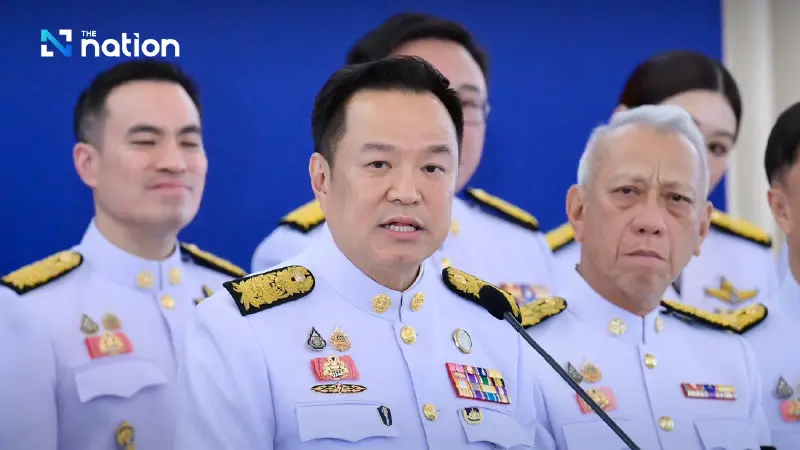


The Anutin II government is set to take full control after its policy statement, with a special Cabinet meeting on April 11 to consider a major oil crisis package.
- Prime Minister Anutin Charnvirakul has called a special Cabinet meeting for April 11, 2026, to address the crisis of soaring oil prices.
- The Finance Ministry will propose an emergency borrowing decree of THB150 billion to compensate the Oil Fuel Fund and THB100 billion in low-interest loans for businesses.
- The Transport Ministry will propose fuel subsidies for the transport sector, including freight lorries, public buses, vans, and rider vehicles.
- Other proposals include a THB50 billion budget transfer bill from the Budget Bureau and measures to reduce public transport fares through a common ticketing system.
The Anutin II government is preparing to take full control of state administration after completing its policy statement to Parliament ahead of the Songkran festival on April 9-10, 2026.
Prime Minister Anutin Charnvirakul has called a special Cabinet meeting on April 11, 2026, to consider a major package of measures to deal with the oil crisis.
Among the measures to be proposed to the Cabinet on April 11, the Finance Ministry will propose issuing an emergency borrowing decree worth THB150 billion to compensate the Oil Fuel Fund, along with low-interest loan support worth THB100 billion to help business operators.
Meanwhile, the Budget Bureau will propose a revised fiscal 2027 expenditure calendar and the fiscal 2026 budget transfer bill, which is expected to involve around THB50 billion.
The Transport Ministry will propose measures to assist the transport sector affected by the war in the Middle East, covering two main groups.
The first is non-scheduled freight lorries (yellow plate code 70), or goods transport lorries, numbering 287,175 vehicles.
The government will support fuel costs at THB6 per litre.
The second group covers public transport vehicles and riders.
Assistance will be divided into Category 2 and 3 public buses, numbering 11,395 vehicles, for which the government will support costs at THB4 per litre; Category 4 public buses, such as vans, numbering 19,414 vehicles, for which the government will provide THB300 per vehicle per day; and rider vehicles, numbering 114,653, for which the government will provide THB300 per vehicle per month.
Transport pushes a common ticket to cut travel costs
Deputy Prime Minister and Transport Minister Phiphat Ratchakitprakarn said the Transport Ministry is preparing a package to reduce public transport fares across electric rail, buses and passenger boats to ease people’s travel costs.
At present, the Mass Rapid Transit Authority of Thailand and the Department of Rail Transport are considering either a THB40 all-day fare or a zoning system.
They are currently assessing which model would offer the best value and greatest savings for users, with a view to extending the measure to other rail lines.
At present, the THB40 fare measure has already been piloted on the Purple Line and Red Line, and ridership has increased satisfactorily.
However, the key flagship policy to make the measure sustainable is the push for the draft Rail Transport Act 2025 and the Common Ticketing System Management Act 2025, both of which have already been approved by the Senate and are now awaiting subordinate legislation.
The Transport Ministry is preparing to submit them to the Cabinet for immediate promulgation.
These laws will help reduce costs across the entire mass transport system on land, water and rail.
Agriculture to submit six urgent items to the government
A source at the Ministry of Agriculture and Cooperatives told Thansettakij that the ministry is preparing to submit six urgent agenda items to the Agriculture and Cooperatives Minister: 1. measures to cope with the impact of the US-Iran war; 2. the 2026 project to prevent and address burning in agricultural areas, with a budget of THB1.869 billion; 3. a project to address the stockpile of boxed milk under the school supplementary milk programme, with a budget of THB800 million; 4. a school supplementary milk programme to ensure daily provision, with a budget of more than THB2.7 billion, to continuously support student nutrition; 5. a community agricultural development project through agriculture and cooperatives volunteers, with a budget of THB845 million; and 6. other key projects to upgrade production and strengthen food security in communities.
Agriculture and Cooperatives Minister Suriya Jungrungreangkit said the current urgent policy is to address fertiliser shortages and high prices.
As for budget cuts in line with the policy to reallocate funds for urgent government measures, he said the details would first have to be examined.
Push to fast-track key laws in Parliament
Deputy Prime Minister Pakorn Nilprapunt said, upon taking up his post in the current government, that he is determined to push important legislation, particularly the Act on Facilitating the Consideration of Permits and Public Services.
This also includes revising key laws related to modernising the civil service and pushing Thailand to join the OECD.
He said that pushing the Facilitation Act draft would form the core system of the Super License, to be completed and enforced within 180 days.
Although the bill has already passed Parliament, the new government must reaffirm it and return it to Parliament once again before it can be submitted for royal assent and enacted into law.
Budget transfer bill to be accelerated amid crisis
The government’s policy statement says that while the administration was serving in a caretaker capacity, it had sought to manage the energy situation to ease the impact on the public, including ensuring sufficient fuel supplies, managing production inputs such as chemical fertiliser and petrochemical feedstocks linked to energy prices, and increasing the share of biofuels to reduce oil imports while generating income for farmers at the same time.
Once the government assumes full powers, it will expedite the fiscal 2026 budget transfer bill as quickly as possible, while also accelerating budget disbursement and implementing relief measures for vulnerable groups affected by surging energy prices.
Tackling household debt, helping SMEs
On economic policy, the government is prioritising a comprehensive solution to household debt, with a debtor-centred approach covering all types of financial institutions, asset management companies and cooperatives, in order to help people regain access to the credit system.
This will go hand in hand with the development of an individual data system for Thai citizens from birth to death, so that the state can design and deliver welfare on a centralised, targeted and efficient basis.
The government will also support SMEs in gaining access to formal funding at an appropriate cost, while revising laws and licensing procedures for trade and investment to make them more convenient and transparent.
It will also give an advantage to producers of Thai-made goods in government procurement, while developing a free online accounting system, a free tax burden assessment system and an e-invoice system to reduce business costs, alongside pushing a hometown tax law to generate income for local areas.
Building new economic engines
For long-term economic restructuring, the government has announced plans to create new economic engines in digital industries and AI, robotics, semiconductors, high-value processed food, clean energy, biotechnology, modern vehicles, as well as the medical and health industries.
It will focus on attracting foreign investors to establish joint ventures with Thai partners in order to upgrade the capabilities of Thai entrepreneurs and support businesses that mainly use domestic raw materials and labour.
It will also push the development of Deep Tech, starting with industries where Thailand has an advantage, such as agriculture, food, medicines and medical products from natural sources, and bio-industries.
At the same time, it will build an ecosystem that supports innovation at every level, from developing capital markets for innovative businesses and establishing a Matching Fund to incubating high-potential start-ups so they can grow and compete globally.
On infrastructure, the government will expand the role of the private sector through infrastructure funds and the Vayupak Fund so that infrastructure development can continue without burdening the budget, covering water management systems, logistics cost reduction and support for the energy transition.
At the same time, it will accelerate the modernisation of the money and capital markets.
Boosting trade, agriculture and tourism
On international trade, under the policy of “Connecting Thailand to the global economy, building trade partnerships”, the government will tackle nominee businesses established in Thailand.
It will also diversify export markets to reduce reliance on any single market, open new high-potential markets, and develop value chains with partner countries, while accelerating efforts to secure Thailand’s OECD membership by 2028.
In agriculture, the government will use AI and biotechnology to increase productivity and reduce costs, while leveraging Big Data to plan production from upstream to downstream.
It will push Thailand to become a global food security hub, while also driving a half-interest subsidy scheme for farmers joining the fertiliser mother formula and seed-use skills development programme of the Bank for Agriculture and Agricultural Cooperatives.
For tourism, the government aims to develop Thailand into Destination Thailand 365 Days by shifting its focus from visitor numbers to higher value, including attracting high-income Digital Nomads who want long stays.
Public sector reform, economic laws
In public administration, the government has announced that it will shift to an integrated cluster-based system, divided into five groups: macroeconomy and industries of the future; production, trade and services; infrastructure, natural resources and the environment; society and welfare; and foreign affairs and security.
The aim is to ensure that all agencies work towards the same goals and indicators.
On legislation, the government will accelerate the Super License law so that it takes effect within 180 days, to make daily life and business operations easier while reducing costs and burdens for the public and entrepreneurs.
It will also propose an Omnibus Law package to address economic problems caused by outdated legislation and bring it into force within one year.
At the same time, it will review more than 7,000 subordinate laws that burden the public, repeal laws that are no longer necessary, and amend public procurement legislation so that it no longer focuses solely on the lowest price but also takes overall value and cost-effectiveness into account.
