
Ekniti says era of cheap oil is over, rules out fuel excise cut
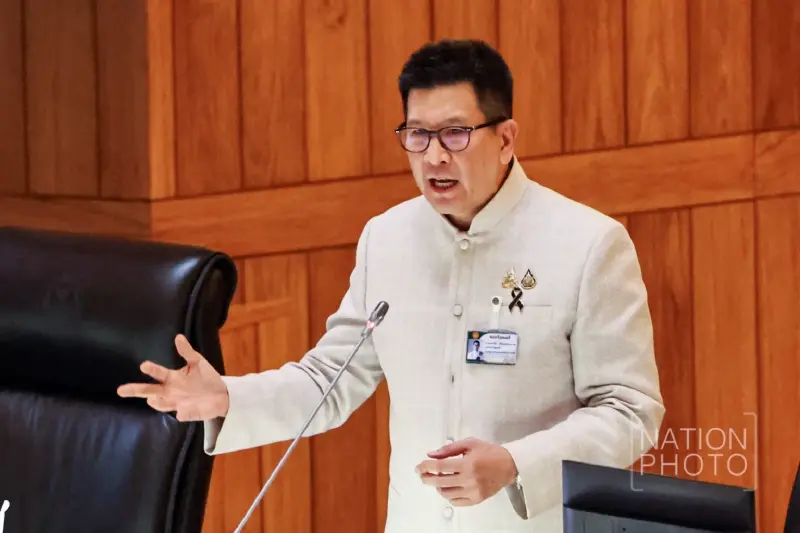


Thailand will rely on the Oil Fuel Fund rather than a fuel excise tax cut, while Ekniti warns the Middle East crisis could keep oil prices elevated for 1-2 years
Deputy Prime Minister and Finance Minister Ekniti Nitithanprapas has made clear that the government will not cut fuel excise tax in response to the latest energy shock, saying Thailand must preserve the tax base for essential public spending and instead use the Oil Fuel Fund as its first line of defence.
Speaking during Parliament’s joint sitting on April 9, 2026, as the Cabinet delivered its policy statement under Section 162 of the Constitution, Ekniti said the government had already assessed the growing economic risks stemming from the Middle East war. The conflict, he said, has triggered a global energy crisis, driven sharp oil price volatility and raised the possibility of shortages in some goods due to transport disruption around the Strait of Hormuz.
He warned that the crisis may not be short-lived and could intensify into a stagflationary environment, with high inflation coinciding with a broader global economic slowdown. The government, he said, must act early to prevent the fallout from escalating into a crisis severe enough to echo the economic trauma of 1997.
But Ekniti stressed that not every measure being proposed is the right one for Thailand. Addressing calls for an excise tax cut to lower fuel prices, he said such a move would offer little practical difference from using the Oil Fuel Fund, while carrying heavier consequences for the state’s finances.
Thailand, he noted, already has an Oil Fuel Fund mechanism that many other countries do not. That fund should therefore be used first to cushion price pressures. By contrast, fuel excise tax revenue remains an important source of funding for other national priorities, including hospitals, patients, doctors, nurses and rising healthcare costs.
For that reason, he said, the government cannot afford to use up fiscal resources in a way that weakens its ability to support the public elsewhere. Every available tool must be deployed carefully, with limited resources directed where they are most needed and where they can deliver the greatest value.
Ekniti said the government would therefore focus on targeted relief rather than broad-based tax cuts. A special Cabinet meeting is scheduled for April 11 to consider support measures for transport operators, who are among the first groups to be hit by higher fuel costs and whose expenses feed directly into consumer prices.
Further assistance is also being prepared for vulnerable groups through the state welfare card system, as well as for fishermen affected by higher fuel costs for offshore operations and farmers facing expensive fertiliser. He said the aim is to contain the crisis before it spreads further, while preserving enough fiscal room to support other groups if conditions worsen.
If too much of the available budget is concentrated on one area alone, he warned, the country could face a second wave of economic strain, including worsening business conditions and job losses. The government’s immediate task, he said, is to prevent that escalation while helping people who are already under pressure.
Ekniti also argued that the current crisis must be viewed as more than a temporary oil price spike. In his view, the world is entering a new phase in which cheap oil will not return for at least another one to two years, because the war has caused heavy damage to energy infrastructure in the Middle East and recovery will take time.
That means Thailand must adapt for the longer term. He said the country should accelerate the transition towards cleaner and alternative energy, including rooftop solar, ethanol from sugarcane and cassava, and biodiesel from palm oil. These options would not only help households and businesses cope with expensive energy, but also support farm incomes.
Beyond energy, he said the government wants to use the crisis as a turning point to strengthen Thailand’s long-term competitiveness. That includes investing more heavily in human capital, widening access to AI tools and drawing in more foreign investment by removing regulatory obstacles and linking technology transfer to industrial development.
Even so, his clearest message on the day was that the government would not opt for a blunt tax reduction on fuel. Instead, it will try to balance short-term cost-of-living support with the need to protect the state’s wider fiscal capacity as Thailand braces for what could be a prolonged period of expensive energy and greater economic uncertainty.
