
Finance, Tourism to discuss THB1,000 levy on Thais travelling abroad
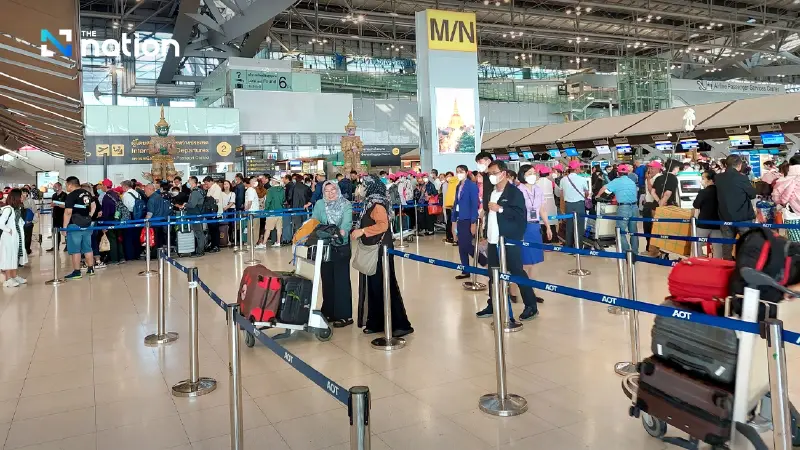


The proposal to charge Thai travellers THB1,000 per overseas trip is being weighed against legal issues, economic conditions and wider public impact.
- Thailand's Finance and Tourism ministries are discussing a proposal to charge Thai citizens a THB1,000 levy for travelling abroad.
- The measure is expected to generate around THB10 billion annually, which would be used to fund a domestic tourism stimulus program.
- A legal basis for the levy already exists under a 1983 emergency decree, but its suitability and economic impact in the current context are being carefully considered.
- Concerns have been raised about the levy's potential impact on budget travelers and tourism-related businesses, as well as the fairness of a tax that only targets Thai nationals.
Vinit Visessuvanapoom, director-general of the Fiscal Policy Office (FPO) and Finance Ministry spokesman, said the matter would require further discussion, especially on legal issues and whether it could be implemented.
Although the 1983 Emergency Decree on Departure Levy already provides a legal basis, details of enforcement in the current context still need careful consideration.
Previously, Surasak Phancharoenworakul, Minister of Tourism and Sports, said the ministry had discussed with the Finance Ministry the possibility of bringing the law back into use to collect a fee from Thais travelling abroad.
He cited information that an average of about 10 million Thais travel overseas each year, which, if charged at THB1,000 per person, would generate around THB10 billion a year for the state.

Revenue earmarked for 10 million ‘Half-half travel’ entitlements
The main purpose of the measure is to use the revenue to support the ‘Half-half travel’ programme, with 10 million entitlements, to stimulate domestic tourism spending and reduce the outflow of money to overseas tourism.
The policy is designed as a way of ‘bringing money back into the system’ from Thais with the ability to travel abroad to support the domestic economy.
The measure would apply only to Thais, not foreigners, to avoid duplication with an entry fee, or ‘arrival fee’, which has been proposed for foreign tourists at THB300.
The aim is to channel the money into a tourism development fund and set up an insurance system.

Existing legal basis, but the impact must be weighed
Legally, the Tourism Ministry said the measure could be implemented immediately if approved by the cabinet, because it is already supported by the 1983 Emergency Decree on Departure Levy.
Thailand previously collected this type of tax at THB500 before it was later discontinued.
However, a Finance Ministry source said that, while there is a law to support it, bringing it back into use requires consideration of whether it fits the current economic context and changed travel behaviour, as well as an assessment of the impact on the wider public.
Suitability of ‘tax and consumer behaviour’ debated
From a policy perspective, the Tourism Ministry's view is that the THB1,000 rate is unlikely to be significant in Thai travellers’ decisions when compared with overall travel costs, which have risen, especially airfares and overseas expenses, in the recent period.
However, analysts say the measure could affect the ‘marginal decisions’ of some groups of travellers, such as those making short trips or those with limited budgets.
It could also affect businesses linked to overseas tourism, such as airlines and tour companies.
On the other hand, it could help increase incentives for more domestic tourism.
In addition, there is an issue of fairness in tax collection, as the measure would apply only to Thais.
This may require consideration of its suitability under tax principles, as well as public acceptance.
