
Thailand’s Durian Drama: Can the State Save the King of Fruit?
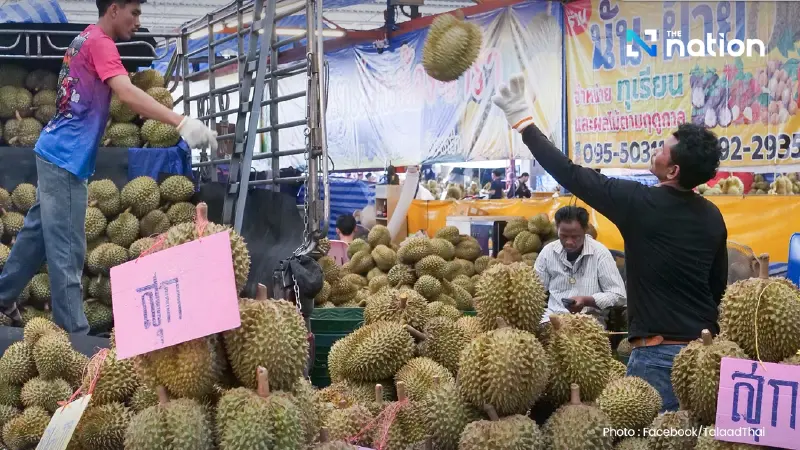


A viral durian livestream has exposed the deeper fault lines in Thailand’s agricultural policy—and raised urgent questions about whether the government can protect its farmers from a perfect storm of oversupply and regional competition
- A government minister's promotional livestream selling durians for a low price of 100 baht sparked fears among farmers that it would devalue their crops and set an unsustainable market standard.
- Thailand is facing a massive durian oversupply, with a projected 33% increase in volume, compounded by a climate crisis that has increased the amount of lower-grade fruit.
- The country's dominance in its key export market, China, is severely threatened by Vietnam, which has rapidly captured over 40% of the market due to logistical advantages and year-round production.
- Critics argue the government is using short-term "stunts" instead of a long-term national strategy, unlike the successful precision farming in the Netherlands or premium branding in New Zealand.
- The government's proposed solution involves diversifying logistics into Western China, investing in value-added processing like frozen durian, and training farmers in direct-to-consumer e-commerce.
A viral durian livestream has exposed the deeper fault lines in Thailand’s agricultural policy—and raised urgent questions about whether the government can protect its farmers from a perfect storm of oversupply and regional competition.
Known for its pungent aroma and rich, custard-like texture, the durian has recently become a focal point of Thai national discourse. However, the current debate centres not on its flavour, but on its role as a litmus test for the government’s ability to engineer sustainable solutions for the nation’s agricultural sector.
While Thai fruits are globally renowned for their superior quality, the reality for the people growing them is far less sweet.
For decades, farmers have been trapped in a predatory cycle of high production costs and plummeting seasonal prices.
This long-standing "durian drama" recently reached a fever pitch after Deputy Prime Minister and Commerce Minister Suphajee Suthumpun appeared in a livestream with Pimrypie—Thailand’s most influential online merchant—who made headlines by announcing a promotional price of just 100 baht ($2.80) per durian.
The 100-Baht Flashpoint
What should have been a feel-good story—a cabinet minister teaming up with a digital titan to move surplus stock—rapidly descended into a public relations headache.
The moment the 100-baht price was uttered to Pimrypie’s millions of followers, shockwaves hit the orchards of Chanthaburi and Chumphon.
Farmers expressed immediate concern that this low promotional price would be misinterpreted by wholesalers as a new market standard, putting immense downward pressure on farmgate prices.

The Ministry of Commerce’s defence was swift but defensive. Deputy spokesman Koranit Nonjui clarified that the promotion applied strictly to "secondary-grade" durians—fruit that is ripe and flavourful but visually imperfect.
Suphajee herself insisted the price was a "sales-promotion technique" rather than a reflection of intrinsic value.
But for many growers, the clarification felt like an afterthought. Panusak Saipanich, president of the Thai Durian Association, noted that with actual production costs hovering between 70–80 baht per kilogramme, a 100-baht retail price leaves almost no margin for the farmer once logistics and middleman fees are deducted.
In a season already burdened by high volume, any low-price signal from the government risks becoming a ceiling rather than a floor.

A Supply Crisis Years in the Making
The livestream controversy is merely the most visible symptom of a structural glut that has been building for years. Lured by high prices during the late 2010s, Thai farmers aggressively expanded their plantations.
Thailand’s total durian-bearing area is expected to reach nearly 1.4 million rai in 2026, a 10% increase from the previous year.
The result is a projected output of two million tonnes this year—a massive 33% rise in volume.
Compounding this "mountain of fruit" is a climate crisis; unseasonably hot, dry weather has stunted fruit growth. This has pushed a higher percentage of the harvest into the "lower grade" categories—the very fruit that struggle to find export buyers and are now being offloaded via viral livestreams.

The Vietnam Shadow
Perhaps the most sobering aspect of this analysis is Thailand’s deteriorating competitive position in China—its most vital export market.
In 2025, Vietnam’s durian exports to China surged to $3.44 billion, while Thailand’s growth remained stagnant at just under $4 billion. From a standing start in 2020, Vietnam has seized over 40% of the Chinese market in just three years.
The reasons for this shift are structural. Vietnam shares a land border with China, offering a significant logistics advantage in an era of high fuel costs and supply chain volatility.
Furthermore, Vietnam’s climate allows for year-round production, providing Chinese buyers with a consistency that Thailand’s seasonal harvest cannot match. For the first time in decades, Thailand's status as the "unassailable" leader of the durian trade is in genuine jeopardy.

The Strategic Vacuum: Lessons from Abroad
Opposition politicians have seized on the "Pimrypie incident" as evidence of a tactical government relying on "stunts" rather than strategy.
Karndee Leopairote, a Democrat Party MP, argued that while Suphajee’s entrepreneurial energy is commendable, it is no substitute for a national agricultural roadmap.
Karndee pointed to two international benchmarks that highlight Thailand's missed opportunities:
The Netherlands: Despite possessing only a fraction of Thailand’s land, the Netherlands is the world’s second-largest agricultural exporter. This is achieved through "precision farming"—using AI, drone-based soil monitoring, and climate-controlled logistics to ensure that every hectare produces maximum value with minimum waste.
New Zealand: The transformation of the "Chinese gooseberry" into the premium "Zespri Kiwi" is a masterclass in branding. New Zealand doesn't sell fruit by the tonne; it sells a branded health product by the unit.
Thailand, by contrast, remains largely a "commodity" exporter, vulnerable to the whims of middlemen and the fluctuations of Chinese border regulations.

Suphajee’s Counter-Offensive
To her credit, Minister Suphajee has outlined a plan that is more sophisticated than the 100-baht headline suggests. Her ministry is currently executing a "multi-front" strategy:
Logistical Diversification: Moving beyond congested eastern border crossings to target second-tier cities in Western China via new rail and sea routes.
Value-Added Processing: Investing in a nationwide network of cold storage and high-tech processing facilities to bolster the frozen fruit sector; this seeks to decouple the market price of Thailand’s seasonal harvest—from durian to mangosteen and pineapple—from the constraints of immediate shelf life.
Direct-to-Consumer Training: A national programme to train farmers in content creation and live commerce, aiming to break the dependency on traditional "Lhong" (middlemen) networks.
However, the shadow of 2025 still looms large. Last year, Chinese authorities detected 'Basic Yellow 2'—a carcinogenic industrial dye—in some Thai shipments, causing prices to crater.
The government is now racing to implement "Clean Energy" and "Zero Contaminant" certifications to restore the "Premium Thai" brand.

Facilitator or Fixer? The Role of the State
The deeper debate here is about the proper role of the state. For decades, Thai governments have oscillated between two impulses: the populist urge to intervene directly in prices and the neoliberal recognition that such subsidies create a "dependency trap."
The Netherlands and New Zealand succeeded because their governments acted as architects, not managers. They built the high-tech infrastructure, set the rigorous standards, and funded the global branding—then they stepped back and let the farmers compete.
Thailand’s government, by contrast, is often forced to act as a "crisis manager," rushing to TikTok livestreams only when the fruit is already rotting on the trees.
The Verdict: A Test of Bandwidth
As of late April, export-grade durians are holding at 135–150 baht per kilogramme. The market has not collapsed, but the "May–June peak" is the true test.
The 100-baht durian was always going to be a lightning rod. In a nation where agriculture employs millions, a promotional livestream is never "just" a marketing exercise; it is a political statement about what the government thinks its farmers are worth.
Minister Suphajee has presented a sophisticated plan involving market diversification and digital skilling. Whether the Thai bureaucracy has the institutional bandwidth to execute this—across multiple ministries and in the face of a surging Vietnam—remains the central question.
Thailand’s farmers have waited a long time for the state to become a genuine strategic partner. As the harvest peaks and the competition closes in, the orchards of Chanthaburi are watching. They are no longer interested in viral moments; they are waiting for a future where their harvest has value, with or without a livestream.
