
Thai transport minister rejects three-airport rail contract changes
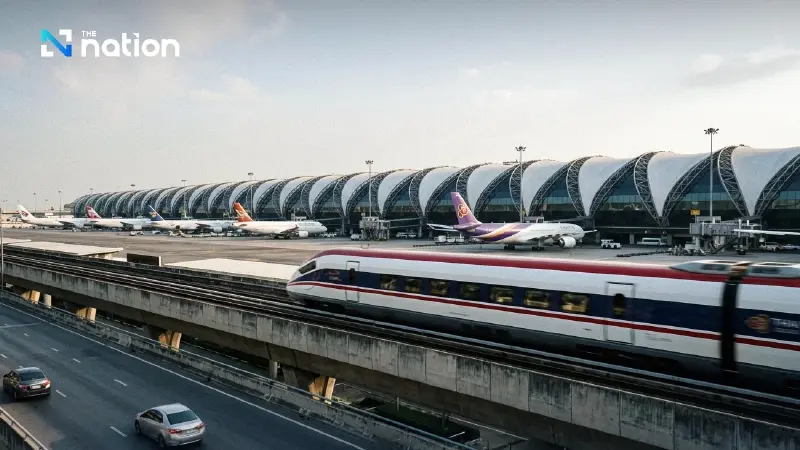


SRT is preparing formal talks with the concessionaire in May after the Cabinet rejected proposed changes to the original contract terms.
- The Thai Transport Minister has rejected a proposal from the private concessionaire, Asia Era One, to amend the contract for the high-speed rail project connecting three airports.
- The rejected changes included a request to pay the THB10.671 billion work-payment in seven installments, a proposal made due to rising energy and construction material costs.
- The government insists on adhering to the original contract, which requires the company to complete construction within five years and receive reimbursement over ten years.
- Following the rejection, the private company has the option to terminate the contract, which could delay the project by an estimated 8-10 years as a new bidding process would be required.

Phiphat Ratchakitprakarn, Minister of Transport, said the latest progress on the high-speed rail project linking three airports (Don Mueang–Suvarnabhumi–U-Tapao) was that informal internal talks had been held with the private concessionaire, Asia Era One Company Limited, or CP.
“We have considered the matter and believe that the current situation means it cannot continue. The government has opened the way for the private sector to give notice of contract termination,” Phiphat said.
At the same time, the state’s position had been conveyed frankly: the government would not be able to amend the contract in line with the private sector’s proposal, particularly on changing the payment terms for the THB10.671 billion work-payment amount into seven instalments.
It stressed that the private sector must complete construction within five years and that the state would reimburse it gradually over 10 years, only as set out in the original contract.
This was despite the private side presenting reasons for seeking the contract amendment, citing volatility in energy prices and floating rises in construction-material costs caused by external factors such as war in the Persian region.
Phiphat said the matter would have to be considered further under a previous Cabinet resolution, which had set a guideline that if the winning bidder could not proceed because of uncontrollable factors, such as war or severe cost impacts, the state might consider restructuring or terminating the contract without treating it as abandonment of work.
In addition, the state is trying to frame a new proposition to help increase future passenger numbers, with a policy to push for major attractions to draw travel demand, such as a world-class theme park (Disneyland style) and a large sports stadium, for the private sector to consider when assessing the project’s break-even point.
If calculations still show no break-even point, the private sector also has the right to decide to terminate the contract.
Anan Phonimdang, deputy governor and acting governor of the State Railway of Thailand (SRT), said the Cabinet had now clearly resolved not to accept in principle the contract amendments proposed by the private sector, confirming that the original conditions agreed at the outset should be used.
The key issue is the payment for management rights to the Airport Rail Link (ARL) project.
The private sector has tried to propose splitting the payment into instalments with interest and placing a THB160 billion bank guarantee to guarantee construction and the opening of services within five years.
However, as the state has not accepted this condition, the private sector is obliged to pay 100% under the original contract.
The private sector has accumulated arrears to SRT of about THB300 million a year, from the time it began management on Monday (October 25, 2021) to the present.
Anan said that, for the next steps, SRT was preparing to open formal negotiations with the private sector this May to ask clearly whether it would be able to proceed if all terms reverted to the original contract and original conditions.
The private sector has throughout tried to drive the project forward, whether by increasing its shareholding ratio or making various preparations.
Ultimately, however, everything must comply with existing regulations and laws.
“If the private sector confirms that it cannot bear the original conditions, this could lead to a contract-termination process. SRT acknowledges that it has considered a contingency plan, giving priority first to points affecting other structures, such as connection points with the Thai-Chinese railway project or structures at U-Tapao Airport,” Anan said.
However, if the situation deteriorates to the point where a new bidding process must be started, Anan said this would become a major loss in terms of time.
He expected it would delay the project by 8-10 years from the original plan, because a new bidding process would take at least 2-3 years, and construction would take another roughly five and a half to six years.
The possibility of calling in the second-ranked bidder for further negotiations is almost impossible, as the bid bond and bid validity period are likely to have expired long ago, meaning the process would have to start again from zero.
On SRT’s side, although it is ready in terms of land, with almost all expropriation complete, and the original environmental impact assessment (EIA) report can still be used if there is no significant design change, starting again under procurement law and finding a new contractor remains a time-consuming obstacle.
In addition, SRT has prepared fully for work in areas concerning it, particularly civil works and the resolution of overlapping points with the suburban Red Line extension, for which designs have been completed.
“The decisive factor now rests with the decision of the private contractual partner on whether it will accept the Cabinet’s original conditions. SRT hopes the talks that will take place soon will find a conclusion so the project will not have to stall and create additional cost burdens for the state and the public in the future,” Anan said.
