
Hook the rails south – Thailand revives Malaysia link plan
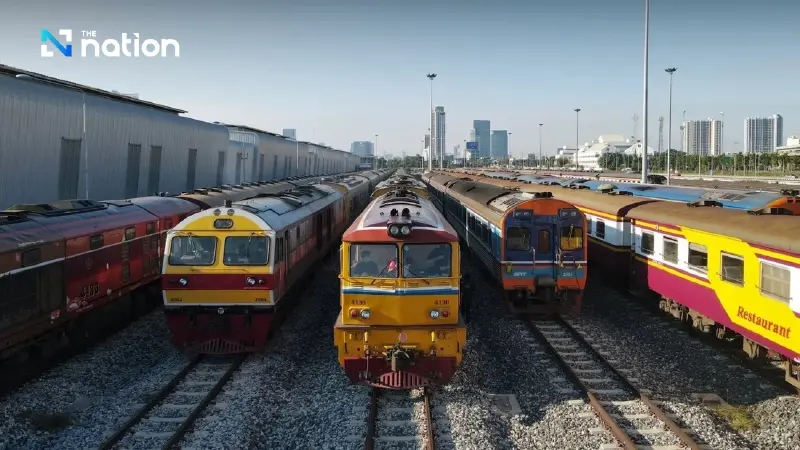


Thailand pushes southern double-track rail expansion and Malaysia link revival to boost cross-border trade, logistics capacity and regional connectivity
Thailand is accelerating plans to upgrade its southern rail network and revive cross-border links with Malaysia, as part of a broader push to position the country as a regional logistics hub.
The Ministry of Transport has outlined a strategy to strengthen rail as a key mode of transport connecting Thailand with neighbouring countries. The policy, driven by Deputy Prime Minister and Transport Minister Phiphat Ratchakitprakarn, calls for the State Railway of Thailand (SRT) to expedite Phase 2 of its double-track railway programme, with a particular focus on the South.
Three major double-track routes in the region, with a combined investment of more than 100 billion baht, are expected to go to bidding within 2026. These include the 168-kilometre Chumphon–Surat Thani section, valued at 30.42 billion baht; the 321-kilometre Surat Thani–Hat Yai–Songkhla route, worth 66.27 billion baht; and the 45-kilometre Hat Yai–Padang Besar stretch, with a budget of 7.77 billion baht.
The Hat Yai–Padang Besar line is seen as particularly strategic, as it forms part of the rail corridor linking Thailand to Malaysia. Alongside this, Thai authorities are working with their Malaysian counterparts to revive the historic Sungai Kolok–Rantau Panjang railway, which has been out of service for more than 20 years.

The initiative was discussed at a bilateral meeting chaired by Pichet Kunadhamraks, Director-General of the Department of Rail Transport, on April 29. The talks focused on defining Thailand’s position on rail cooperation with Malaysia, including the restoration of the Sungai Kolok route to enhance cross-border trade and regional logistics.
Pichet said the discussions followed a proposal from Malaysia to reconnect the railway between Sungai Kolok station in Narathiwat province and Rantau Panjang station in Kelantan. The meeting explored options for restoring both passenger travel and freight services, with the aim of stimulating economic activity in Thailand’s southern border provinces.
Participants also reviewed progress on key projects expected to shape the future rail network. These include Malaysia’s East Coast Rail Link (ECRL), scheduled for completion in January 2027, with Kota Bharu station located just 30 kilometres from the Sungai Kolok connection point.

On the Thai side, a separate double-track railway project between Hat Yai and Sungai Kolok, spanning around 215 kilometres, is currently under feasibility study to prepare for increased transport demand once cross-border connectivity is restored.
The meeting also considered upgrades to rail freight handling facilities at Padang Besar checkpoint. Plans include expanding container yard capacity to ease congestion and address space constraints at the existing station, enabling faster and more efficient cross-border trade.
“Today’s discussions mark an important step towards translating cooperation into tangible outcomes and building an efficient cross-border transport network,” Pichet said. “This will not only facilitate travel for the public but also strengthen logistics capability and regional competitiveness over the long term.”

