
New power tariff may raise bills for homes using over 400 units from July
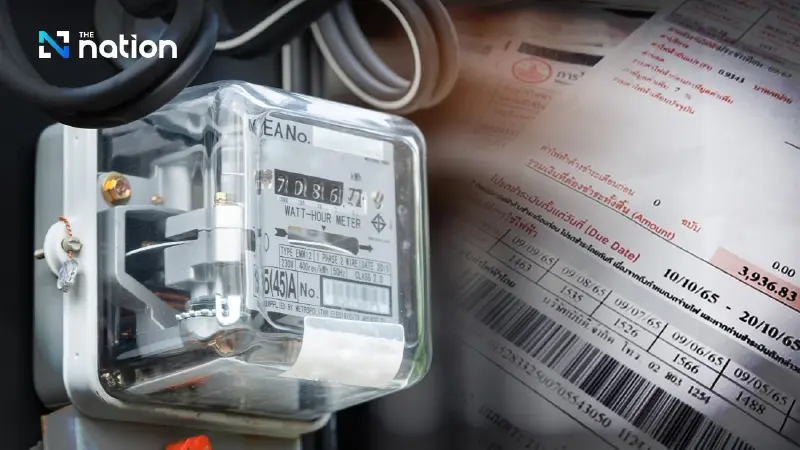


ERC opens public consultation on a new progressive power tariff, with heavy household users likely to pay more from the July billing cycle.
Poonpat Leesombatpaiboon, secretary-general of the Office of the Energy Regulatory Commission (ERC), has updated progress on the restructuring of Thailand’s progressive electricity tariff, aimed at encouraging more efficient power use.
Under the proposed structure, electricity users with higher consumption levels would pay higher rates according to the amount of power they use.
The ERC and power agencies have prepared four case studies, or scenarios, and will hold a public hearing from May 22 to June 5, 2026, through the website www.erc.or.th. Feedback will be summarised before the new electricity tariff structure is announced. It is expected to take effect from the July 2026 billing cycle.
The four scenarios focus mainly on adjusting progressive rates to better reflect current electricity consumption behaviour.
1. Low-consumption users, or the first 0-25 units
All scenarios leave this group unchanged. The existing rates will remain at 2.3488 baht for the first 15 units and 2.9882 baht for the next 10 units, in order to protect basic electricity users.
2. Medium-consumption users, or 26-200 units
The ERC aims to reduce the burden on the public. In all scenarios, electricity rates for this group would be cut significantly. The rate for 26-150 units would be reduced by around 0.24-0.71 baht per unit.
The key highlight is the 151-200 unit range, which would be cut by 1.2218 baht per unit, from 4.2218 baht to 3.0 baht in all scenarios.
3. High-consumption users, or above 200-400 units and beyond
This is where the scenarios begin to differ clearly.
Under Scenarios 1 and 2, the rate for 201-400 units would remain unchanged at 4.2218 baht, but the rate would increase sharply after 400 units.
Under Scenario 1, the rate would rise by 1.0234 baht per unit, bringing it to 5.4451 baht. Under Scenario 2, the highest increase would be 1.0357 baht per unit for consumption above 501 units.
Under Scenarios 3 and 4, the rate would begin rising earlier, from the 201st unit onwards, by around 0.49-0.54 baht per unit. The highest rate would be around 4.96-5.00 baht per unit for electricity use above 400 units, an increase of 0.54-1.03 baht.
“Scenario 4 is considered the most suitable specific rate for users consuming more than 400 units. Their electricity tariff would have to rise by an average of 0.54-1.03 baht per unit, or to an average rate of 4.96-5.00 baht per unit. The payment curve would not increase too sharply. Most of these users are in Bangkok and surrounding provinces,” Poonpat said.
Poonpat said the electricity tariff structure is normally reviewed every five years. For this round, covering 2026-2030, residential users have been considered first.
The industrial and commercial sectors will be considered next, with the process expected to be completed within 2026.
The Energy Policy and Planning Office (EPPO) has already submitted the criteria and principles for reviewing the electricity tariff structure to the Committee on Energy Policy Administration (CEPA), which has approved them. The next step is to submit the matter to the National Energy Policy Council (NEPC).
Once the policy is approved, the ERC will consider the details for industrial and commercial users.
Poonpat said industrial and commercial electricity tariffs may normally appear more expensive than household tariffs, but the actual rate depends on the tariff category chosen.
If users choose the Time of Use (TOU) rate and consume less electricity at night, or manage their consumption behaviour well, their electricity costs could be lower.
The TOU and TOD, or Time of Day, systems will also be reviewed as part of the new structure, as electricity load patterns have changed. For example, electricity consumption at night has increased.
“The new structure will support adaptation towards greater use of clean energy and more solar panel installations, helping reduce electricity costs and support the country’s energy direction,” Poonpat said.
