
Consumer board summons Volvo after EX30 battery fire crisis
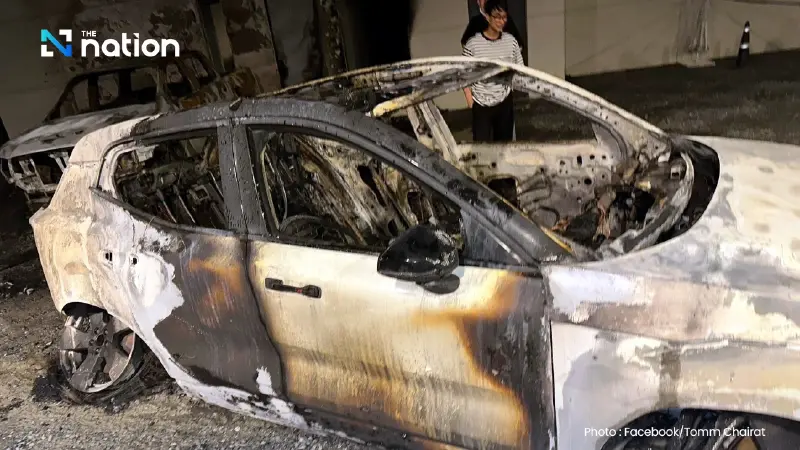


Volvo Car Thailand halts EX30 sales and plans battery module replacements for 1,668 cars, as battery fire concerns form part of a global recall affecting 33,777 vehicles
Volvo’s EX30 electric SUV is facing growing scrutiny in Thailand after fire incidents linked to battery overheating triggered regulatory action, a sales suspension and an urgent plan to replace battery modules in affected vehicles.
The Office of the Consumer Protection Board (OCPB) summoned Volvo Car Thailand to clarify the facts on May 21, 2026, after a Volvo EX30 caught fire while being charged at a customer’s home on May 15 at around 9pm. The agency said it wanted details on the cause of the fire, the company’s recall plan and measures to protect consumers while they wait for repairs.
The issue has intensified after Thailand’s consumer watchdog signalled possible civil action against Volvo Thailand and its dealers following fresh fire complaints involving the EX30. Authorities were considering legal measures seeking refunds and compensation for affected consumers after talks with the company failed to reach a mutual resolution.
The case has become more serious because the EX30 models involved are part of a known battery overheating issue affecting Volvo EX30 Single Motor Extended Range and Twin Motor Performance vehicles. Volvo had previously advised affected customers to limit charging to no more than 70% of battery capacity as a temporary safety measure.
According to the OCPB, 45 consumers have already filed complaints, while 1,668 Volvo EX30 vehicles in Thailand are affected. The agency said the “do not charge above 70%” instruction appeared insufficient after an actual fire incident occurred, prompting it to consider stronger consumer-protection measures.

Volvo Car Thailand has temporarily suspended sales of the EX30 in Thailand. The company said both fire cases involved vehicles in the affected battery group and that preliminary checks found charging had exceeded the recommended 70% limit. Volvo urged customers to follow the safety advice strictly until battery module replacement is completed.
The company said it would contact affected customers through its customer relations team and begin arranging battery module replacements from May 22, 2026. Each service appointment is expected to take about three days, including quality checks before the vehicle is returned.
Reuters also reported that mounting delays in replacement battery supplies had fuelled customer frustration in several countries. Volvo acknowledged the delays, saying disruptions linked to the Iran conflict had affected logistics, while insisting that actual fire incidents remained extremely rare at “well under” 0.1% of affected vehicles globally.
At the OCPB meeting, Volvo’s technical and after-sales service director said the company would replace the new battery modules free of charge for affected vehicles. The first replacement was expected to begin on May 25, with the company aiming to complete the process for all affected cars by August 2026.
Volvo also said it would provide temporary replacement vehicles and compensation for loss of vehicle use while customers wait for repairs. However, the company has not announced a direct buy-back scheme, though customers seeking to change vehicles may discuss possible solutions with the company on a case-by-case basis.
The OCPB has ordered Volvo Cars Thailand to test or prove the safety of the product and report the results within 30 days. It is also preparing to submit consumer complaints for further consideration, including possible civil action against the company and dealers to seek full refunds with interest for affected consumers.
The issue is not limited to Thailand. Spring News reported that the EX30 battery safety problem has also been linked to overseas cases, including Brazil, and a wider global recall covering 33,777 vehicles, including 10,440 in the United Kingdom. The report said the problem involved a small proportion of battery cells overheating.
The case has also exposed tension in the supply chain. Spring News reported that Sunwoda Electronic chairman Wang Wei denied that the company supplied battery packs directly to Volvo, saying the packs were assembled within Volvo’s own network, while cell production involved a joint venture between Geely and Sunwoda in which Sunwoda held a 30% stake.
The report also said Viridi E-Mobility Technology, or VREMT, a Geely subsidiary, was responsible for battery pack design, the battery management system and cooling system. VREMT has reportedly filed a 2.31-billion-yuan claim against Sunwoda over alleged quality issues with battery cells.
The EX30 case has now evolved beyond a standard EV recall into a wider test of consumer confidence, battery safety oversight and how global automakers respond when technical problems begin affecting real-world users across multiple countries.


