
Single-owner rail plan heads to Cabinet
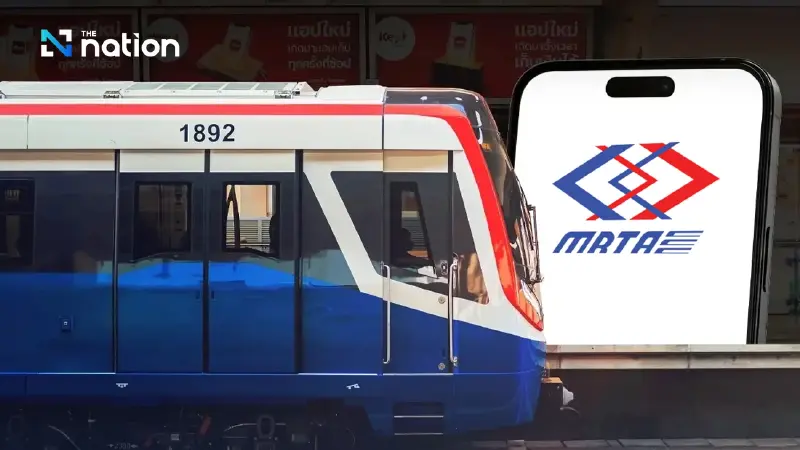


Thailand’s Transport Ministry will ask the Cabinet to note a single ownership plan for electric rail lines to support a joint fare system
Thailand’s Transport Ministry is preparing to ask the Cabinet to acknowledge a proposed shift towards single ownership of the country’s electric rail network, a move seen as a key step towards a joint ticket and fare system.
Deputy Transport Minister Siripong Angkasakulkiat said the ministry would submit the matter to the Cabinet meeting on June 2.
The proposal involves transferring certain management rights for electric rail projects across all colours and lines to the Mass Rapid Transit Authority of Thailand, or MRTA.
The approach, described as “single ownership”, is intended to allow the rail network to be managed more cohesively and to support the government’s joint ticket policy.
Siripong said the ministry was discussing ways to manage rights and operational powers for parts of the rail system.
Under the plan, Bangkok Metropolitan Administration would transfer some management rights to MRTA so that the overall network could be run more efficiently.

He said the arrangement would mark the starting point for a common fare structure.
The proposal must first receive Cabinet approval in principle so that a framework can be set for cooperation among all agencies involved.
A Transport Ministry source said the Cabinet would be asked to acknowledge the principle of single ownership, covering the transfer of BMA-related electric rail projects and amendments to concession contracts so that MRTA would become the owner.
Once the Cabinet acknowledges the principle, negotiations would begin with private concession holders and BMA to transfer rail service rights to MRTA.
The ministry insisted that the plan would not require budget spending and would not affect public debt. Instead, it would involve changes to concession contracts, shifting the contracting party from BMA to MRTA.
The source said transferring management rights to MRTA would be the first step towards a joint rail fare system.
The government aims to complete the policy this year and introduce a new fare starting at 40 baht for all-day travel as a New Year gift to the public on January 1, 2027.
Four electric rail projects are currently expected to be affected by a change in concession model from PPP Net Cost to PPP Gross Cost.
The first is the Green Line, covering the Sukhumvit section from Mo Chit to On Nut and the Silom section from National Stadium to Saphan Taksin.
BMA signed the main concession contract with Bangkok Mass Transit System Plc, or BTSC, for these sections, which is due to expire in 2029.
The Green Line also has operating and maintenance contracts running until 2042.
These cover the main Mo Chit-On Nut and National Stadium-Saphan Taksin sections, the first extensions from Saphan Taksin to Bang Wa and from On Nut to Bearing, and the second extensions from Mo Chit to Khu Khot and from Bearing to Samut Prakan.
The second project is the Blue Line, covering the Hua Lamphong-Bang Sue section and the Hua Lamphong-Lak Song extension.
MRTA signed a contract with Bangkok Expressway and Metro Plc, or BEM, covering train operations, fare collection and commercial development.
The concession is due to expire in 2049, while the contract states that BEM must pay MRTA returns from fares and commercial development under the rates specified in the concession agreement.
The concession period ends in 2050.
The third project is the Pink Line from Khae Rai to Min Buri.
MRTA signed a PPP Net Cost concession with Northern Bangkok Monorail Co Ltd, or NBM. Under the deal, the private sector invested in civil works, systems, train procurement, operations and maintenance.
The concession lasts 30 years from the start of service, with the state providing financial support for civil works. It is due to expire in 2053.
The fourth project is the Yellow Line from Lat Phrao to Samrong. MRTA signed a PPP Net Cost concession with Eastern Bangkok Monorail Co Ltd, or EBM.
The private sector is responsible for civil works, systems, train procurement, operations and maintenance, while the state provides support for civil works.
The 30-year concession is also due to end in 2053.
