
Disease Control Department seeks views on indoor smoking zones at international airports
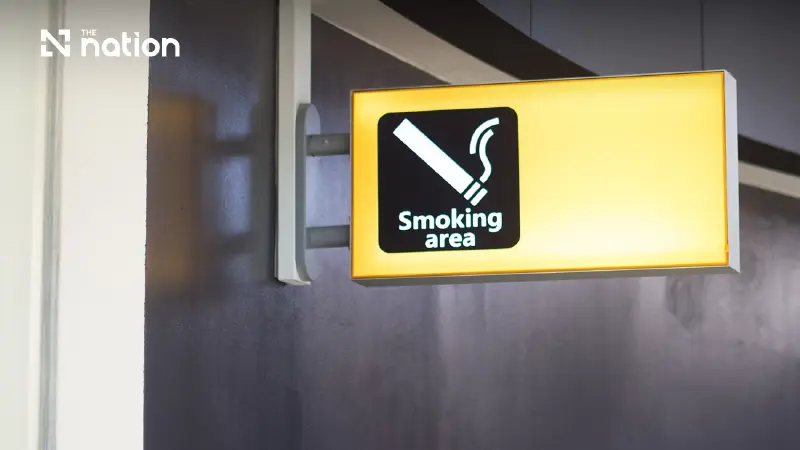


Thailand’s Disease Control Department has opened a public hearing on whether international airports should be allowed to set up smoking zones inside passenger terminals.
The Department of Disease Control under the Public Health Ministry has begun a public consultation through the central legal platform to assess whether international airports should be allowed to set up smoking areas inside passenger terminal buildings.
The move marks a review of current practice under existing restrictions, which classify airports as non-smoking areas and allow smoking zones only outside buildings, structures or premises.
Legal background and current restrictions
Under Section 41 of the Tobacco Products Control Act B.E. 2560 (2017), the Public Health Minister, with advice from the National Tobacco Products Control Committee, has the authority to issue notifications designating all or part of public places, workplaces and vehicles as non-smoking areas.
The law also allows smoking zones to be designated within non-smoking areas where appropriate. The principle is intended to regulate shared social spaces in the interest of public health and safety.
However, current rules designate airports as non-smoking areas. Smoking zones may be set up only outside buildings, structures or premises, and must strictly comply with legal criteria and physical requirements.
As a result, all indoor areas of airport buildings are physically closed spaces where smoking is not permitted.

International travel creates specific constraints
The physical limitations of international travel are a key factor behind the proposal.
Airports serving international flights have specific conditions, especially for international passengers, transit or transfer passengers, and travellers who must remain inside controlled airside areas for extended periods.
These passengers cannot access smoking zones located outside terminal buildings due to aviation security and immigration procedures. Once passengers pass through screening and immigration points, they cannot conveniently leave the terminal and re-enter the controlled area within the normal travel process.
For this reason, the department is considering whether it is appropriate and necessary to allow smoking zones inside passenger terminals at airports serving international flights, under the supervision and criteria of the Tobacco Products Control Act.
The aim is to address structural and passenger-management issues for those waiting for long periods in closed airport areas.
Impacts and stakeholders
Any change to the current regulation would directly affect two main groups.
The first group is passengers and airport users, both smokers and non-smokers, who share terminal spaces.
The second group is airport workers and business operators inside passenger terminals, who spend long hours each day in the same environment.
Key issues to be considered include the protection of non-smokers’ health, the wellbeing of airport workers, the efficiency of space management inside airports and practical obligations that may arise.
These include the cost and responsibility of installing air extraction and ventilation systems, standards inspection, equipment maintenance, and controls to ensure that smoking rooms or zones do not affect surrounding areas.
The matter therefore involves both public-health considerations and economic and management dimensions.
Key questions in the public hearing
The consultation aims to gather comprehensive opinions from the public, government agencies, the private sector and all relevant stakeholders before the state considers any policy decision or future subordinate legislation.
The key issue is whether the 2018 Public Health Ministry notification should be amended.
The hearing focuses on two main questions.
First, should smoking zones be allowed inside passenger terminal buildings at airports serving international flights?
Second, if such zones are permitted, what physical conditions, engineering requirements or other criteria should be imposed to ensure that the smoking zones do not affect or cause nuisance to other people using the same building?
