
Paetongtarn smiles as Constitutional Court hears Hun Sen audio case
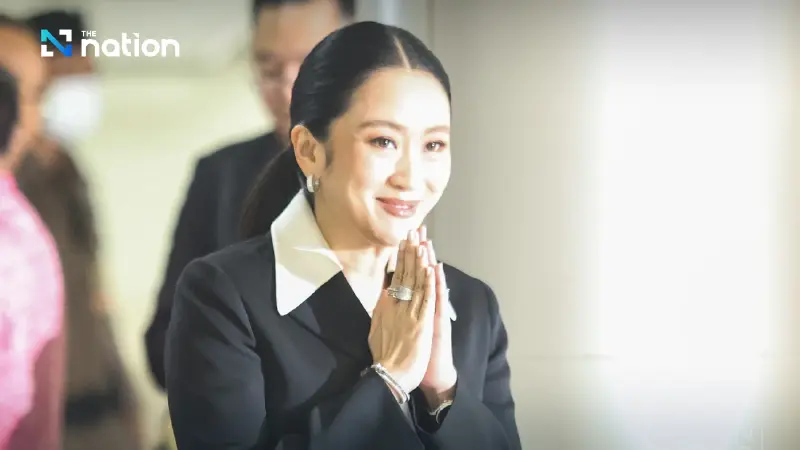


The Constitutional Court on Thursday (August 21) summoned Prime Minister Paetongtarn Shinawatra and Chatchai Bangchuad, Secretary-General of the National Security Council (NSC), for a hearing on the controversial audio clip involving former Cambodian prime minister Hun Sen.
In the morning, Somchai Swangkarn, a former senator, and his group arrived at the court to attend the hearing, after being granted permission on Wednesday.
Somchai told reporters that he had petitioned the court for a live broadcast of the proceedings. While this was not fully granted, the court allowed those who had submitted requests to attend the hearing in person.
He added that he would also request permission to attend the ruling on August 29. Some parts of the hearing would be broadcast for the media, he noted.

Somchai expressed confidence that both Paetongtarn and the NSC secretary-general would testify truthfully. He said the court had accepted petitions from senators and would also hear expert witnesses and neutral parties. Based on the prime minister’s statement, he believed the judges would raise additional questions.
We are not the petitioners. We are observers who will use this information for legal purposes. I myself have already submitted related complaints to the Central Investigation Bureau, he said.
Asked what questions the court might raise, Somchai said he expected the focus to be on national security issues.
The NSC secretary-general was one of five people mentioned in the petition as potentially linked to border security concerns. He explained that on June 6, the NSC held a meeting and tasked the armed forces with certain operations. On June 15, Paetongtarn phoned Hun Sen, and the following day she reportedly agreed to reopen the border. Hun Sen released the audio clip on June 18.
Paetongtarn later admitted the conversation had taken place. The clip was viewed nationwide, particularly by those living along the border. It sparked political disputes between the two families, escalated into military clashes, and led to both civilian and military casualties. “All of this began with that clip,” he said.

Somchai added that he wished to hear how the NSC secretary-general explained matters to the court, stressing that national security officials should protect the state rather than politicians.
He speculated that Paetongtarn’s statements were probably drafted with the help of her legal team, citing works from Harvard University that are widely sold in Thailand. However, he said such books deal with business negotiations, not political disputes or armed conflicts.
Somchai argued that international leaders usually follow strict protocols in bilateral talks. Meetings are normally recorded, vetted by the Foreign Ministry, and conducted with security officials present, without the use of personal phone calls, he explained.
He pointed out that the audio clip made it clear mistakes had been made, which led senators to allege serious ethical violations.
“Paetongtarn is fortunate. If she resigns before the ruling, the case would be dropped and she would be safe. She still has seven days before the August 29 verdict,” he said.
“But if she remains, I believe the outcome will be similar to past prime ministerial cases — Samak Sundaravej, Yingluck Shinawatra, and Srettha Thavisin. Compared with those three cases combined, Paetongtarn’s is far heavier. My advice is: resign on your birthday,”

At around 9.28am, Paetongtarn arrived at the Constitutional Court with her family, aides, and legal team. She smiled but declined to speak to the press.
According to court officials, Thursday’s hearing would be shown via closed-circuit television for the media, but only the opening session would include sound. The rest of the proceedings would be silent until the hearing concluded.
A press release summarising the testimony will be issued later in the evening.
