
Thai foreign minister visits Saab headquarters in Sweden after Gripen jet deal
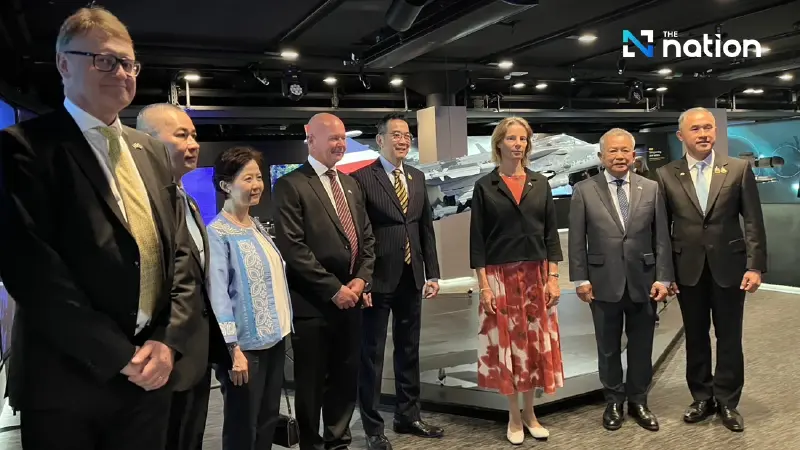


Thai Foreign Minister Maris Sangiampongsa visited the headquarters of Saab AB, the Swedish defence and aerospace company that manufactures the Gripen fighter jet, in Stockholm on Monday (August 25).
He was warmly received by Saab AB CEO Micael Johansson, who, together with senior executives, guided him through the company’s latest defence and security innovations.
The visit came shortly after Thailand finalised a deal with Sweden for the purchase of Gripen E/F fighter jets under the first phase of its procurement programme.

Saab highlighted the advanced capabilities of the Gripen E/F, notably its Active Electronically Scanned Array (AESA) radar system, which allows for more accurate target detection, enhanced resistance to jamming, and simultaneous tracking of multiple targets.
The jet also features ten weapon hardpoints, enabling it to carry a wider variety of armaments.
Beyond the Gripen, Saab also showcased other defence technologies, including unmanned aerial vehicles (UAVs), submarines with air-independent propulsion, and systems for public safety and cyber security.

Johansson emphasised that the offset policy linked to the Thai Gripen purchase will focus initially on technology transfer and knowledge-sharing in system integration. This will allow Thailand to link its various platforms, including naval vessels, airborne early warning aircraft, and Gripen fighters.
He praised the collaboration with Thai industry and the Royal Thai Air Force, saying he was impressed by Thailand’s working approach and believed Sweden could also learn from its partner.
Further cooperation will cover aircraft maintenance, upgrades to airborne early warning systems, and educational exchanges enabling Thai engineers to study aerospace technology in Sweden.

In the long term, Saab plans to establish a research and development office in Thailand. This will allow Thai engineers to develop and integrate their own software into aircraft, as Saab designs its jets for user-driven software enhancement, including artificial intelligence applications.
The move marks a long-term commitment to bilateral defence and technology cooperation between Saab and Thailand.


