
Thai Premier Unveils 15-Point Urgent Agenda to Parliament
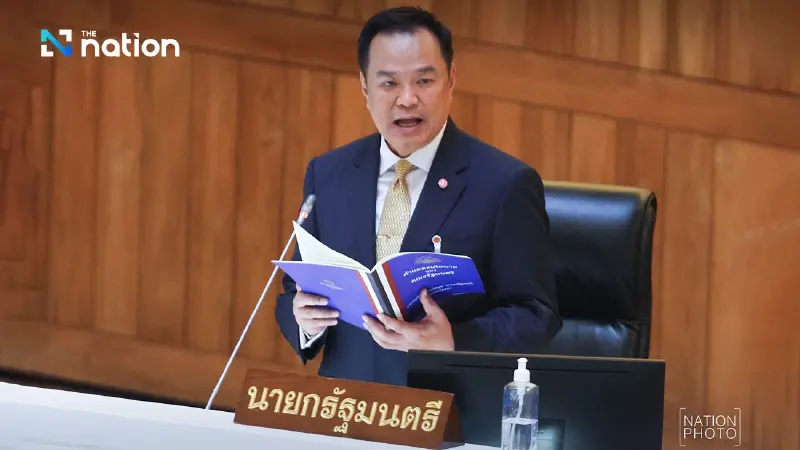


Premier Anutin Charnvirakul outlines 15 key areas, from boosting the economy with the 'Kon La Krueng' scheme to tackling illegal gambling and climate change
- The agenda prioritizes economic relief through stimulus measures like the "Kon La Krueng" co-payment scheme, lowering essential costs for energy and transport, and addressing national debt.
- Key governance policies include a strict crackdown on illegal gambling without any plans for legalization, alongside efforts to eradicate corruption and reform the legal system by removing outdated laws.
- Environmental goals are central, with commitments to achieve Net Zero emissions by 2050, tackle PM2.5 air
Prime Minister Anutin Charnvirakul led his Cabinet in delivering the new government’s policy statement to the Parliament on Monday, setting out a comprehensive 15-point urgent agenda aimed at immediately addressing the nation’s core challenges.
The policy list heavily features economic stimulus, notably through the continuation of the "Kon La Krueng" (Co-payment) scheme, alongside key measures to reduce the cost of living by lowering essential prices, including energy and transportation fares.
The urgent items also include commitments on national debt resolution, a crackdown on illegal gambling, environmental protection, and legislative reform.
Parliamentary Ceremony and Commitments
The joint parliamentary session, chaired by Parliament President Wan Muhamad Noor Matha, was convened to officially receive the policy statement, as required under Section 162 of the Constitution.
The assembly saw a large attendance, with over 393 legislators registered, including 165 Senators and 228 Members of Parliament. The session is scheduled to dedicate 25 hours over two days to the debate.
At 9:35 AM, Premier Anutin, who also serves as the Minister of Interior, formally announced the government’s policy, affirming that his administration’s mandate is anchored in the democratic regime with the King as Head of State.
He stated that the policy aligns with the Constitution’s directives and the existing National Strategy (2018–2037).

The government, he pledged, will adhere to three core principles:
- Protection of the institutions of the Nation, Religion, and the Monarchy.
- Adherence to the democratic regime with the King as Head of State.
- Upholding the rule of law, fair enforcement, and administration based on good governance for the benefit of the populace.
Navigating Crises and Laying Foundations
The Prime Minister acknowledged that the government takes office at a moment of "comprehensive uncertainty"—spanning economic, social, political, and geopolitical factors—which directly impacts national competitiveness.
Given the limited time, the non-discretionary budget, and its standing as a minority government, the administration must urgently address four immediate threats: economic, security, social, and environmental (driven by climate change).
This dual approach involves crisis management alongside laying a solid foundation for sustainable development, guided by the Sufficiency Economy Philosophy.
The government also committed to supporting the process of holding a referendum and pursuing constitutional amendments, stressing the need to secure public participation and adhere to the Constitutional Court’s rulings to maintain the integrity of the monarchy-led democratic system.
Detailed Policy Breakdown
A. Economic Priorities
Income and Cost Management: Implementing the Kon La Krueng scheme and immediately lowering daily costs such as energy, clean drinking water, fares, and tolls to increase citizens' purchasing power.
It also includes managing agricultural prices, promoting digital technology for reskilling and upskilling, and boosting community income through the use of solar energy in households and agriculture.

Debt Resolution and Liquidity:
Public Debt: Assisting in resolving individual debt within the system, up to 100,000 baht per person, to release citizens from debt traps.
SME Liquidity: Providing SMEs with enhanced liquidity, up to 1 million baht per business, and improving access to capital for disciplined borrowers.
Increasing Public Savings: Giving all citizens the right to easily purchase government bonds and developing new lottery products that convert a portion of non-winning funds into a savings scheme.
Restoring Tourism Confidence: Focusing on enhancing tourist safety, suppressing fraud, and launching stimulus measures to encourage domestic travel for the rest of 2025, including promoting second-tier cities and improving facilities via tax incentives.
Addressing Trade War Impacts:
Global Trade: Establishing "Team Thailand" to upgrade existing Free Trade Agreements (FTAs) and proactively open new markets (Middle East, Africa, Latin America). The government will also push for Thailand’s membership in the OECD.
Trade Defence: Tackling issues like the circumvention of Certificates of Origin and supporting sectors affected by foreign tariffs. Crucially, the government will prohibit the import of agricultural products resulting from burning in neighbouring countries to mitigate PM2.5 dust.
Investment Environment: Modernising regulations and licensing procedures to be transparent. Adjusting investment promotion to target high-tech sectors, including Digital/AI, Advanced Electronics, Modern Automotive, Clean Energy, and Bio-industries.
B. Security and Stability
Thai-Cambodia Dispute: Committing to resolving the border dispute with Cambodia through peaceful means to ensure security for the border populace and preserve Thailand’s rightful sovereignty according to international boundaries.
This will be pursued via diplomatic negotiation and robust national defence. A referendum will also be held for public opinion on potentially revoking the Thai-Cambodia Memorandum of Understanding (MoU).
Southern Border Provinces: Accelerating efforts to create a safe environment and improve the quality of life, coupled with sustainable economic development in the region.
C. Social and Governance
Suppressing Illegal Gambling: Committing to the serious suppression of all forms of illegal gambling. The government explicitly stated it will not support the legalisation of any gambling business or entertainment complexes featuring gambling, and will amend the Gambling Act to limit permits.
Upholding the Rule of Law: Declaring failure to enforce laws in critical areas—such as drugs, online crime, fraud, and cyber threats—as a severe disciplinary violation for state officials. It also strictly prohibits the use of laws and state officials for political gain.
Eradicating Corruption: Decisively and seriously eradicating corruption in cooperation with anti-graft bodies and civil society.
Protecting Religions: Implementing measures to protect and eliminate the undermining of Buddhism and other religions, acting with the approval of the Supreme Patriarch for Buddhist matters.
D. Environment and Disaster Management
Disaster Warning Systems: Accelerating the installation and development of disaster warning systems, especially in high-risk zones. This includes systemic water resource management to build resilience against climate change.
Driving a Low-Carbon Society: Announcing Thailand’s commitment to achieving Net Zero Greenhouse Gas Emissions by 2050.
Energy and Transport: Promoting solar energy, electric vehicles, and public transport.
Sustainable Agriculture: Transitioning to environmentally friendly farming methods, with a focus on preventing agricultural burning to reduce PM2.5 dust.
Legislation: Establishing an internationally standardised carbon credit trading market and accelerating the implementation of key environmental laws, such as the draft Climate Change Act.
E. Public Administration and Legal Reform
Digital Government: Accelerating the development of an interconnected digital government, promoting the disclosure of public open data, and modernising public administration for efficiency and transparency.
Legal and Regulatory Reform: Accelerating the Legal Guillotine (the cancellation of outdated laws and regulations) that create unnecessary burdens for citizens and businesses. The government will also initiate legislation for the digital platform economy.
Financial Discipline and Long-Term Vision
In concluding his address, Prime Minister Anutin affirmed that his government is committed to acting with "integrity, honesty, and virtue," prioritising the nation’s benefit. He pledged to maintain confidence in fiscal policy, ensuring it is credible, disciplined, and transparent.
"As Prime Minister, I will pursue every avenue in the government’s administration to solve the country’s problems while laying the foundation for sustainable national development in all dimensions for the well-being and happiness of the Thai people," Anutin stated.
