
SRT files first land suits, key test for Anutin in tackling Khao Kradong dispute
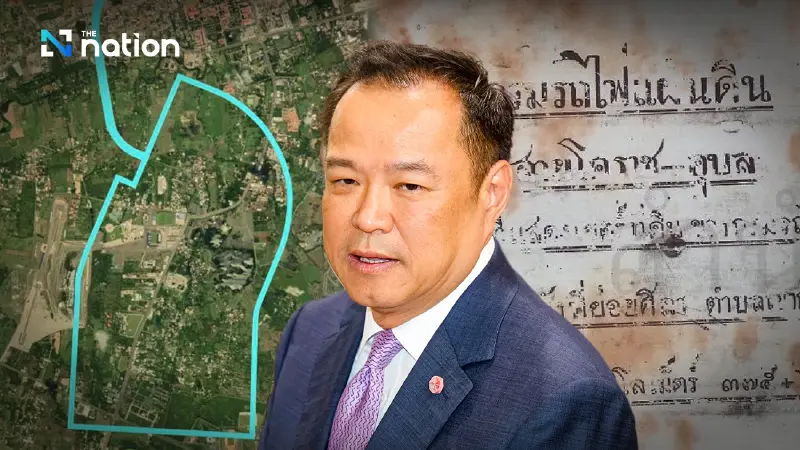


The SRT has launched lawsuits to revoke the first two Khao Kradong land title deeds, following an NACC ruling in 2016. The high-profile dispute is seen as a test for Prime Minister Anutin Charnvirakul’s government, as parts of the contested land are linked to a powerful political family in the region.
- The State Railway of Thailand (SRT) has filed its first lawsuits to reclaim disputed land at Khao Kradong, initially targeting two plots previously identified by the National Anti-Corruption Commission (NACC) as unlawfully issued.
- This legal action is considered a key test for Prime Minister Anutin Charnvirakul's government, as the controversy involves land in his Bhumjaithai Party's political stronghold, raising concerns over potential interference.
- The SRT's broader plan is to prosecute all encroachers on the 5,083 rai of disputed land, which encompasses 995 plots, by proceeding on a case-by-case basis.
- In response to scrutiny, Prime Minister Anutin and other senior ministers have publicly assured that his administration will not interfere in the judicial process.
The long-running “Khao Kradong” land controversy has emerged as a key test for the newly installed Cabinet of Prime Minister Anutin Charnvirakul, with public scrutiny focused on how the government will handle sensitive cases linked to powerful political families.
The disputed area covers more than 5,083 rai of land (813.3 hectares) in Buri Ram province, of which over 4,414 rai is reported to overlap with property owned by the State Railway of Thailand (SRT). At least 12 plots totalling 288 rai have been tied to business networks associated with a prominent political dynasty in the lower Northeast.
Critics question whether the rise of the Bhumjaithai Party to the helm of government, with influence extending to Parliament and independent agencies, could result in interference with judicial proceedings already under way.
Observers note that several key Cabinet members, closely connected to Bhumjaithai’s political stronghold in the region, may find themselves linked to decision-making on the matter.
During the government’s policy debate on September 29–30, Anutin repeatedly assured lawmakers that his administration would not interfere in the judicial process, whether in the Khao Kradong dispute or the Senate selection fraud case.
Senior Bhumjaithai figures, including Deputy Prime Minister Sophon Sarum and Transport Minister Phiphat Ratchakitprakarn, also stood up to reinforce the same message. They pledged that the coalition’s four-month trial period under the memorandum of agreement with the People’s Party would see cases proceed transparently and without compromise.
Still, the opposition People’s Party pushed back, highlighting unresolved issues. Its MPs pointed to at least two disputed plots, covering 44 rai, already flagged by the National Anti-Corruption Commission (NACC) as SRT land. They urged the prime minister and his ministers to instruct the SRT to file lawsuits to reclaim the land, setting a clear precedent.
“If the courts rule the plots belong to the SRT, they should be revoked. If not, then the matter can be closed,” opposition speakers argued. Bhumjaithai leaders responded by reiterating their commitment to follow through on the case.
SRT moves to reclaim Khao Kradong land plots flagged by NACC
NACC, in a confidential letter dated September 14, 2016, informed the Department of Lands that it had resolved to revoke land title deeds No. 3466 and No. 8564, ruling that they were unlawfully issued over land belonging to the State Railway of Thailand (SRT). The NACC instructed the department to annul the deeds under Section 61 of the Land Code, citing its authority under Section 99 of the Organic Act on Counter Corruption 1999.
On Tuesday evening (September 30), Phiphat told Parliament that the SRT is now pressing ahead with lawsuits against encroachers on Khao Kradong land in Buri Ram province, covering 5,083 rai in 995 plots. He said the railway operator will proceed case by case until all offenders are prosecuted.
SRT Governor Veeris Ammarapala has already signed a directive, dated September 29, 2025, authorising the legal division to initiate lawsuits specifically targeting the two contested plots previously identified by the NACC, title deeds No. 3466 and No. 8564 in Isan subdistrict, Mueang district, Buri Ram. The suits seek revocation of the titles or eviction of current occupants.
According to officials, the SRT decided to take the matter into its own hands after earlier requesting the Office of the Attorney-General (OAG) on March 21, 2025 to file cases seeking annulment of deeds overlapping railway land at the Khao Kradong junction. The OAG has yet to respond, prompting the SRT to act directly.
The SRT legal division noted that court precedents, including rulings from the Supreme Court, the Appeal Court Region 3, and the Supreme Administrative Court, support revocation of unlawfully issued deeds. It therefore requested authority to file lawsuits to cancel or reclaim the two disputed plots.
“The Khao Kradong land is SRT property, reserved for public use in railway operations. The SRT has consistently sought to recover this land, which is of nationwide public interest and has been widely reported in the media. For this reason, we must bring the matter before the courts and seek revocation of documents unlawfully issued over state-owned land,” the agency stated in its letter.
The attorney-general serving in March 2025 was Phairat Pornsombunsiri, who held office from October 1, 2024 until his retirement on September 30 this year.
This development is seen as significant under the newly installed “Bhumjaithai government.” The Department of Lands, under the Interior Ministry, a key agency directly responsible for revoking land titles, has so far delayed action, citing the fact that the SRT has already petitioned the Central Administrative Court to rule on a previous decision by the former lands director-general not to revoke land at Khao Kradong.
During the preceding “Pheu Thai government,” the administration had ordered the cancellation of that earlier decision, appointed a new director-general of the Department of Lands, and even had then-Deputy Interior Minister Dech-it Khaothong publicly instruct the department to revoke the disputed titles. But following the change in government, the agency is once again perceived as having shifted into “neutral gear” on the matter.
In addition to administrative proceedings, the case is also under criminal investigation, with the Department of Special Investigation (DSI) taking the lead. The DSI has launched an inquiry into allegations of illegal occupation and unlawful issuance of land titles over what may be state land at Khao Kradong. The DSI director-general authorised a full investigation, during which the agency has collected witness testimony and evidence pointing to the involvement of private groups as well as officials from the SRT.
On September 5, legal representatives from SRT filed a formal complaint with the DSI over alleged encroachment on Khao Kradong land. The one-hour session was used to reaffirm the SRT’s ownership rights and request that the DSI prosecute all groups and individuals occupying the 4,414 rai in dispute, along with any related offences. The DSI confirmed it is continuing its special investigation.
Most recently, on the evening of September 30, Phiphat told Parliament that the SRT is pressing ahead with lawsuits against holders of land documents across the 5,083 rai at Khao Kradong, covering 995 plots. He stressed that cases would be filed one by one until all encroachment disputes are addressed.
These updates underline the latest developments in the Khao Kradong controversy, which is being pursued on both administrative grounds, through revocation of illegal land titles, and in the criminal sphere as a DSI-led special case. Amid political turbulence, the saga is emerging as a key test of whether the “Bhumjaithai government” will follow through on its pledge to handle the matter transparently and in accordance with the law.
