
Abhisit urges government to act proactively on Thai–Cambodian tensions
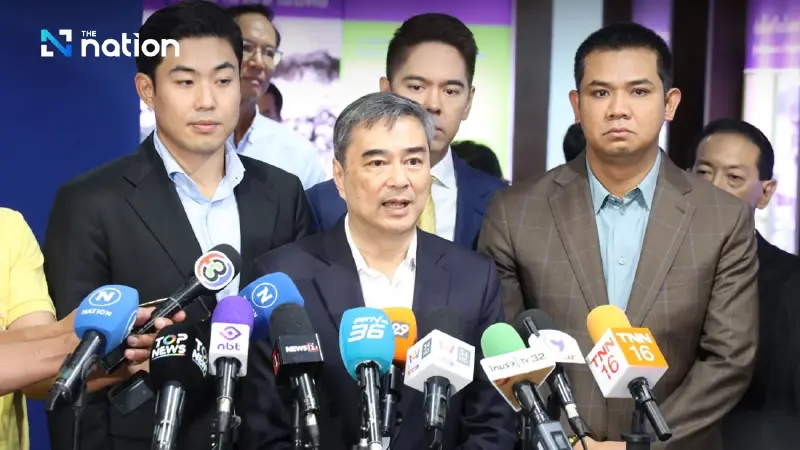


Democrat leader Abhisit Vejjajiva urges the Thai government to take a proactive approach to border issues, warning that holding a referendum to revoke the MOUs with Cambodia could lead to problems.
At the Democrat Party headquarters in Bangkok on Monday, Democrat Party leader Abhisit Vejjajiva urged the government to adopt a proactive approach in addressing the ongoing Thai–Cambodian border tensions, stressing that the issue cannot be resolved by the military alone but must involve diplomacy and foreign policy.
He praised the military for carrying out its duties effectively with public support, but cautioned that the government’s current direction lacked clarity, particularly as it links the border agreement issue to a national referendum.
“Many may recall the photo of me having dinner with the Prime Minister (Anutin Charnvirakul). That day, I warned him to be cautious because Cambodia has used every international platform to advance its narrative. We should not just be defensive — Thailand needs to be more proactive,” Abhisit said.
He added that while the Foreign Minister had done well in addressing the issue during the UN General Assembly, Thailand still needed to step up its diplomatic efforts.
“A proactive stance would make the military’s job easier. If we remain defensive, the army will face pressure whenever foreign diplomacy is applied,” he said, adding that he had already conveyed this concern to the Prime Minister.
Abhisit further noted that Thailand had long taken a passive stance — partly due to its past status as a coup-installed government seeking to avoid geopolitical conflict — but now, the country could assert a stronger international role.
When asked about the government’s plan to hold a referendum to revoke the 2000 and 2001 memoranda of understanding (MOUs) with Cambodia, Abhisit said the issue was highly sensitive and complex.
“This kind of agreement is not easily understood by the public. While we want people to be informed before deciding, Cambodia would also gain access to the same information — which poses its own challenges,” he said.
He emphasised that if the government insists on moving forward, it must clearly outline what strategy or options Thailand would adopt in the absence of the MOUs.
“I have yet to hear from the government what the alternative will be. To be fair to the public, it is not enough to simply cancel the MOUs — people must also know what comes next so they can make an informed decision,” Abhisit said.
