
Thailand and Cambodia set three-month timeline to achieve three key goals
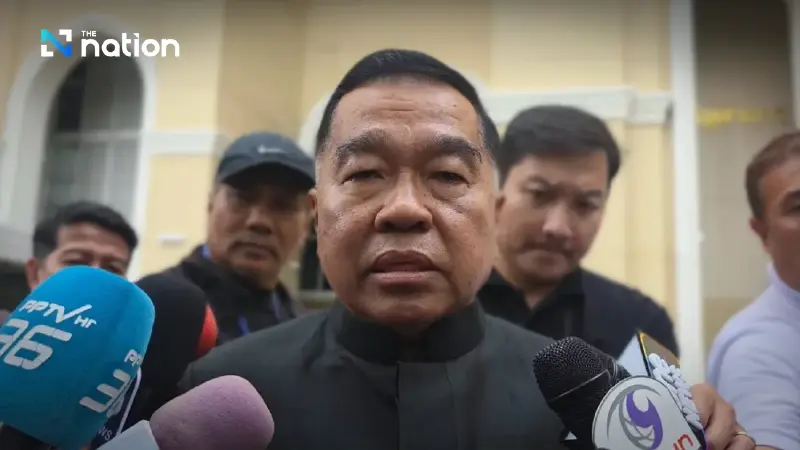


Defence Minister Gen Nattapon said Thailand and Cambodia agreed on a three-month plan to complete heavy-weapon withdrawal, demining, and border coordination
Defence Minister Gen Nattapon Nakpanich addressed the progress of the withdrawal of heavy weapons from the Thai–Cambodian border, noting that the process began shortly after the General Border Committee (GBC) meeting on October 23 and the signing of the peace declaration by Prime Minister and Interior Minister Anutin Charnvirakul on October 26.
He said that by the evening of October 26, both sides had begun withdrawing heavy weapons, though the types of weapons removed by Thailand and Cambodia differ.
Gen Nattapon added that the Second Army Region is currently in discussions with Cambodian counterparts to work out operational details.
He urged the public to remain confident that the Ministry of Defence upholds national sovereignty and prioritises the safety of the Thai people, affirming that Thailand will never compromise its national dignity.
When asked whether Thailand had also begun withdrawing its heavy weapons on the evening of October 26 as a symbolic gesture, Defence Minister Gen Nattapon Nakpanich confirmed, “Yes.”
Regarding the BM-21 multiple rocket launchers, which Thailand has urged Cambodia to remove due to their destructive potential, Gen Nattapon said this remains a priority and is part of the agreed withdrawal plan.
The operation is structured into a six-week timeframe — about one and a half months — or possibly longer if required, and Cambodia has agreed to this arrangement.
The withdrawal will take place in three phases:
- Phase 1: began immediately on the night of October 26 2025,
- Phase 2: to start within three weeks, and
- Phase 3: in the sixth week.
Weapons will be withdrawn in batches, and discussions are under way to decide which equipment will be removed in each phase. Both sides must withdraw simultaneously in every phase, Gen Nattapon stressed.
When asked about the ASEAN Observer Team (AOT), he explained that its initial mandate will last about three months, with the option of extension if necessary. Within this period, the AOT expects progress in three key areas — the withdrawal of heavy weapons, clearance of unexploded ordnance and landmines along the border (particularly near Ban Nong Chan and Ban Nong Ya Kaew in Khok Sung District, Sa Kaeo Province) — with completion targeted for December 17, 2025.
This will also cover areas under the Second Army Region, where preliminary work has already begun and an operational plan has been sent to Cambodia.
Gen Nattapon reiterated that October 26 marked the “D-Day” for both sides to start withdrawing weapons. “Even small steps count as progress,” he said.
He added that the Prime Minister has approved the establishment of a special working group chaired by Supreme Commander Gen Ukrit Boontanon, with members from the Ministry of Foreign Affairs, the National Security Council, and the Ministry of Interior to coordinate implementation and reassure the public.
Gen Nattapon also noted that each country will be responsible for clearing landmines on its own territory.
When asked how Thailand could ensure that Cambodia would conduct mine clearance in areas such as Ta Kwai Temple and its surroundings, he said the AOT would inspect these locations to verify actual progress.
“The AOT will go to Ta Kwai Temple to see whether demining has truly taken place,” he said, adding that operations would begin at 13 initial sites along the border.
