
Political Maneuvering and Crisis Management: Assessing the Leadership of 'Anutin' in the Face of Crisis
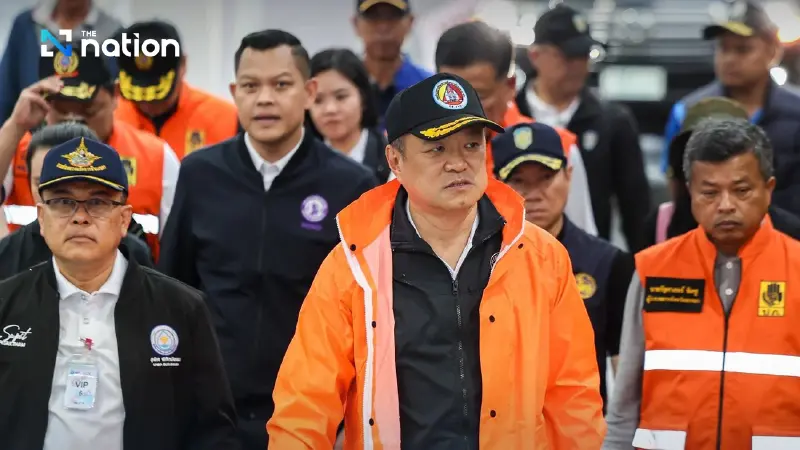


Political maneuvering amid the Hat Yai flood crisis highlights leadership weaknesses in crisis management. The Emergency Decree sparks questions, as political motives appear.
- The National Security Council (NSC) explained the government’s intent behind using the Emergency Decree, aiming to centralise power and streamline processes to save lives.
- The Disaster Prevention and Mitigation Act is specifically designed to address disaster management.
- "Anutin" wears two hats as both Prime Minister and Interior Minister, and using the Disaster Prevention and Mitigation Act should have been sufficient to address the crisis.

Despite being a discretionary decision of "Anutin Charnveerakul," the Prime Minister and Interior Minister, to use any framework to manage crises—whether flood issues, the Thai-Cambodian border, or cracking down on scammers—the declaration of the Emergency Decree to resolve the flooding crisis in Songkhla, particularly in Hat Yai, and appointing Gen Ukrit Boontanon, the Commander-in-Chief, with powers to control the area, raised the question: does "Prime Minister Anutin" have weaknesses in crisis management?
The National Security Council (NSC), which is responsible, quickly clarified the government’s decision. It stated that the intent behind using the Emergency Decree was to centralise power and reduce bureaucracy in saving lives. The decree enables the integration of all sectors—military, police, civil service, and private sector—to mobilise resources, personnel, and budgets for a quick and efficient response.
However, the Disaster Prevention and Mitigation Act, which was specifically designed to address disasters such as fires and floods, already provides authority to handle these situations. At the local level, it allows for timely action in case of incidents. If the disaster escalates beyond local capacity, it is elevated to the district level, where resources can be mobilised. In cases of severe disasters, the provincial governor can take action, and in cases that span multiple provinces, the Interior Minister can manage the situation nationwide.
"Anutin" wearing two hats—as both Prime Minister and Interior Minister—should have been enough to use the Disaster Prevention and Mitigation Act as a tool to address the situation, integrating resources, personnel, and equipment from civilian, police, and military agencies.
From the perspective of professionals in water management, the Disaster Prevention and Mitigation Act alone should suffice to manage the flooding crisis in Hat Yai. If the leader possesses strong leadership skills, they can assign anyone as the incident commander with the same powers as the Emergency Decree. However, the Emergency Decree is more about protecting officials in case of legal action, regardless of intent.
The public views the use of the Emergency Decree as unnecessary for handling the flood issue since the decree should primarily address national security concerns, though it can be used for disaster-related situations as well. Still, this is seen as a weakness of the current government in its crisis management capability, as noted by Lt Gen Paradorn Pattanatabut, former Secretary-General of the NSC.

If we look back at the government’s response to the scammer crackdown, which could be considered a global crisis, "Prime Minister Anutin" managed the issue without treating it as a true emergency. Rather than establishing an operational centre with a Single Command for unified action, the government chose the conventional route of forming committees and sub-committees, leading to delays.
Turning back to the Hat Yai flood, despite the government having the technology to accurately predict disasters, it failed to assess the situation correctly, underestimating its severity. When risk emerged, "Prime Minister Anutin" seemed to lack direction, even though plans were already in place under the Disaster Prevention and Mitigation Act. This is seen as a reflection of the government’s inability to effectively utilise its resources.
Even with the Emergency Decree in place, with the Commander-in-Chief of the Armed Forces taking charge, the operation on the ground created confusion among officials regarding the chain of command.
This was evident when "Deputy Prime Minister and Minister of Agriculture, Thammanat Prompao," in his role as the commander of the Hat Yai flood response, disagreed with the distribution of resources and aid zones designated by the Commander-in-Chief.
"You won't see the zones. Believe me, you won’t see them because the water level is the same everywhere. You need locals to guide you. Using zones like that won’t work. No matter which zone you look at, it’s all water. You need to communicate with the Commander of the Fourth Army Region. I just need the soldiers to help get people out of the crisis areas where I’m assisting. The soldiers who said they had SEAL units, I haven't seen them. Or maybe they’re working in the Eastern zone, I don’t know," said Thammanat.
The handling of the Hat Yai flooding has also been viewed as politically motivated, from the local level to the national level. Various political factions seem to be jockeying for advantage in the upcoming elections, with many political figures descending on the area, which some see as political campaigning rather than a genuine crisis response.
The political maneuvering to visit the area and oversee the response may suggest that "Prime Minister Anutin" handed over control to the "Commander-in-Chief" in an attempt to shift the situation in his favour.
Songkhla is a large province with 9 MPs, second only to Nakhon Si Thammarat in the southern region, which makes it a significant area for political gain. Thus, "Prime Minister Anutin’s" approach to managing the Hat Yai flood crisis not only reveals weaknesses in crisis management capability but also suggests political motivations that cannot be overlooked.
