
Censure motion standoff sparks dissolution brinkmanship
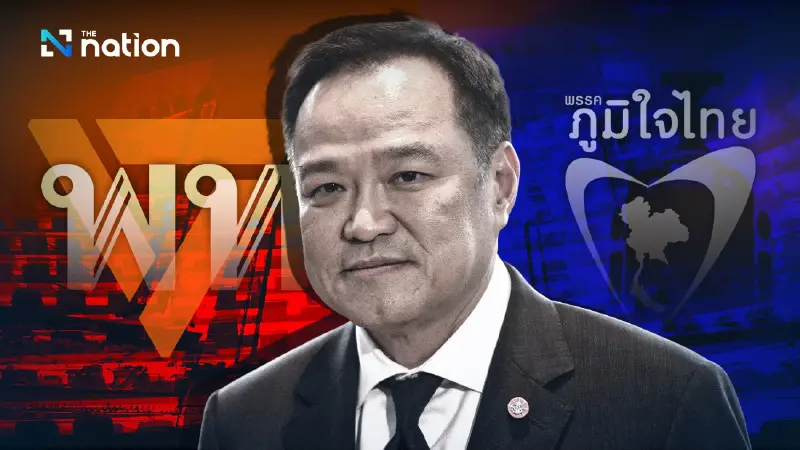


Opposition’s game: two censure-motion timelines as the “red–orange–blue” blocs brace for a turning point over the flood crisis
- The Pheu Thai Party is assessing two possible periods for submitting a no-confidence motion against Prime Minister Anutin, with the possibility of filing either before or after the third-reading consideration of the constitutional amendment bill.
- The censure motion will be linked to the constitutional-amendment timeline. If the motion is submitted before the third-reading vote, Prime Minister Anutin would immediately dissolve Parliament, which would cause the constitutional-amendment draft to lapse.
- In the political game of the “red–orange–blue” camps, each side is ready to accuse the others of being the reason the constitutional amendment bill is aborted or fails.
- The southern flood crisis will be a key issue the opposition will use as a turning point to discredit the government’s popularity, while also pointing out that the “People’s Party” has not fulfilled its role as an opposition in scrutinising Anutin’s government effectively.
The factors determining the timing of a House dissolution by Prime Minister “Nu” Anutin Charnvirakul, who also serves as Interior Minister, at this moment depend on whether the opposition parties—especially the Pheu Thai Party—will submit a motion requesting a general debate for a no-confidence vote against the prime minister during the upcoming parliamentary session, which opens on 12 December 2025 for the second annual ordinary session.

At the same time, Parliament is holding an extraordinary session to consider the constitutional amendment bill in its second reading on 10–11 December. According to the timeline, if the constitutional amendment draft—under the formula reviewed by the Constitution Amendment Committee chaired by Natthawut Buapratum, a party-list MP from the People’s Party—has its provisions revised regarding the body tasked with drafting the new constitution, the new Constitution Drafting Committee would comprise 35 members selected by the National Assembly, and would be responsible for completing the new constitution within 360 days.

In addition, the advisory council for constitution drafting would be modified into a committee for public hearings and for promoting public participation in the constitution-drafting process, also consisting of 35 members.
For the selection of the Constitution Drafting Committee (CDC) members and the Public Hearing Committee members, which are to be chosen by the National Assembly, the timeframe requires Parliament to complete the process within 60 days, using the “20-to-1” formula. Under this formula, members of the National Assembly must form groups of 20, according to the criteria set by the President of Parliament, in order to nominate one member each for the Constitution Drafting Committee and the Public Hearing Committee until the required numbers are filled. The list of selected members will then be published in the Royal Gazette.
This heated issue concerning constitutional amendment will proceed to the third reading if the bill passes the second reading. The third-reading consideration must wait for a 15-day interval, as stipulated by the Constitution, before the amendment bill can be deliberated.
Most recently, Witthaya Kaewparadai, a party-list MP of the Ruam Thai Sang Chart Party (RTSC) in the faction aligned with Pirapan Salirathavibhaga, the party leader, has come out to oppose the content of the constitutional amendment bill, arguing that its substance does not align with the “people’s constitution”, and expressing the view that the Constitution should instead be amended article by article.

Meanwhile, the Pheu Thai Party, through Julapun Amornvivat, Chiang Mai MP and party leader, believes that the government should provide a safeguard by holding a referendum first—one question during the general election—on whether people agree to the drafting of a new constitution.
Pheu Thai’s efforts aim to propose an alternative path in the event that the constitutional amendment plan under the “20-to-1 committee formula” cannot advance to the stage of winning approval from the joint sitting of Parliament in the third reading.
The earliest possible timeline for considering the constitutional amendment bill in the third reading—if the joint sitting of Parliament approves all sections in the second reading on 11 December 2025—would begin from 26 December 2025 onward, which is the earliest date permitted under the required timeframe.
This has led to differing views within the Pheu Thai Party, including those who believe that the party should move immediately to submit a no-confidence motion on 12 December 2025.
Several key figures in Pheu Thai share the view that the third reading of the constitutional amendment process will not gain approval from the National Assembly, because the senators, who need only one-third of their votes—either by abstaining or voting against—can once again cause the constitutional amendment bill to fail in the middle of the parliamentary chamber.
Moreover, the Pheu Thai Party has previously learned a lesson at the end of Gen Prayut Chan-o-cha’s administration, when it was unable to push forward the constitutional amendment bill to establish a Constitution Drafting Assembly, because the bill was voted down in the third reading.
Key figures in Pheu Thai therefore view the current MOA deal between the Bhumjaithai Party and the People’s Party as merely a ceremonial process—a staged attempt to create legitimacy for themselves before leading to a House dissolution and a general election.
Meanwhile, another faction within Pheu Thai, particularly Prayut Siripanich, a party-list MP, believes that the timing for submitting a no-confidence motion against the prime minister should be after the New Year, in early 2026, once the joint sitting of Parliament has completed consideration of the constitutional amendment in the third reading. This is to prevent accusations that the party is attempting to obstruct or delay the constitutional amendment.
Naturally, in the political manoeuvre over submitting a no-confidence motion against Prime Minister Anutin, the People’s Party has set its strategy to wait until the constitutional amendment process is completed. This has led to discussions with the Pheu Thai Party, asking them to wait for this process to finish before wielding the censure “sword”.
But at a deeper level, Pheu Thai’s key figures believe there is no need to wait for the constitutional amendment to be completed in the third reading. They argue that the opposition’s role in Parliament is to scrutinise the executive branch, especially in situations where the government cannot be allowed to continue governing if there are errors, corruption, or dereliction of duty.
This is particularly true regarding the issue of water management, which has resulted in a major flood crisis in the South, especially in Hat Yai district, Songkhla province.
It is clear that Pheu Thai must seize this heated issue to directly discredit the coalition parties, even though their political assessment suggests that Parliament may not be able to open for a censure motion at all—because Anutin could dissolve the House at any moment up until 31 January 2026.
However, given the current context and the political manoeuvring surrounding the constitutional amendment, the process remains a tug-of-war aimed at boosting political ratings among the three major factions — the red, the blue and the orange camps.

If the Pheu Thai Party submits a censure motion before the constitutional amendment bill is completed in its third reading, it is certain that Anutin will use his authority as prime minister to dissolve the House immediately. In this scenario, the People’s Party would quickly seize the opportunity to attack and stir public sentiment by claiming that the “red” camp never truly intended to amend the Constitution, while the “blue” camp is dissolving Parliament to evade the amendment process.
Meanwhile, Pheu Thai would intensify its rhetoric against Anutin, accusing him of avoiding scrutiny through the no-confidence debate and causing the constitutional amendment draft to be aborted before reaching the third reading due to a House dissolution. The party also views the “orange” camp as being unwilling to thoroughly scrutinise the government.
As for Bhumjaithai, the party holds an advantage by controlling the state apparatus and the full machinery of government during an election period, which serves as its built-in leverage.
In the current political game, the “blue side” is being ridden by the “orange” camp and pressed down by the “red” camp, at a time when the “Anutin government” is already in severe difficulty due to the massive flooding and as the administration approaches its final stretch, with Bhumjaithai as the leading party and Kla Tham as its companion in facing the electoral battleground.
