
Anutin insists House dissolution follows MOA and is not a betrayal of People’s Party
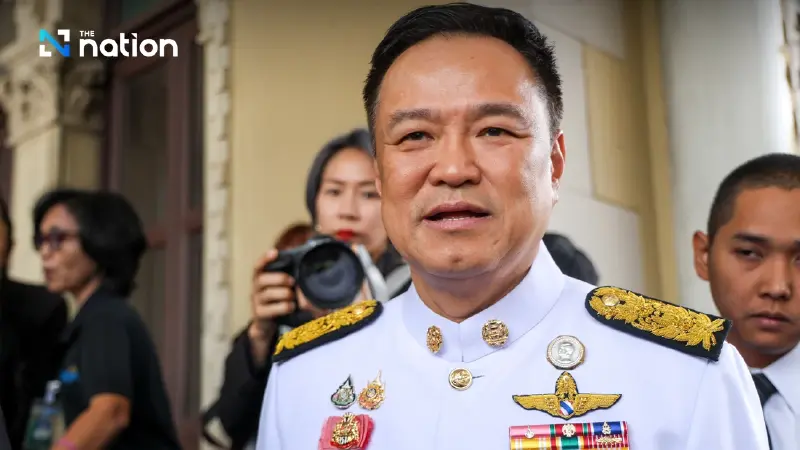


Anutin says dissolving the House complied with all MOA commitments, denies betraying the People’s Party and stresses Bhumjaithai could not force the Senate on charter reform.
Prime Minister and Interior Minister Anutin Charnvirakul said on Friday that his decision to dissolve the House of Representatives was fully in line with the Memorandum of Agreement (MOA) signed with the People’s Party, insisting there was no betrayal.
He said his government had complied with all four or five items in the MOA, including the pledge to amend the constitution. He noted that People’s Party leader Natthaphong Ruengpanyawut had declared in Parliament that if Bhumjaithai did not vote in line with the People’s Party’s wishes, the party would withdraw its support and call on the prime minister to dissolve the House.
“Since they made me prime minister, and then said they would no longer support me and asked for a House dissolution, I simply did as they requested. That is customary and the proper procedure,” Anutin said.
On charter amendment, he said the government had already taken the process through the first and second readings, but became stuck on provisions relating to the Senate.
“Bhumjaithai has no ability to pressure, compel or persuade senators to vote the way the People’s Party wants,” he said.

Anutin stressed that this did not amount to a double-cross and that the MOA contained no clauses about the Senate. Bhumjaithai, he added, had done its utmost on constitutional reform, including refraining from increasing the number of MPs to form a majority government and pushing ahead with preparations for a referendum.
Once Parliament had voted and forwarded the matter to the Cabinet, deputy PM and legal expert Borwornsak Uwanno advised that the date for the referendum could be set by the caretaker Cabinet, which would consider it in due course.
“This shows we followed every part of the MOA. There was no betrayal,” Anutin said.
He added that the draft Royal Decree dissolving the House had been prepared since he took office, with only the month needing to be changed. As a minority government, he said, he had to accept political realities.
His role, he continued, was to unblock deadlocks in national affairs: moving forward on negotiations, trade and international recognition, bringing Thailand back onto the global stage, reinforcing national security, and putting the civil service in order so that administration could continue smoothly.
“When the people who brought us into office tell us to do only this much, we do exactly that,” he said.
The prime minister also explained that the caretaker government now retains full powers, but any use of exceptional powers must be approved by the Election Commission.
Looking at precedents, he said, an election would likely be held within about 60 days, with results certified within a further 45 days and a new Cabinet formed in roughly another month. The current government’s tenure would end when the new Cabinet is sworn in — a process he estimated would take around five to six months in total.
Asked whether the border situation with Cambodia would be resolved before the election, Anutin replied that the government would do its best.
“The military are already doing everything they can to defend our sovereignty,” he said, adding that on Friday evening he would receive a briefing at the Royal Thai Armed Forces Headquarters before holding talks with the Malaysian leader and Donald Trump.
