
Landslide hopes could reset Thailand’s three-bloc politics
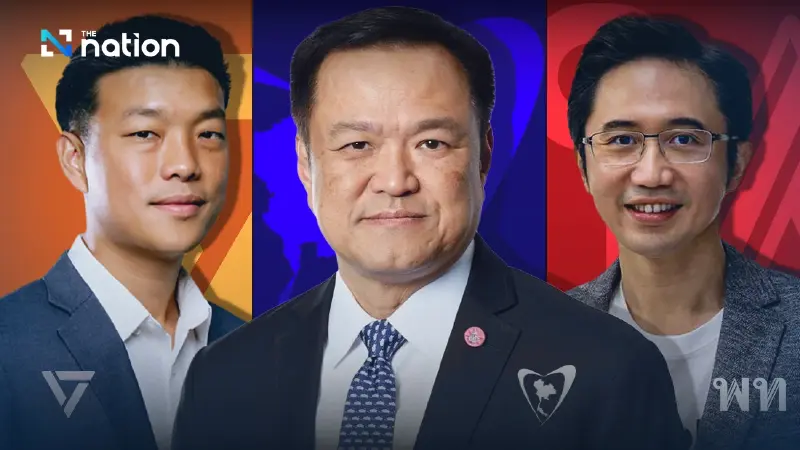


Thailand’s post-election landscape remains a three-way contest between the People’s Party, Bhumjaithai and Pheu Thai, with support for all three continuing to soften.
Within the next 60 days, Thais are expected to see which party wins the election — and whether the country gets a new prime minister or keeps the current one.
However, forming a new government officially could take until April–May 2026. That would mean Anutin Charnvirakul, leader of the Bhumjaithai Party, would remain as caretaker prime minister until a new premier is in place.
Election campaigning is now effectively under way. Looking ahead to the general election in late January or early February 2026, the post-election picture is expected to be dominated by a fierce contest among three major parties — a “Three Kingdoms” of Thai politics — battling for the top three spots.
This is reflected in the latest quarterly political popularity survey by NIDA Poll (Q4 2025), conducted by the National Institute of Development Administration. The poll surveyed 2,500 people aged 18 and over nationwide across regions, education levels, occupations and income groups between December 4–12, 2025.
On who respondents would support as prime minister at present, the findings were:
- 40.60%: No suitable person identified
- 17.20%: Natthaphong Ruengpanyawut (People’s Party)
- 12.32%: Anutin Charnvirakul (Bhumjaithai Party)
- 10.76%: Abhisit Vejjajiva (Democrat Party)
- 6.28%: Julapun Amornvivat (Pheu Thai Party)
- 3.88%: Gen Rangsee Kitiyanasap (Economic Party)
- 3.12%: Khunying Sudarat Keyuraphan (Thai Sang Thai Party)
On which political party respondents would support at present, the results were:
- 32.36%: No suitable party identified
- 25.28%: People’s Party
- 11.80%: Democrat Party
- 11.04%: Pheu Thai Party
- 9.92%: Bhumjaithai Party
- 2.76%: Economic Party
- 2.32%: United Thai Nation Party
- 2.00%: Thai Sang Thai Party
- 1.12%: Palang Pracharath Party

People’s Party chasing a “landslide”
As the presumed front-runner for the coming general election, the People’s Party moved early by unveiling three prime ministerial candidates on November 23, 2025 — before the House was dissolved.
The launch came as the party’s orange-aligned camp stepped up scrutiny of “scammers” and so-called “grey capital”, in what appeared to be an effort to erode support for the Kla Tham Party, whose spiritual leader is Thamanat Prompow.
Party leader Natthaphong Ruengpanyawut was named as the No. 1 prime ministerial candidate, alongside Sirikanya Tansakun, the deputy leader and a public policy specialist, and Weerayut Kanchoochat, also a deputy leader and a key figure on economic policy.
The People’s Party used its first pre-dissolution campaign to frame its election pitch around “building a Thailand with no grey, equal, and globally competitive”, while also pushing the slogan “No grey, no us”.
Even so, the party failed to drive through a constitutional amendment that would have opened the way under Section 256 for drafting a new charter. Senators in parliament rallied against any move that would cut the Senate’s one-third approval power required for constitutional amendments.
That setback was followed by Anutin Charnvirakul moving swiftly to seek royal endorsement of the decree dissolving the House of Representatives, which took effect on December 12.
Support for the People’s Party has slipped since the third quarter poll in September, falling from 33.08% to 25.28%. Natthaphong’s personal rating also declined from 22.8% to 17.2%.
Analysts say the orange camp still ranks No.1 among political parties thanks to a loyal base, but has been losing points due in part to its role in voting for Anutin to become prime minister — a move that sparked the narrative of an “orange-voted PM”.
The party was later blocked in parliament from moving ahead with constitutional reform.

At the event titled “A heartfelt apology, and moving forward together — towards the election mission to decide Thailand’s future”, the party showcased its three prime ministerial candidates and its spiritual leader while listening to feedback from voters.
One voter openly criticised the apology campaign, saying it amounted to apologising only over the failed constitutional amendment, while avoiding an apology for the party allowing its MPs to back Anutin as prime minister.
The voter also complained the party had not taken a clear stance on the border situation, leaving Anutin to dominate the narrative by stoking nationalist sentiment. Such factors, the criticism suggested, have kept both the party’s numbers and Natthaphong’s support from rebounding.
Still, attention is now on the party’s strategy — and its ability to build momentum through its network of natural grassroots canvassers — to see whether it can win over undecided voters, a bloc that remains as high as 32%.
While key figures in the orange camp insist the People’s Party is still in first place, they are quietly hoping for a late surge that could deliver the “landslide” they are aiming for — a result that would upend the political equation and potentially allow the party to form a single-party government, or to choose coalition partners from a position of strength.

Bhumjaithai bids to become the No. 1 conservative party
Bhumjaithai Party leader Anutin Charnvirakul has previously floated two additional prime ministerial candidates: Ekniti Nitithanprapas, the deputy prime minister and finance minister, and Suphajee Suthumpun, the commerce minister. Both are seen as professional members of the government’s economic team, with a technocratic image.
In the run-up to the dissolution of the House, and with fewer than 120 days to deliver, the party managed to push through the first phase of its “Kon La Khrueng Plus” co-payment scheme. Anutin also leveraged his authority at the Interior Ministry by reshuffling governors and district chiefs in preparation for the upcoming election.
This fuelled talk that Anutin would move to dissolve the House around December 12 — the first day of the new parliamentary session — to get ahead of a no-confidence motion planned by the opposition.
Even so, Bhumjaithai’s support in the fourth quarter fell to 9.92%, down from 13.24% in the third quarter. Anutin’s personal rating also dropped sharply, from 20.44% to 12.32%.

It is hard to deny that the decline was driven in part by a slow response to the flooding crisis in late November, which escalated into a major disaster in the South, particularly in Hat Yai, Songkhla.
Anutin and Bhumjaithai took a heavy hit to their popularity, despite the party’s ambition to expand in the South and become the region’s leading political force.
From here, attention will be on how the “three prime ministerial candidates” in the blue camp counter the narrative that the House was dissolved to dodge a censure debate — and whether they can outmanoeuvre the Democrat Party and seize the conservative momentum.
With the Democrats bringing Abhisit Vejjajiva back as party leader, their popularity has begun to edge above Anutin and Bhumjaithai. The two parties are competing for much of the same base as they vie to fly the conservative flag.
Bhumjaithai, however, has an organisational edge — and a stronger ability than before to draw influential powerbrokers into the blue camp.
Whether Anutin’s familiar “say it, do it” campaign can propel Bhumjaithai into the top spot will ultimately be decided at the ballot box.

Pheu Thai unveils a secret weapon as its support slips
Turning to Pheu Thai, the red camp, the party has been left without a clear centre of power while its spiritual leader, Thaksin Shinawatra, remains in prison — weakening its role as the party’s unifying figure.
Even so, the red camp still has a heavyweight operator in Suriya Jungrungruangkit, Pheu Thai’s election director. He has been travelling to shore up support among influential local MPs in the Northeast, aiming to defend the party’s dominance in both the North and the Northeast. The party has set itself a target of no fewer than 200 seats.
However, NIDA Poll’s Q4 results suggest Pheu Thai’s numbers have yet to recover. Support fell from 13.9% to 11.04%, leaving it behind the People’s Party and the Democrat Party — though still ahead of Bhumjaithai, which stood at 9.92%.
As for the prime ministerial field, Julapun Amornvivat, the party leader, remains one of Pheu Thai’s three expected prime ministerial candidates. But in the latest survey his personal support was only 6.28%, trailing Natthaphong, Anutin and Abhisit.
That is why Pheu Thai’s strategy — and its “secret weapon” for overhauling its prime ministerial line-up — will likely hinge on turning familiar policies into concrete outcomes, while putting forward a candidate with a strong public image capable of restoring political momentum and winning back undecided voters.
The party also needs to hold onto its traditional base — voters who will choose Pheu Thai regardless — to prevent defections, while also persuading disappointed Red Shirt supporters, who felt let down by the cross-bloc deal in 2023, to return.

One name now drawing attention is Yodchanan Wongsawat, the eldest son of Somchai Wongsawat, Thailand’s 26th prime minister, and linked to Yaowapa Wongsawat, a key northern figure.
With a strong academic profile, he is a researcher in neuroscience and biomedical engineering. Yodchanan has also been increasingly present in meetings with party leaders and Pheu Thai’s younger generation.
Within Pheu Thai, it is widely understood that he is the party’s No. 1 prime ministerial prospect — the figure it hopes could become the next premier. As for the other two names, Julapun, as party leader, is expected to remain one of the three.
Another slot is one to watch. If it is not Suriya Jungrungruangkit, it could go to a well-known economic professional — an outsider backed by the Shinawatra network and trusted enough to receive its support.
This has fuelled talk of approaches to senior executives at commercial banks, as well as the CEO of ASI, to join the prime ministerial ticket.
With its momentum fading after two years leading the government, Pheu Thai is expected to step up sharply — starting with its first election campaign centred on unveiling three prime ministerial candidates on December 16 under the slogan: “Reboot Thailand — Pheu Thai can do it.”
The aim is to showcase achievements that were not actively communicated while the party led the government, and to reinforce trust among its core supporters ahead of the vote.

The “deep state” sets the political script
The strategy for Thailand’s three-way political contest — three blocs with strong bargaining power in today’s landscape — will depend on campaign messaging, policy packages and the heavy machinery of local power networks to win over undecided voters.
Those undecided still account for as much as 40% when it comes to choosing a prime minister, and 32% who have yet to settle on any political party.
Looking ahead to 2026, Thailand’s political direction appears likely to remain trapped in the same old cycle of power. The backdrop, in this narrative, is the “deep state”, while the three competing blocs fighting for leadership may still find themselves reliant on decisions made by behind-the-scenes “spiritual leaders” — a reality that is difficult to deny.
