
The end of the ‘three Pors’ era in Thai politics
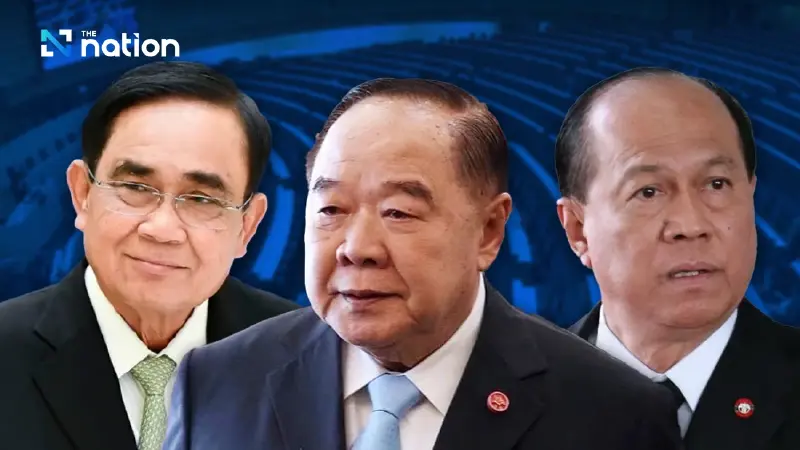


Gen Prawit quits PPRP’s PM race on health grounds as the ‘three Pors’ parties weaken, signalling the waning of military-backed politics
The curtain appears to be falling on Thailand’s “three Pors” power bloc, with Gen Prawit Wongsuwan (“Big Pom”) making his clearest move yet towards stepping back from frontline politics since Palang Pracharath Party (PPRP) was formed.
Prawit, the PPRP leader, has asked to withdraw as the party’s No.1 prime ministerial candidate, citing health reasons—widely read within the party as an unmistakable sign he is winding down his political role.
In recent months, PPRP’s preparations for the 2026 election have looked increasingly sluggish, a far cry from the party’s earlier momentum. Veteran politicians who once converged on the party’s “Ban Pa” camp—expecting Prawit’s project to remain viable—have begun drifting away as his condition and political clout appear to weaken.
From NCPO legacy to election vehicle
PPRP was widely seen as an electoral extension of the National Council for Peace and Order (NCPO), which seized power in the 2014 coup and ruled for five years, ushering in the 2017 constitution—often criticised as having been designed to preserve the junta’s influence.
Ahead of the 2019 election, the “three Pors”—Gen Prawit Wongsuwan (“Big Pom”), Gen Anupong Paojinda (“Big Pok”), and Gen Prayut Chan-o-cha (“Big Tu”)—helped build PPRP as a political platform, drawing on networks including the Sam Mitr group, the former PDRC bloc, and provincial “big house” factions.
PPRP won 116 seats and, backed by 250 senators, helped return Prayut to the premiership for a second term, leading a coalition government and sustaining what critics dubbed “green power” for nearly a full four-year term.
The split: Prawit vs Prayut
The alliance later fractured—most visibly between Prawit and Prayut—after an alleged behind-the-scenes effort by figures linked to Prawit’s camp to unseat Prayut failed, leaving lasting damage within the trio.
Before the 2023 election, Prayut attempted to wrest control of PPRP from Prawit but failed, prompting him to split away and form Ruam Thai Sang Chart (RTSC), severing the “three Pors” relationship.
The 2023 results left both PPRP (40 MPs) and RTSC (36 MPs) with diminished bargaining power. Despite Senate backing, their numbers were not enough to shape the next government, opening the door for a conservative-led deal with Pheu Thai to form an administration. Prayut exited the premiership, while Prawit’s own ambitions stalled; PPRP later joined the Pheu Thai-led coalition but was subsequently pushed out.
PPRP’s new PM slate
The latest shift was disclosed by Paiboon Nititawan, a deputy party leader, after an executive meeting discussing constituency and party-list candidates, as well as the party’s PM nominees.
Paiboon said Prawit had requested to step aside as a prime ministerial candidate, with Treenuch Thienthong—PPRP secretary-general—moved up as the party’s No.1 nominee. The party’s second nominee is Thirachai Phuvanatnaranubala, a deputy party leader.
Paiboon insisted Prawit will remain party leader, citing the need for him to sign official documents certifying constituency and party-list candidates.
Even so, the party’s broader prospects are portrayed as grim: while Treenuch is seen as able to secure two seats in Sa Kaeo, expectations for party-list seats and constituency wins elsewhere are described as limited.
RTSC also struggling without “Uncle Tu” magic
Across the aisle, RTSC—born from Prayut’s political brand—faces its own decline under party leader Pirapan Salirathavibhaga.
During its time in the Pheu Thai-led government, Pirapan is depicted as running the party in a way that fuelled internal splits, with rival camps emerging: one linked to business backers seeking to remove him, and another aligned with the party’s secretary-general, Akanat Promphan, trying to steady the leadership. In the end, the account says both camps chose to leave, citing Pirapan’s hard-line approach.
Despite Pirapan’s efforts to campaign aggressively for 2026, RTSC has been hit by a steady exodus of prominent figures and poll numbers that, according to the piece, remain far below the party’s peak during Prayut’s era.
Taken together, the developments are framed as the “final act” for the political parties associated with the “three Pors”—and a symbolic end to a long-running period of military-linked dominance in Thai electoral politics.
