
People’s Party vs Thai Sang Thai: debt fixes face off
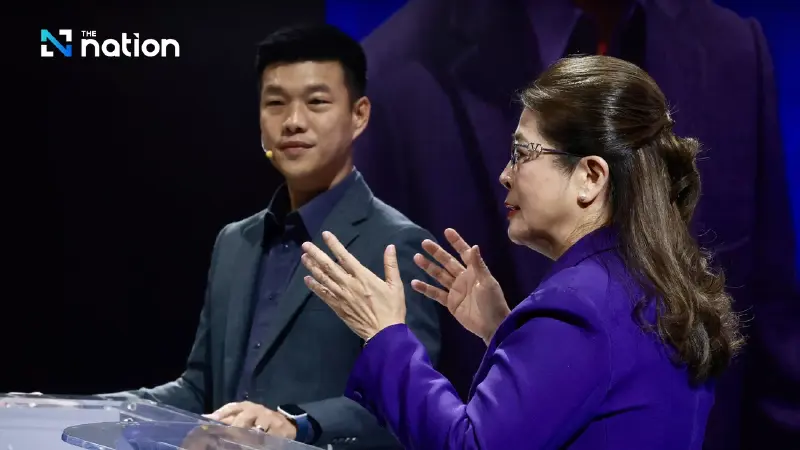


At Nation Election Debate 2026, the People’s Party and Thai Sang Thai traded policies to raise incomes and inject capital so Thais have more cash in hand.
Nation Group hosted Nation Election Debate 2026: The Crossroads on Saturday (January 17), providing a public platform for party leaders, key figures and prime ministerial candidates from several political parties to present their policies, ideas and positions at the Bangkok Youth Centre (Thailand–Japan) in Din Daeng.
One key topic was “household debt”, debated between the People’s Party and the Thai Sang Thai Party by Natthaphong Ruengpanyawut, leader of the People’s Party and prime ministerial candidate, and Khunying Sudarat Keyuraphan, leader of the Thai Sang Thai Party and prime ministerial candidate, alongside additional proposals from other parties.

People’s Party: Debt moratoriums are not enough — people must have cash in hand
Natthaphong Ruengpanyawut, leader of the People’s Party and prime ministerial candidate, said that when tackling debt, beyond policies such as suspending principal and interest repayments, the crucial point is ensuring people who are already in debt have money left in their pockets — by boosting their income.
For entrepreneurs, that means enabling them to sell goods while also easing costs at the same time.
He cited the flooding in Hat Yai, when the government introduced soft loans for victims and business operators, but local business owners spoke with one voice: do not rush to provide loans — restore the economy first.
If they could sell goods again, they would have money to repay the remaining debt themselves. But today, if they borrow, they do not know where they will find the money to repay.
“Therefore, the answer is how to reduce people’s debt burden and leave them with cash in hand,” Natthaphong said.
The People’s Party, he said, has several grassroots economic stimulus policies to improve SME liquidity and spread purchasing power more widely among ordinary people, such as a “receipt lottery” policy.
For grassroots households, beyond cutting electricity bills, the party also proposes lowering rent and providing 1,000 baht in support, covering 1.5 million households, along with universal welfare within the same budget year.
From October 1, 2026, it proposes an immediate universal child allowance of 600 baht and an immediate universal old-age allowance of 1,000 baht, with further increases by 2030.
All of this, he said, is the answer to how to solve the debt problem by increasing the amount of money people have left in their pockets.
Natthaphong added that many SME operators currently face unfair treatment by large businesses, making it necessary to use technology to build fairer mechanisms.
He proposed establishing a central e-invoice platform so small businesses can submit invoices into a transparent central system.
When liquidity is tight, financial institutions would be able to provide e-factoring immediately under state supervision. This would go alongside pushing for full, effective enforcement of the Trade Competition Act and the 45-day credit-term measure to prevent unfair trading practices.
He also proposed developing a personal data protection platform that benefits everyone through a Digital ID system, stressing the state would not use it to monitor people. Instead, it would allow individuals to access their own basic financial data — such as water and electricity bills, income and expenditure.
When people need to consult a “debt doctor” or refinance with a bank, they could voluntarily consent to share their data, helping ensure debt solutions are more targeted and effective.

Thai Sang Thai proposes a “Start-up Fund” and an “SME Fund”
Khunying Sudarat Keyuraphan, leader of the Thai Sang Thai Party and prime ministerial candidate, said capital must be injected so people can get back on their feet. Thai Sang Thai divides the problem into two levels: household debt or personal debt — much of it informal debt, with brutal interest rates of 20–30% per month.
Borrowing 50,000 baht can mean paying 10,000 baht in interest — leaving people wondering how they can ever earn enough just to cover the interest, she explained.
Thai Sang Thai’s “Start-up Fund” would allow small-scale borrowers to access low-interest funding, cutting rates to just 1% per month.
A loan that once incurred 10,000 baht in interest would fall to 500 baht. Borrowers could use the funds to repay informal debt and as working capital, with loans of 10,000–100,000 baht — and loans would be genuinely accessible.
The second fund is an “SME Fund”. SMEs, she said, were devastated by Covid and floods, and now face weak economic conditions and inflows of foreign goods. The party would establish an SME fund covering all sectors, especially tourism, with a total credit line of 300 billion baht.
It would use a special mechanism to lend through the Joint Standing Committee on Commerce, Industry and Banking (JSCCIB), which better understands real operators and can reach target groups more effectively than the usual system.
“Where would all the money come from? Today, 17 trillion baht is sitting in banks. The rich earn 1% interest, some 2%. We will issue government bonds paying 3% — take the rich’s money and lend it to the poor and to SMEs,” she said.
“The poor get opportunities, and the government’s interest cost is just 3%, while it can lend at 12%, leaving 9% to manage. WIN WIN WIN — all of it.”
Sudarat added that beyond debt relief and capital injection, “income” must be added.
Thai Sang Thai sees income opportunities based on Thailand’s strengths: agriculture — exporting quality food worldwide, targeting a rise to 2.5 trillion baht within three years; tourism — within five years raising revenue to 5 trillion baht; and health — with a vast global market, aiming to make Thailand a health hub and reach 2 trillion baht within three years.

Prachachat Party proposes reforming rehabilitation laws to protect debtors
Pol Col Tawee Sodsong, leader of the Prachachat Party and prime ministerial candidate, highlighted legal reform to protect debtors. He said Thailand’s debt and enforcement situation involves excessively high interest rates.
Thailand still applies interest rates under a revolutionary council announcement that allow rates as high as 25% even for unsecured debt, whereas the normal Civil Code provides for only 15%, he pointed out.
He said enforcement can be harsh after debts are purchased, with lawsuits and the use of state power via the Legal Execution Department to seize assets — a severe form of coercion against debtors.
With massive debt values, he said debts under enforcement now total as much as 25 trillion baht — larger than the country’s GDP. Concerning young debtors, the most worrying is Student Loan Fund (SLF) debt. The central bank, he said, needs to step in to align interest rates with the Civil Code.
Tawee proposes a “debtor rehabilitation law” — the first in 100 years — as an innovative mechanism to solve people’s debt problems.
United Thai Nation proposes unlocking the credit bureau
Atthawit Suwanpakdee, deputy leader of the United Thai Nation Party and prime ministerial candidate, focused on unlocking the credit bureau system, saying five million people are trapped — over 90% of them working-age — unable to access funding.
He proposed ending the 36-month freeze on credit history after a debt is fully repaid and switching to a US-style credit scoring system: higher scores, lower interest; lower scores, higher interest — to spur competition among commercial banks as a long-term solution.

Democrat Party warns over bad debt from Buy Now, Pay Later
Abhisit Vejjajiva, leader of the Democrat Party and prime ministerial candidate, added that Thailand needs a mix of short-term measures — such as debt moratoriums or buying back debt — with longer-term preventive measures.
He also proposed embedding financial literacy in the education system. The Democrat Party is monitoring BNPL (Buy Now, Pay Later) services — buying items now and paying later via platforms — which could become non-performing loans (NPLs) in the future.
Pheu Thai proposes topping up 3,000 baht per month
Yodchanan Wongsawat, prime ministerial candidate for the Pheu Thai Party, said the most important thing is knowing where the poor are. Anti-poverty and cash top-up policies should clearly identify low-income people so assistance is targeted.
He proposed topping up 3,000 baht per month so people have sufficient basic necessities, while enabling the state to provide upskilling and reskilling to help them escape poverty sustainably.
