
Four major parties pitch ‘economic engines’ to lift GDP
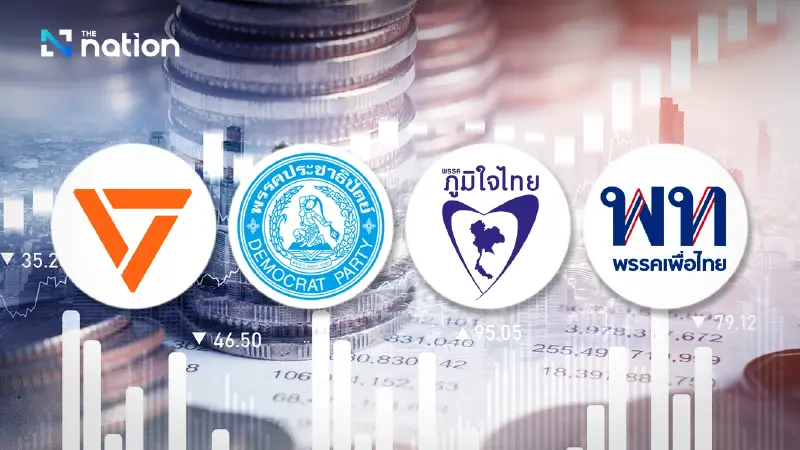


Bhumjaithai, People’s Party, Pheu Thai and Democrat unveil “economic engine” plans targeting 3–5% GDP growth ahead of Feb 8 election
With Thailand’s general election due on February 8, 2026, major political parties are setting out plans to raise economic growth from levels widely seen as persistently weak, leaving Thailand trailing regional peers.
The Democrat Party and Pheu Thai Party are both targeting GDP growth of about 5% a year. The People’s Party says it wants GDP to expand steadily by 3.5%, while Bhumjaithai is aiming for growth of at least 3% a year. Each party has framed its approach as an “economic engine” model designed to drive expansion towards those targets.
Bhumjaithai: accelerate a new S-curve
Ekniti Nititandapraphas, deputy prime minister and finance minister, who is expected to retain the post under Bhumjaithai, said the party’s four-year economic plan would follow an “Economy 10 Plus” approach, aiming to keep growth at no less than 3%—described as a “3% Plus” policy.
The party’s proposed “new S-curve” growth industries include smart agriculture, electric vehicles (EVs), automation, data centres to support AI, and a full-service wellness and healthcare industry. Key conditions would include technology transfer to Thai workers and drawing SMEs into global supply chains.
He said Thailand’s growth potential has weakened over time—after expanding around 5% in the years following the 1997 crisis, it is now about 2.7%, and growth this year could be only 1.5%, mainly due to structural problems.
To return growth to the 4–5% range, he said Thailand would need to raise total investment back towards 40% of GDP, compared with about 23% at present. Investment projects awaiting approval through the Board of Investment (BOI) total as much as 480 billion baht, he said, adding that unlocking them through a BOI Fast Track scheme could push growth this year above 1.5% and lift expansion next year above current levels.
For infrastructure investment, he said the Thailand Future Fund could be used to mobilise financing without increasing public debt.
People’s Party: 500-billion-baht energy investment push
Thanathorn Juangroongruangkit, chairman of the Progressive Movement and an assistant campaigner for the People’s Party, said the party aims to deliver 3.5% GDP growth within four years of forming a government. He argued that sustained growth depends on competitiveness reforms, with the fastest results typically seen within the next four to five years, before maintaining expansion at around 4% in the longer term.
Key investment “engines”, he said, would include energy-related industries, healthcare, and investment that supports SMEs.
He highlighted an energy policy centred on reforming the electricity structure and developing a smart grid, creating a new investment cycle. The plan would require 400–500 billion baht over 10 years, focusing on upgrading transmission lines to a smart grid and replacing more than 30 million electricity meters with digital systems, priced at about 2,000 baht each. The goal is to enable freer electricity trading and greater competition in the power market.
The party would also support households installing solar panels and promote vehicle-to-grid (V2G) systems, allowing power from EVs to be used at home during peak-price periods or sold back into the grid, similar to mobile-phone package models.
In the long term, he said Thailand should become an ASEAN energy hub through an “ASEAN Grid” linking power from upstream suppliers such as Laos to Malaysia and Singapore, generating income through transmission fees similar to pipeline transit charges.
Pheu Thai: AI as a flagship, built on food and healthcare
Yodchanan Wongsawat, Pheu Thai’s prime ministerial candidate, said Thailand needs a clear flagship strategy for a new economy, arguing that the country should position itself as an AI hub—focused on sectors where Thailand has strengths, notably food and the wellness economy.
On agriculture, he said Thailand has strong foundations and biodiversity as an upstream source of food and advanced materials, and should build on those advantages rather than abandon them. Policy should therefore focus on raising productivity and value added by developing end-to-end supply chains and applying AI to help Thailand become the world’s top food producer.
On healthcare, he said Thailand should develop a Medical AI Hub, with data centres designed specifically for medical AI rather than serving as general-purpose data centres. He argued that energy constraints mean generic data centres may not deliver sufficient value, and that infrastructure should be built on a project basis that delivers public benefits. Becoming a hub would also give Thailand earlier access to medical data and its applications than other countries.
Julapun Amornvivat, Pheu Thai leader and a prime ministerial candidate, said the party’s goal is to lift Thailand into a high-income country and drive GDP growth of 5% a year, backed by a “geoeconomics” strategy combining trade and fiscal policy with upgrades in technology and innovation to keep Thailand integrated into modern global supply chains.
Democrat: step-by-step growth and a processed-food push
Korn Chatikavanij, deputy leader of the Democrat Party and a prime ministerial candidate, said restoring growth to its potential of 5% a year is a target to be achieved within four years, with a step-by-step approach.
He said GDP would need to be stabilised at around 2% first. If confidence and macroeconomic management improved, growth could rise to 3% in 2027, then 3–4% in 2028, and reach 5% once key pieces are in place.
“The key is to change the government’s mindset so it becomes an enabler rather than an obstacle to the private sector—especially businesses and investment,” he said, adding that technology should be used to reform the bureaucracy, cut costs and improve efficiency.
He said boosting GDP to 5% would require promoting high-potential industries, especially the food sector, currently valued at about 3 trillion baht, with an ambition to lift it to 5 trillion baht in a relatively short period. One fast-growing segment is premium food, particularly pet food, where exports have been expanding by about 20% a year due to strong control across the value chain from upstream agriculture to downstream production.
He also called for accelerating the green transition, arguing that massive investment will accompany the shift to lower-carbon technology and clean energy, creating a new and more sustainable engine of growth for Thailand.
