
8 Political Parties Unveil Policies to Boost Market Confidence
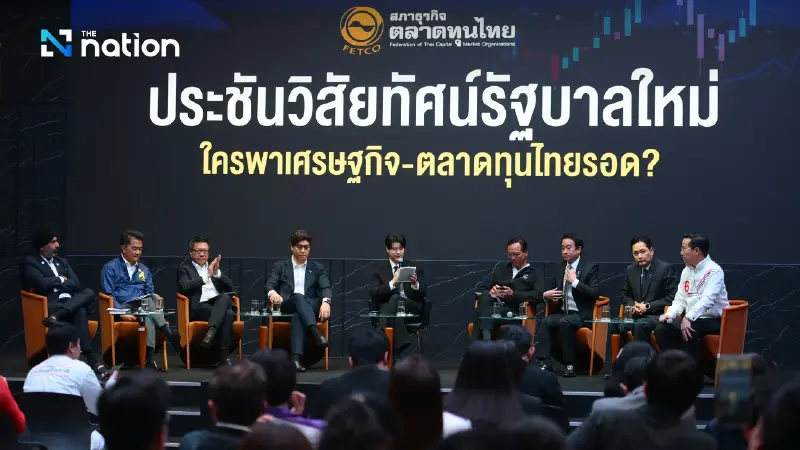


Eight Thai political parties present economic plans to revive the stock market, with proposals to improve liquidity, boost personal savings, and enhance governance
Eight political parties in Thailand have gathered to unveil their proposals for addressing the country’s economic and market challenges in advance of the upcoming elections. The event, titled "Vision Showdown for a New Government: Who Will Save Thailand’s Economy and Capital Markets?", was hosted by the Federation of Thai Capital Market Organizations (FETCO). The aim was to explore ways to restore investor confidence and revitalise the stock market.
The main focus of the political parties’ proposals revolved around improving market liquidity and making the Thai capital market more attractive to both individual and institutional investors. A critical part of their vision included the revival of Long-Term Equity Funds (LTF) and the establishment of personal savings accounts with tax benefits, encouraging greater public participation in the stock market.
In a statement, Korn Chatikavanij, Deputy Leader of the Democrat Party, expressed concerns about the state of investor confidence in Thailand’s capital markets. He noted that issues such as corruption, stock market manipulation, and the use of the capital market for money laundering had severely undermined trust. He also expressed disappointment with the Securities and Exchange Commission (SEC), calling its performance “below expectations.” Korn highlighted the importance of restoring integrity to the market and opening up opportunities for new investments by creating fair competition and improving transparency.

Dr. Paopoom Rojanasakul, Deputy Leader of the Pheu Thai Party, emphasized the need to transform the capital market into a key driver for economic restructuring. He pointed out that although previous governments had made attempts to develop the market, their efforts had fallen short. He called for the development of new policies such as the introduction of G-Tokens and Financial Hubs, which would generate substantial funds to inject into the market. These initiatives, he suggested, could bring in THB 13 billion per year.
Pheu Thai’s proposals also included unlocking regulatory barriers and reducing the IPO process from two years to just one. The party also advocated for measures to support SMEs entering the stock market and the creation of a new trading board for digital assets. Their goal was to establish a market value of THB 100 billion and reach four million accounts.

Anucha Burapachaisri, a candidate from the Bhumjaithai Party, echoed these concerns, suggesting that investor confidence in Thailand’s stock market had significantly waned. He stressed the importance of sending a clear message that the Thai economy is improving, through transparent policies and fiscal discipline. Anucha also called for an overhaul of market regulations and highlighted that many laws in recent years had been ineffective, particularly in holding wrongdoers accountable.
Dr. Atavit Suwanpakdee, Deputy Leader of the Ruam Thai Sang Chart Party, proposed opening up the solar energy sector to foster greater competition, particularly for new businesses in the "new economy" that rely on large-scale energy consumption. He suggested that bringing back LTF funds could help support rapidly growing digital industries. He also pushed for reforms in the banking sector, where credit scoring and loan processes need to be modernised to allow for more fair competition.
Dr. Chaiwat Sathawornwijit, Deputy Leader of the People’s Party, emphasized that his party’s policy would focus on encouraging medium and small-sized enterprises (SMEs) to enter the stock market by dismantling monopolies and increasing market liquidity. He proposed reducing fees for investors and increasing competition through reforms like reviewing tick sizes and facilitating market makers' ability to short stocks. He also highlighted the need to ensure that market governance was free of political interference and that the regulators could take decisive action against wrongdoers.
Suradech Taweesaengsakulthai, Chairman of the Economic Strategy for the Thai Sang Thai Party, proposed introducing new financial products like digital assets and tokens to attract more investment into Thailand. He also pointed out that certain practices in the market, like short selling and the handling of collateralised stocks, had raised concerns due to a lack of regulatory enforcement. Suradech emphasized that the authorities needed to clearly indicate which areas needed reform and be transparent in their actions.

Dr. Kanate Wangpaichitr, Leader of the Economic Team for the Thai Kao Mai Party, proposed more aggressive measures to prevent market misconduct, such as creating a dedicated capital market court to handle securities cases. He also pushed for the revival of LTFs and infrastructure funds to improve market liquidity. Kanate stressed the need for transparency and accountability in the reform process to regain public trust.
Nikhon Sachdev, the Economic Policy team member for the Kla Tham Party, proposed focusing on micro-businesses and helping them grow into larger enterprises. His party also advocated for government support for "Made in Thailand" local production and efforts to eliminate conflicts of interest in the market. Nikhon emphasized that Thailand’s stock market needed to evolve into a place where long-term investments could thrive, rather than focusing solely on short-term HFT speculation.
